
Singapore’s tax system is business-friendly, but it is also strict, rules-driven, and built on a self-assessment framework. For SMEs and foreign-owned companies, this means IRAS expects tax filings to be accurate, consistent, and fully supportable, without prompting.
In practice, most tax issues are not deliberate. They arise from assumptions, outdated treatments, or filings that were never properly reviewed. These issues often surface only after IRAS intervenes, when penalties, audits, and expanded reviews are already in motion.
This article explains where SMEs commonly go wrong, why IRAS takes action, and how an experienced tax agent helps businesses stay compliant, protected, and confident.
Understanding Corporate Tax and IRAS Requirements in Singapore
Singapore operates on a self-assessment tax regime. Companies are required to file accurate tax returns supported by proper records, without IRAS reviewing them upfront.
Key obligations include:
- Corporate income tax at 17%, with partial tax exemptions for qualifying companies
- Estimated Chargeable Income (ECI) to be filed within 3 months from financial year end
- Corporate tax returns (Form C-S or Form C) to be filed by 30 November
- Complete supporting documentation for all figures submitted
IRAS expects filings to be internally consistent and defensible. Errors discovered later may still attract penalties, even if they were unintentional.
Why Tax Compliance in Singapore Is Critical for SMEs and Startups
Many SMEs treat tax compliance as an administrative task. IRAS treats it as a governance and risk issue.
Penalties and enforcement actions commonly arise from:
- Late or incorrect filings
- Under-declared income
- Unsupported or disallowed expense claims
- Inconsistencies between ACRA financial statements and tax submissions
Once inconsistencies are identified, IRAS reviews often expand beyond tax into accounting records and director responsibilities. For foreign-owned companies and overseas founders unfamiliar with Singapore’s compliance standards, scrutiny is typically higher.
Common Corporate Tax Mistakes SMEs Make
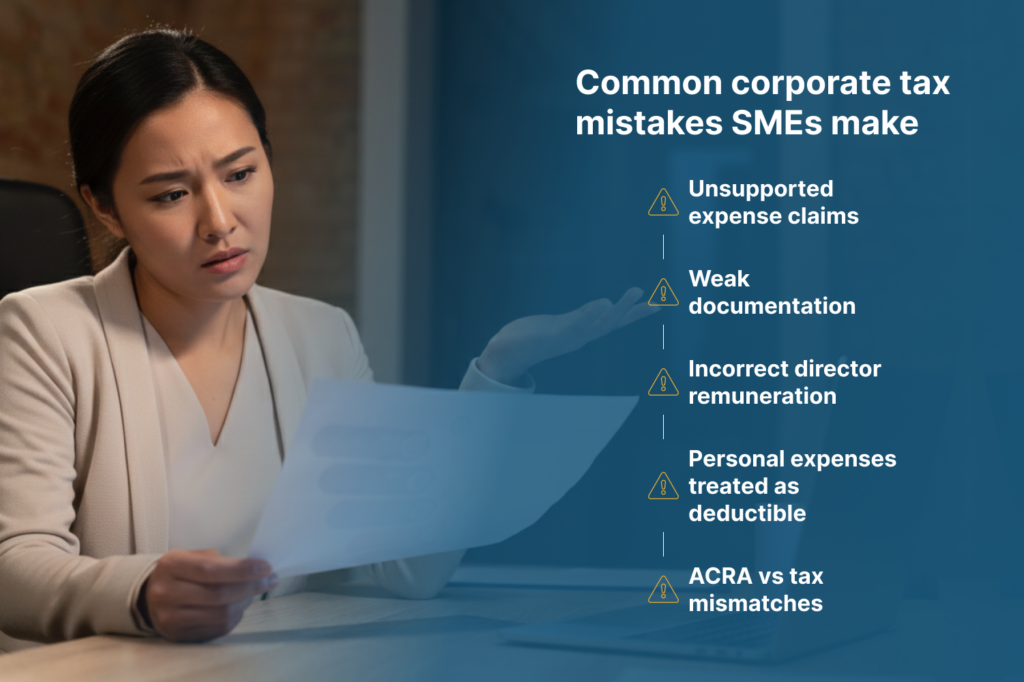
Across SME tax reviews, the same issues surface repeatedly:
- Claiming personal or mixed expenses as fully deductible
- Weak documentation for meals, travel, or entertainment
- Incorrect treatment of director remuneration and benefits
- Misunderstanding CPF and withholding tax obligations
- Mismatches between ACRA filings and tax submissions
- Carrying forward outdated tax treatments without reassessment
- Poor documentation for related-party or overseas transactions
As Joe Tan, Managing Partner of JDT, explains, “most SME tax issues we see are not complex or aggressive. They stem from everyday assumptions; relying on last year’s tax treatment, misclassifying expenses, or underestimating IRAS’ documentation standards.” He adds that “most of these issues are avoidable with proper review before filing.”
Find Out More: What is the difference between deductible vs non-deductible expenses ?
What a Professional Tax Agent Actually Does
A competent tax agent’s role goes far beyond submitting forms. The real value lies in pre-emptive risk management.
In practice, a tax agent:
- Reviews accounts from IRAS’ perspective
- Identifies claims that are commonly challenged
- Ensures consistency across accounting records, ACRA filings, and tax submissions
- Advises clearly on what should not be claimed
- Prepares tax computations that can withstand audit scrutiny
- Manages IRAS correspondence carefully and professionally
As Natalia Ong, Manager for Taxation at JDT, notes, “the role of a tax agent is to ensure the numbers tell a consistent and defensible story. That judgement cannot be automated.”
Key Benefits of Hiring an Experienced Tax Agent
For SMEs, the benefits are practical and cumulative:
- Avoid costly IRAS penalties through proper pre-filing review
- Reduce audit risk with consistent, defensible filings
- Achieve legal tax savings using appropriate exemptions and allowances
- Save management time on compliance and IRAS correspondence
- Receive professional support during IRAS queries or audits
- Gain clarity for foreign directors unfamiliar with Singapore requirements
As businesses grow, these benefits become increasingly critical.
Risks of Filing Corporate Taxes Incorrectly
Filing corporate taxes incorrectly carries consequences beyond simple penalties.
Common outcomes include:
- Additional taxes and penalties imposed by IRAS
- Backdated assessments covering multiple years
- Full tax audits expanding into accounting and governance
- Increased scrutiny on foreign-owned entities and directors
Many SMEs only realise these risks after IRAS raises questions, when corrective options are limited and costs escalate.
Why DIY or Low-Cost Tax Filing Often Backfires for SMEs
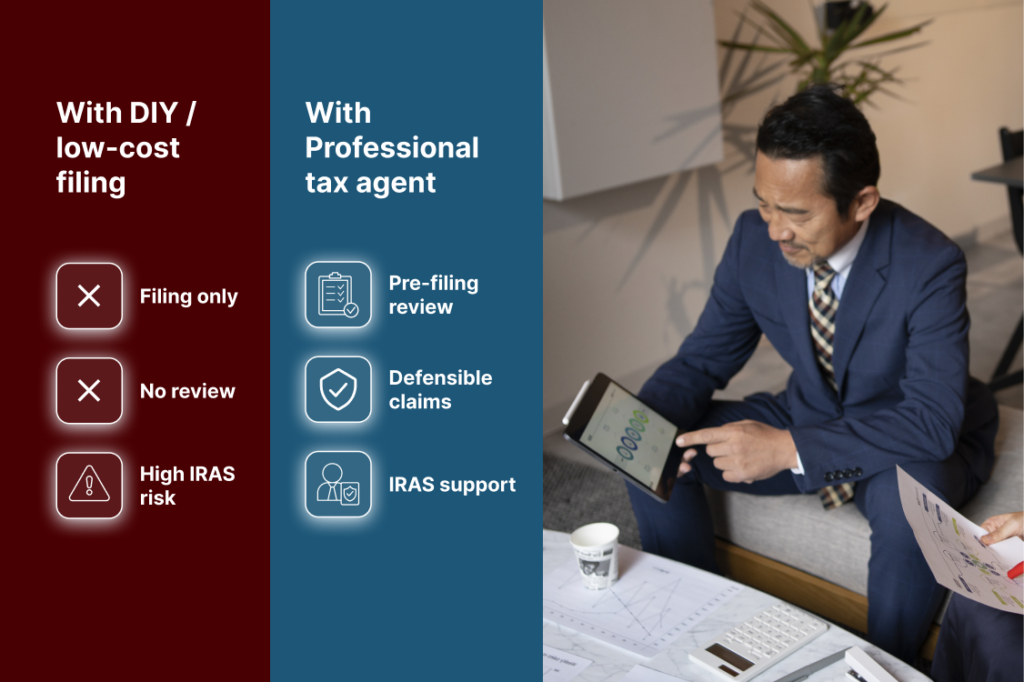
DIY tools and low-cost filing services focus on submission, not risk.
As Doreen Yip, Executive Director of Financial Outsourcing and Business Advisory at JDT, explains, “what these solutions offer is filing, not protection.” They do not assess claim appropriateness, identify IRAS audit triggers, highlight documentation gaps, or support follow-up queries.
When IRAS intervenes, SMEs are often left unsupported. By then, penalties may already apply and earlier years may be reopened. Rectifying issues at this stage is almost always more costly than addressing them upfront.
Highlights: Singapore Budget 2026 Tax Updates
When SMEs Typically Seek Help — and Why That Is Risky
Most SMEs seek professional advice only after receiving an IRAS letter, penalty notice, or audit notification. At that point, options are limited and corrective work becomes more complex and visible.
Early engagement allows issues to be identified before submission, resolved quietly, and managed with minimal disruption.
How to Choose the Right Tax Agent in Singapore
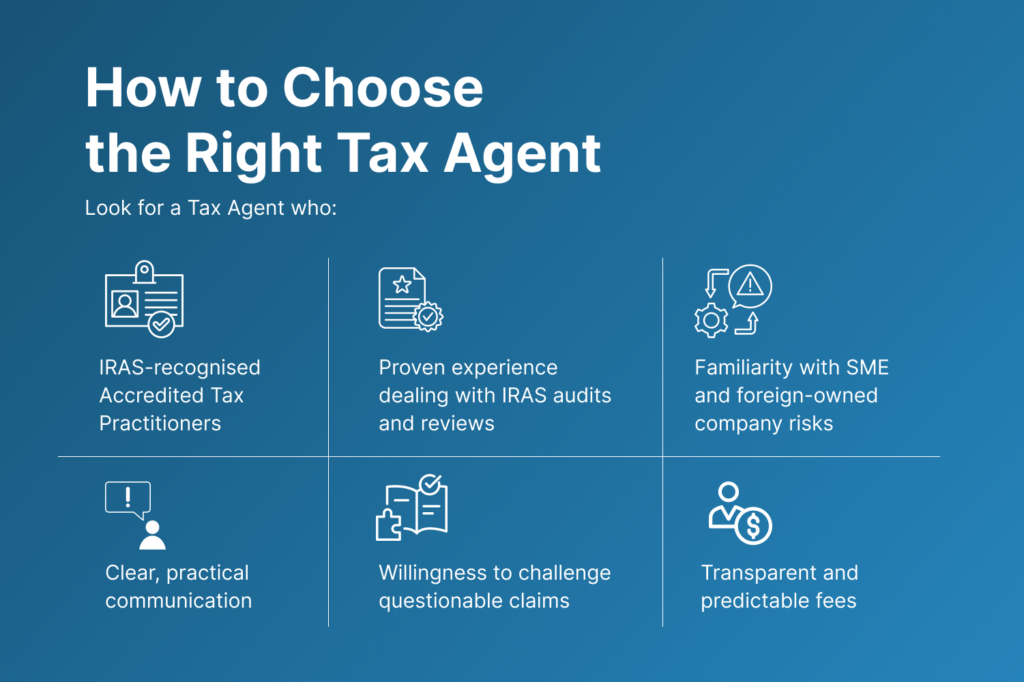
For SMEs, the right tax agent is not defined by speed or price. Look for:
- Accredited Tax Practitioners who hold the Singapore Chartered Tax Professional Qualification recognised by IRAS
- Proven experience dealing with IRAS audits and reviews
- Familiarity with SME and foreign-owned company risks
- Clear, practical communication
- Willingness to challenge questionable claims
- Transparent and predictable fees
As Joe Tan advises, “a good tax agent protects your business. A cheap one often just files and disappears when you need them the most.”
Why SMEs and Foreign-Owned Companies Work with JDT
JDT works with SMEs, startups, and foreign-owned companies that value clarity, compliance, and long-term stability. Ensuring consistency across accounting records, ACRA filings, and tax submissions is a core focus of JDT’s tax compliance services.
With over 20 years of experience in Singapore’s tax environment, JDT understands both the rules and how IRAS applies them in practice. The firm specializes in supporting SMEs and foreign entrepreneurs accounting services, providing end-to-end tax compliance and tax advisory services with clear, transparent pricing. The focus is not aggressive tax reduction, but sustainable compliance with confidence—particularly when it comes to managing unsupported or disallowed expense claims.
Talk to a Singapore Tax Agent for SMEs Today
Learn more about JDT and how its corporate tax services Singapore support regulatory compliance:
- Get a free initial consultation
- Request a tax compliance check
- Avoid unnecessary IRAS penalties before the 30 November corporate tax filing deadline
If you are unsure whether your current tax position would withstand IRAS scrutiny, you can talk to a JDT tax specialist. An early conversation can help identify risks before your next filing or before IRAS intervenes.