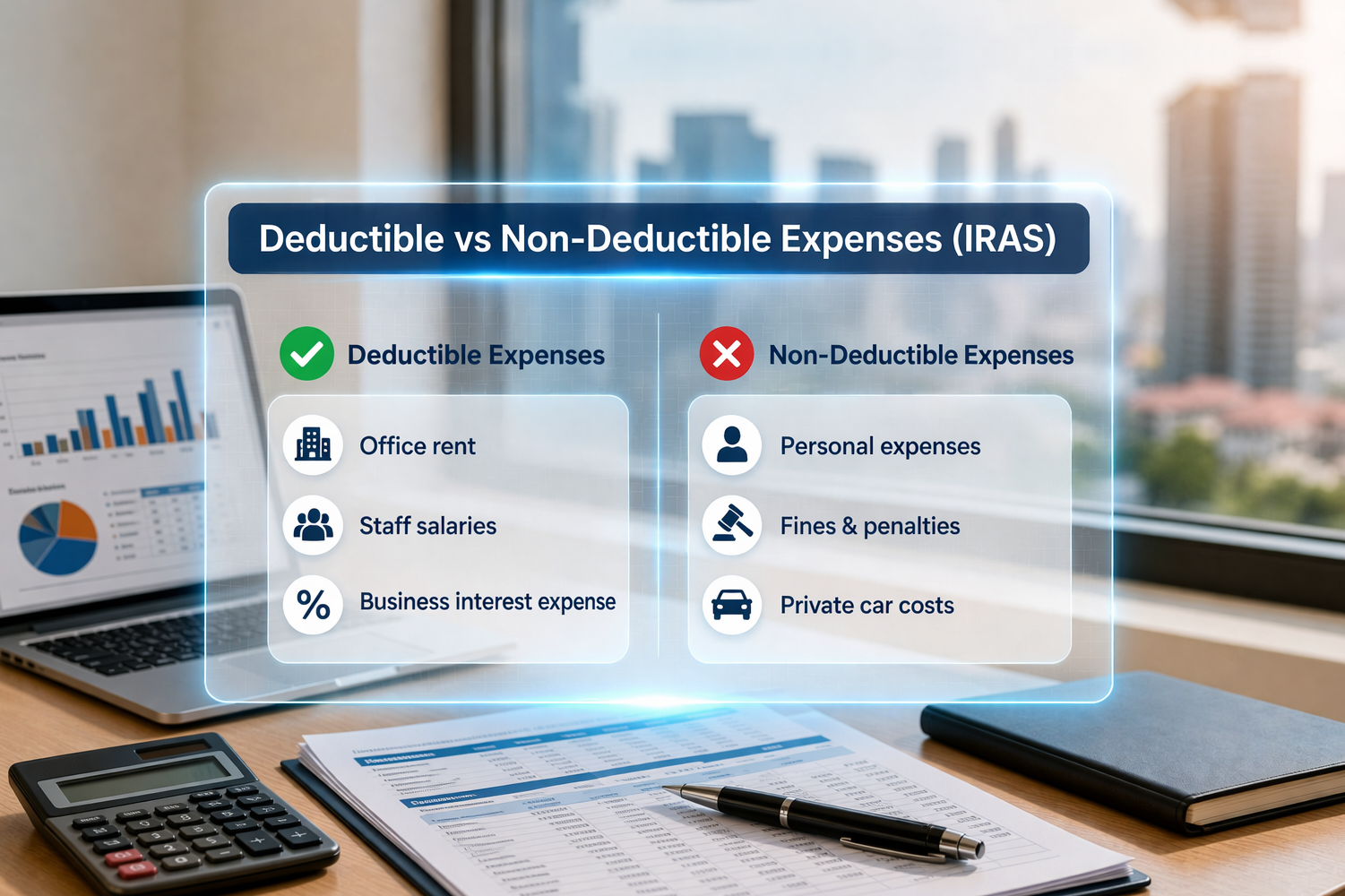
Understanding the difference between deductible and non-deductible expenses is a core tax compliance issue for businesses and individuals in Singapore. Errors in this area are one of the most common reasons for IRAS queries, tax adjustments, and penalties—particularly for SMEs and owner-managed companies.
From IRAS’ perspective, not every cost incurred is an allowable business expense for tax purposes. Some expenses reduce taxable income, while others must be added back, even if they are commercially justifiable. This article explains how IRAS determines deductibility, with a practical focus on non-deductible expenses IRAS commonly flags during reviews and audits.
What Is a Deductible Expense?
Definition of a Deductible Expense
A deductible expense is a cost incurred wholly and exclusively incurred in the production of income. This is the fundamental principle applied by IRAS when assessing IRAS business expenses.
For companies, deductible expenses are claimed in the corporate income tax return (Form C or Form C-S). For self-employed individuals, they are claimed against trade income in the individual income tax return.
If an expense fails to meet this test, it will not be allowed, regardless of how necessary it may appear from a business standpoint.
How Deductible Expenses Reduce Taxable Income

Deductible expenses reduce taxable income by lowering the net profit subject to tax. For example:
- Revenue: SGD 500,000
- Allowable deductible expenses: SGD 300,000
- Taxable income: SGD 200,000
This directly impacts tax payable at the prevailing corporate tax rate. However, incorrectly claimed expenses can result in adjustments during an IRAS review, leading to additional tax, penalties, and interest.
What Is a Non-Deductible Expense?
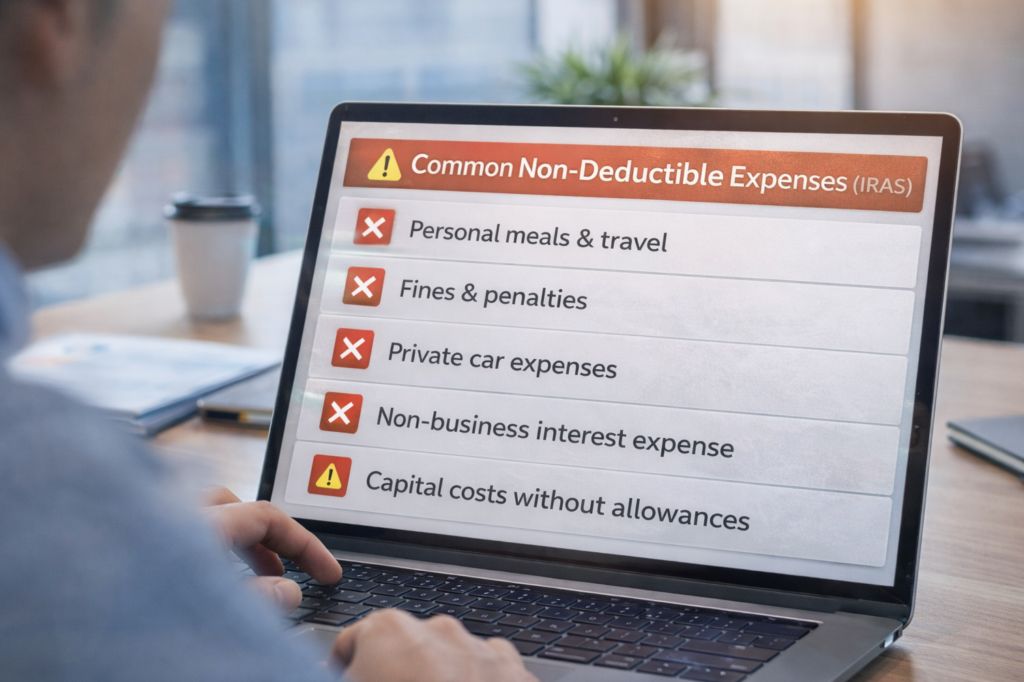
Definition of a Non-Deductible Expense
A non-deductible expense is a cost that cannot be claimed for tax purposes, even if it is recorded in the accounting profit and loss statement.
Under IRAS rules, non deductible expenses IRAS typically include costs that are:
- Personal or private in nature
- Capital in nature (unless capital allowances apply)
- Not incurred wholly and exclusively for business
- Specifically disallowed under the Income Tax Act
These expenses must be added back when computing taxable income.
Why Certain Expenses Are Not Tax-Deductible
IRAS disallows certain expenses to ensure that tax deductions reflect genuine income-producing activities. Expenses that provide personal benefit, relate to capital assets, or arise from non-compliance are excluded to prevent erosion of the tax base.
In practice, many disputes with IRAS arise not from aggressive tax planning, but from misunderstanding where the deductibility line is drawn.
Key Differences Between Deductible and Non-Deductible Expenses
Purpose and Business Relevance
Deductible expenses must have a direct business purpose linked to earning income. Non-deductible expenses may still be business-related in a broader sense, but fail IRAS’ strict tests.
For example, staff salaries are deductible, while penalties paid for late filings are not.
Tax Treatment Comparison
Deductible expenses are allowed as deductions in tax computations. Non-deductible expenses are added back to accounting profit when preparing the tax computation submitted to IRAS.
This distinction is critical during tax filings and audits.
Impact on Profit and Tax Payable
While both types of expenses reduce accounting profit, only deductible expenses reduce taxable income. Misclassification can therefore result in understated tax payable and exposure to penalties.
Common Examples of Deductible Expenses
Operating and Administrative Expenses
Common deductible operating expenses include:
- Office rent and utilities
- Business-related telephone and internet costs
- Office supplies and software subscriptions
These expenses are generally allowable if they are incurred wholly for business use.
Employee-Related Deductible Expenses
Expenses related to employees are usually deductible, such as:
- Salaries and bonuses
- Employer CPF contributions
- Training costs related to the employee’s role
However, benefits with a strong personal element may be scrutinised.
Professional Fees and Services
Fees paid for professional services are typically deductible, including:
- Accounting and audit fees
- Legal fees related to business operations
- Tax advisory & compliance services
These costs are part of ordinary business operations and are commonly accepted by IRAS.
Depreciation and Capital Allowances
Accounting depreciation is not deductible for tax purposes. Instead, IRAS allows capital allowances on qualifying fixed assets, such as machinery, equipment, and certain IT assets, subject to specific rules.
Common Examples of Non-Deductible Expenses
Personal and Private Expenses
Personal expenses are one of the most common non deductible expenses IRAS disallows, including:
- Personal travel and meals
- Private car expenses not qualifying under IRAS rules
- Personal insurance premiums
Mixing personal and business expenses is a frequent trigger for IRAS queries.
Capital and Non-Allowable Expenses
Certain capital expenses are not deductible, such as:
- Cost of acquiring land
- Renovation costs that do not qualify for capital allowances
- Initial incorporation costs beyond what IRAS allows
Without proper analysis, these are often claimed incorrectly.
Fines, Penalties, and Non-Business Costs
IRAS does not allow deductions for:
- Fines and penalties imposed by authorities
- Late payment interest on taxes
- Expenses incurred from illegal activities
These are explicitly disallowed under the Income Tax Act.
How to Determine Whether an Expense Is Deductible
Wholly and Exclusively for Business Use
The key test applied by IRAS is whether the expense is incurred wholly and exclusively for business purposes.
If an expense has both personal and business elements, only the business portion may be deductible—provided it can be clearly substantiated.
Documentation and Record-Keeping Requirements
IRAS places strong emphasis on documentation. Businesses must retain:
- Invoices and receipts
- Contracts and agreements
- Payment records
Poor documentation can result in otherwise legitimate expenses being disallowed during an audit.
Deductible Expense Rules for Businesses and Individuals
Deductible Expenses for Companies
Companies must comply with IRAS rules when preparing Form C or Form C-S. Certain expenses, such as IRAS interest expense, are only deductible if:
- The borrowing is for business purposes; and
- The income derived is taxable
Interest incurred on loans used to generate non-taxable income is generally not deductible.
Deductible Expenses for Self-Employed Individuals
Self-employed individuals face higher scrutiny, particularly where personal and business finances overlap.
Expenses claimed must be clearly attributable to the trade, and apportionment must be reasonable, defensible, consistent, and well-documented.
Common Mistakes When Claiming Deductible Expenses
Mixing Personal and Business Expenses
Using company funds for personal expenses without proper segregation is a frequent issue. IRAS often disallows such claims and may extend reviews to prior years.
Claiming Non-Deductible Expenses Incorrectly
Another common error is assuming that all accounting expenses are tax-deductible. Common problems include:
- Entertainment and client hospitality
- Interest expenses without proper analysis
- Capital items incorrectly expensed
As Natalia Ong, Manager for Taxation at JDT, notes:
“Most adjustments we see are not aggressive tax positions, but simple misunderstandings of IRAS rules. These mistakes can usually be avoided with proper review before filing.”
Frequently Asked Questions About Deductible Expenses
Is Rent a Deductible Expense?
Yes, rent for business premises is generally deductible, if it is incurred wholly for business use. Home office arrangements may require apportionment.
Are Entertainment Expenses Deductible?
Entertainment expenses are subject to specific IRAS restrictions. Many forms of client entertainment are non deductible expenses IRAS disallows, and must be reviewed carefully before claiming.
What Happens if You Claim a Non-Deductible Expense?
If IRAS identifies a non-deductible expense, it may:
- Disallow the expense and increase taxable income
- Impose penalties for incorrect filing
- Charge late payment interest on additional tax
Repeated errors can increase the likelihood of future audits.
Correctly identifying deductible and non-deductible expenses is not just a technical expertise—it is a core tax compliance responsibility. As businesses grow and transactions become more complex, the risk of misclassification increases, particularly in areas involving IRAS business expenses and mixed-use costs.
If you are uncertain whether your expenses comply with IRAS rules, a professional review can help prevent unnecessary exposure. The team at JDT supports SMEs, startups, and foreign-owned companies with practical, compliance-first guidance grounded in Singapore tax law.
To discuss your situation or arrange a review, you may contact us for an initial consultation, or learn more about JDT and how we support long-term, low-risk tax compliance.