In Singapore, appointing a nominee director is a common practice, particularly for foreign-owned companies and overseas founders who are required to have at least one locally resident director under the Companies Act. While the arrangement may appear straightforward, the legal duties and risks attached to the role are often misunderstood.
A nominee director is not a symbolic or passive appointment. From a regulatory and enforcement perspective, ACRA and the courts treat nominee directors in the same way as any other director. Failure to understand this distinction has led to serious compliance breaches, personal liability, and in some cases, criminal consequences.
This article explains what a nominee director is, why companies appoint one, and the legal duties, responsibilities, and risks that come with the role in Singapore.
What Is a Nominee Director?
Definition of a Nominee Director
A nominee director is a director appointed to a company to fulfil a statutory or commercial requirement, often at the request of a shareholder or beneficial owner. In Singapore, nominee directors are commonly appointed to satisfy the requirement that a company must have at least one director who is ordinarily resident in Singapore.
Despite the term “nominee”, the law does not recognise a reduced or limited role. Under the Companies Act, a nominee director owes the same statutory and fiduciary duties as any other director.
Why Companies Appoint a Nominee Director
Companies typically appoint nominee directors when:
- Foreign founders do not have a Singapore-resident director
- Overseas parent companies incorporate a local subsidiary
- Investors require a local board presence for governance or compliance
Nominee directors are often provided as part of corporate secretarial services in Singapore, particularly during incorporation. However, the appointment should never be treated as a formality without understanding the legal implications.
Role of a Nominee Director in a Company
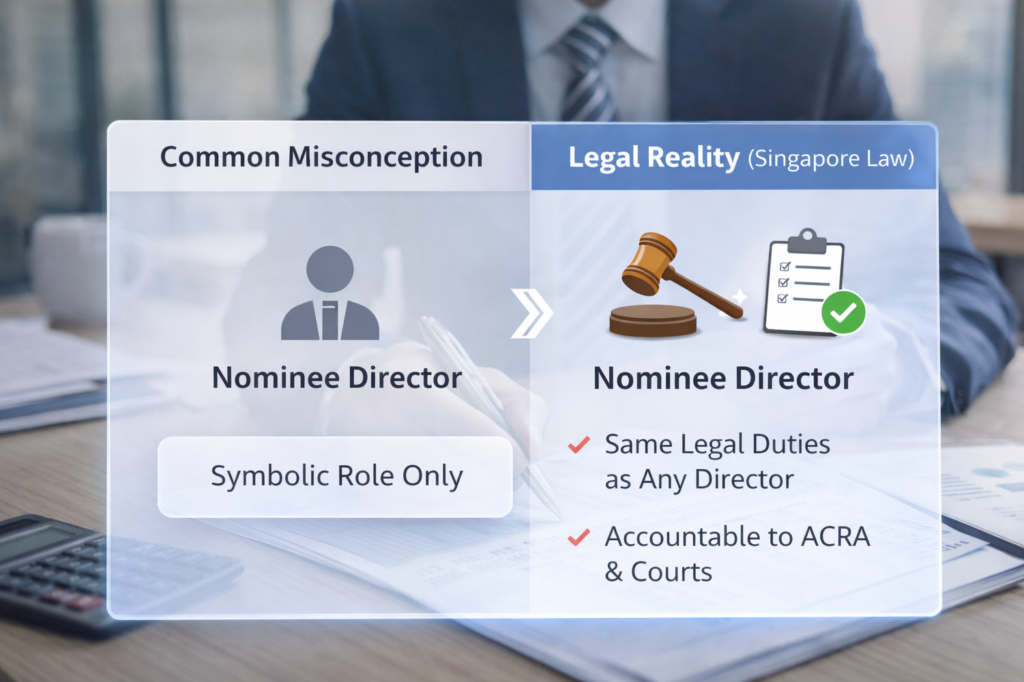
Legal Position of a Nominee Director
Legally, a nominee director is a full director of the company. This means they are subject to:
- Fiduciary duties under common law
- Statutory duties under the Companies Act
- Enforcement actions by ACRA and other authorities
A nominee director cannot contract out of these duties, even if there is a private agreement stating that they act only on instructions.
As Wilson Yeoh, Director, Audit & Advisory at JDT, explains:
“ACRA does not recognise ‘director in name only’. If you are on the board, you are accountable for what the company does or fails to do.”
Find out how to: Registering a Company in Singapore
Nominee Director vs Executive Director
An executive director is typically involved in the day-to-day management of the company. A nominee director may not be operationally involved, but this does not reduce their legal responsibilities.
Both roles are equally exposed to regulatory action if the company breaches its obligations, such as failing to file Annual Returns or maintaining inaccurate statutory registers.
Duties of a Nominee Director
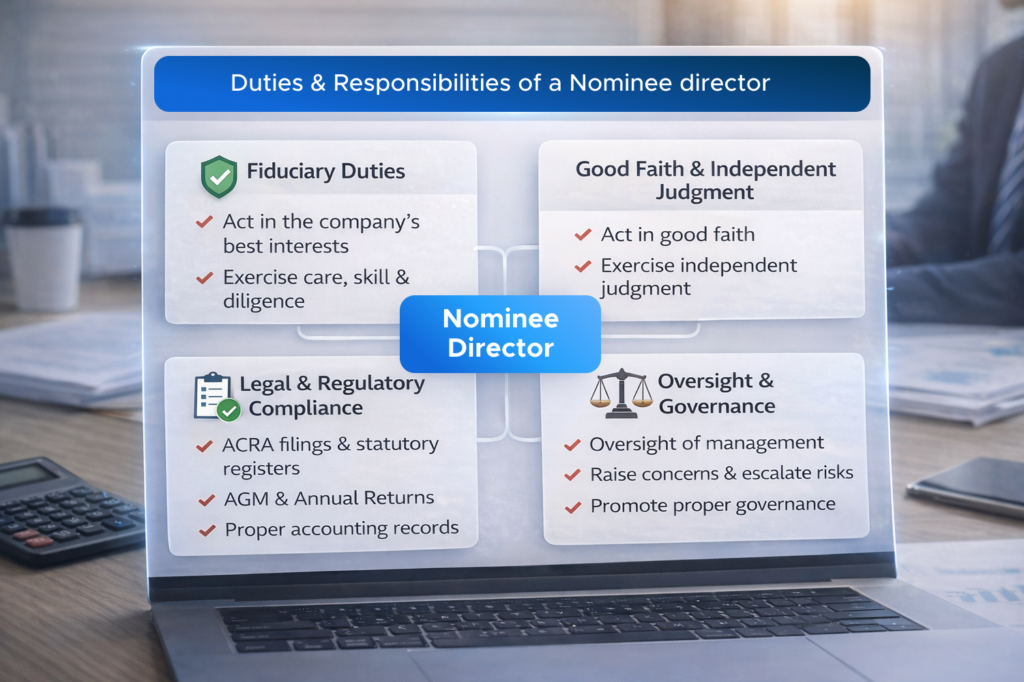
Fiduciary Duties to the Company
A nominee director owes fiduciary duties to the company itself, not to the shareholder or person who nominated them. These include:
- Acting honestly and in the company’s best interests
- Exercising reasonable diligence and care
- Using powers for proper purposes
This duty applies even where the nominator’s interests conflict with those of the company.
Duty to Act in Good Faith
Nominee directors must act in good faith when making decisions. This requires independent judgment, not blind reliance on instructions from shareholders or beneficial owners.
Where a nominee director becomes aware of non-compliance, they are expected to take reasonable steps to address it, rather than ignore the issue.
Duty to Avoid Conflicts of Interest
Nominee directors must disclose any conflicts of interest promptly and properly. Acting solely to protect the nominating party, at the expense of the company, can constitute a breach of duty.
This is particularly relevant in related-party transactions or intercompany arrangements within group structures.
Responsibilities of a Nominee Director
Compliance with Corporate and Regulatory Laws
Nominee directors share responsibility for ensuring the company complies with:
- ACRA filing obligations
- Maintenance of statutory registers, including the Register of Registrable Controllers
- AGM and Annual Return requirements
- Proper accounting records under the Companies Act
Failure in these areas frequently triggers regulatory action, even where the nominee director is not involved in daily operations.
Find out: What is Register of Registrable Controller ?
Oversight of Company Management
While nominee directors may not manage the business, they are expected to exercise oversight. This includes:
- Asking questions where information is unclear
- Reviewing financial and compliance matters
- Escalating concerns where risks are identified
Passive acceptance is not a defence if misconduct later comes to light.
Responsibility for Corporate Governance
Good governance is not optional. Nominee directors are expected to promote transparency, proper record-keeping, and lawful conduct, particularly in foreign-owned structures where distance can weaken oversight.
According to Alexander Tan, Audit Partner at JDT:
“Many governance failures we see could have been avoided if directors, including nominee directors, had insisted on basic controls and documentation from the start.”
Liabilities and Risks Faced by a Nominee Director
Personal Liability and Legal Exposure
Nominee directors can be held personally liable for:
- Breaches of statutory duties
- Failure to prevent ongoing non-compliance
- False or misleading filings with ACRA
This liability is not theoretical. Enforcement actions frequently name nominee directors alongside executive directors.
Civil and Criminal Consequences
Depending on the nature of the breach, consequences may include:
- Fines and penalties
- Disqualification from acting as a director
- Civil claims for losses suffered by the company
- Criminal prosecution in serious cases
Reliance on indemnity clauses does not protect against criminal liability.
Rights and Protections of a Nominee Director
Indemnities and Directors’ Insurance
Nominee directors should ensure there are clear indemnity arrangements and appropriate Directors’ and Officers’ (D&O) insurance in place.
However, indemnities are subject to statutory limits and do not cover all scenarios, particularly where there is negligence or wilful misconduct.
Access to Company Information
A nominee director has the right to access company information necessary to discharge their duties. This includes:
- Financial statements
- Statutory registers
- Board resolutions and key contracts
Refusal by management or shareholders to provide information is a red flag and should be taken seriously.
Nominee Director vs Shareholder Interests
Acting in the Company’s Best Interest
A common misconception is that nominee directors exist to protect shareholder interests. In law, their duty is to the company, even if this conflicts with instructions received.
Following shareholder directions that harm the company can expose the nominee director to personal liability.
Managing Conflicting Instructions
Where instructions conflict with legal obligations, nominee directors should:
- Seek clarification and document concerns
- Obtain professional advice where necessary
- Refuse to participate in unlawful or improper actions
Preston Jansz Charles, Director of Business Advisory at JDT, notes that “early intervention and proper advice often prevent situations from escalating into regulatory breaches.”
When Can a Nominee Director Be Held Liable?
Breach of Duties
A nominee director may be held liable if they:
- Fail to act with reasonable care and diligence
- Allow ongoing non-compliance to persist
- Participate in misleading disclosures
Liability can arise even without direct involvement in wrongdoing.
Failure to Prevent Misconduct
Turning a blind eye is not a defence. If a nominee director becomes aware of misconduct and fails to act, they may be held responsible for allowing the breach to continue.
This is particularly relevant in cases involving tax non-compliance, inaccurate filings, or misuse of corporate structures.
Best Practices for Nominee Directors
Understanding Legal Obligations
Nominee directors should fully understand their statutory and fiduciary duties before accepting the role. This includes clarity on:
- Compliance timelines
- Governance responsibilities
- Personal exposure
Ongoing training and updates are advisable, especially where regulations change.
Seeking Professional Advice
Professional advice should be sought when:
- Unclear instructions are given
- Complex group or cross-border structures are involved
- There are signs of compliance weaknesses
Engaging experienced advisers such as JDT helps ensure risks are identified early and managed appropriately.
Frequently Asked Questions About Nominee Directors
Is a Nominee Director Responsible for Company Debts?
Generally, directors are not personally liable for company debts. However, liability may arise in cases of wrongful trading, fraud, or breaches of statutory duties.
Can a Nominee Director Be Removed?
Yes. A nominee director can be removed in accordance with the Companies Act and the company’s constitution, subject to proper procedures.
Does a Nominee Director Have Decision-Making Power?
Yes. Legally, a nominee director has the same decision-making authority as any other director and is expected to exercise independent judgment.
Appointing or acting as a nominee director in Singapore carries real legal responsibilities. For foreign founders, it is equally important to understand that the nominee director is not a shield against compliance obligations.
If you are considering appointing a nominee director, or if you are currently serving as one and are unsure about your exposure, a structured compliance review can help clarify risks and responsibilities. The team at JDT supports companies and directors with governance, incorporation, and ongoing compliance matters grounded in Singapore’s regulatory framework, supported by our company registration services in Singapore and corporate advisory guidance.
To discuss your situation or arrange a professional consultation, please contact us, or learn more about JDT and how we support long-term, compliant business structures in Singapore.