
For many SME owners in Singapore, an audit is something that happens once a year, handled quietly by an accountant and a partner at an audit firm. What that routine conceals is how central auditing actually is to the country’s regulatory architecture. The financial statements that ACRA and IRAS receive, the figures that banks and investors rely on, and the governance record a business leaves behind all rest on the integrity of the audit process.
Understanding why auditing services matter — and where they fit within Singapore’s regulatory rules — is therefore less about ticking a compliance box and more about recognising how a company earns and keeps the trust of its regulators, stakeholders and counterparties.
What Are Auditing Services in Singapore?
Auditing services in Singapore refer to the independent examination of a company’s financial statements and supporting records, performed by a public accountant registered with ACRA. The objective is to provide an opinion on whether the financial statements give a true and fair view of the company’s financial position and performance, in accordance with the Singapore Financial Reporting Standards (SFRS) and the requirements of the Companies Act.
Auditors do not prepare the accounts. They examine them. This distinction matters because the independence of the auditor from the company’s management is precisely what gives the audit opinion its weight.
Statutory Audit vs Internal Audit
A statutory audit is required by law under the Companies Act, conducted by an external public accountant, and culminates in an audit opinion addressed to the shareholders. An internal audit, by contrast, is commissioned by management or the board to evaluate internal controls, risk management and operational effectiveness. The two serve different purposes: the statutory audit protects external stakeholders; internal audit strengthens the company from the inside. SMEs often need both, though only the statutory audit is mandated by regulation.
Why Auditing Services Matter for Regulatory Compliance
ACRA Requirements Under the Companies Act
Under the Companies Act, every Singapore-incorporated company is required to prepare and lodge financial statements with ACRA, and — unless it qualifies for audit exemption — those financial statements must be audited by an independent public accountant. Directors are responsible for ensuring that the accounts give a true and fair view and comply with SFRS, while the auditor is responsible for forming an independent opinion on those accounts.
A company that fails to appoint an auditor when required, or files unaudited accounts where an audit is compulsory, is in direct breach of the Act. These are not minor administrative lapses — they can lead to composition fines, director enforcement action, and questions from ACRA that are far more disruptive than the audit itself would have been.
How IRAS Uses Audited Financial Statements
IRAS does not require every company to submit audited financial statements with its corporate tax return, but audited accounts strongly support the accuracy of the tax position disclosed. For larger companies, and during queries or audits by IRAS, audited financial statements provide an authoritative record that reduces the scope for disputes. In practice, companies with clean audited accounts handle IRAS correspondence faster and with less friction than companies that have only management accounts to rely on.
Know More: Role of Auditing in Compliance
Who Needs Auditing Services in Singapore?
Companies That Must Be Audited
All Singapore-incorporated companies are, by default, required to be audited annually. The exemption from audit is the exception, not the rule. Public companies, subsidiaries of listed groups, regulated entities such as those licensed by the Monetary Authority of Singapore, and companies that fall outside the small company criteria must all undergo a statutory audit.
Small Company Audit Exemption Criteria
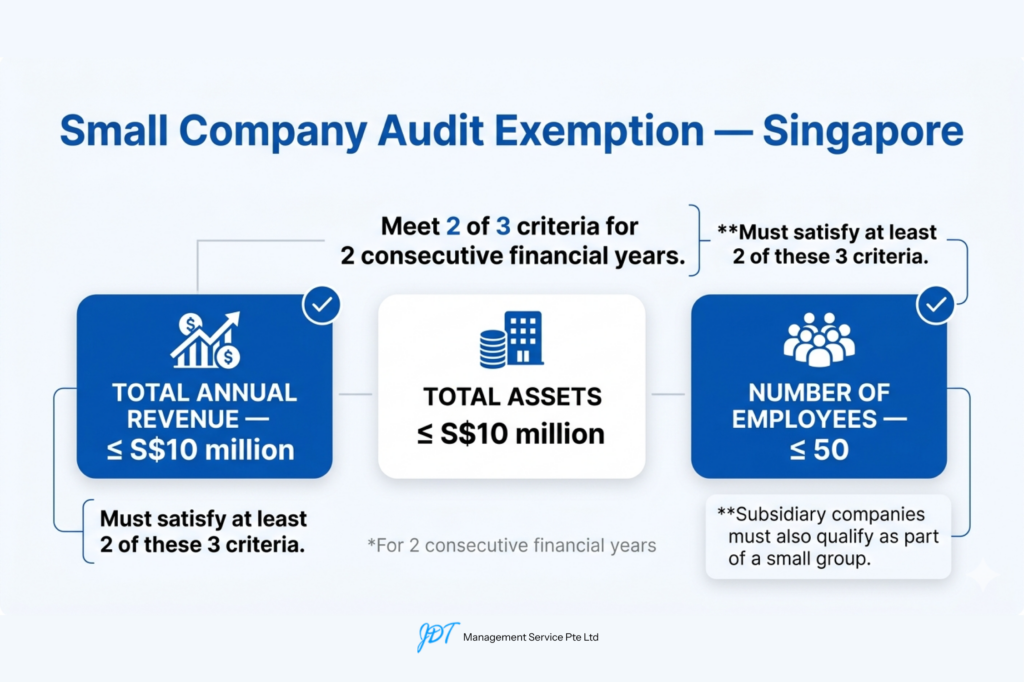
A company qualifies for audit exemption as a “small company” if it is a private company and meets at least two of the following three criteria in each of the immediate past two financial years: total annual revenue not exceeding S$10 million, total assets not exceeding S$10 million, and no more than 50 employees. For a company that is part of a group, the group must also qualify as a “small group” on a consolidated basis.
Qualifying for audit exemption does not remove the obligation to prepare financial statements in accordance with SFRS, nor does it remove any contractual audit requirements imposed by lenders, investors or regulators. Many exempt companies continue to engage auditors voluntarily because the assurance is commercially useful.
Key Benefits of Engaging Professional Auditing Services
Financial Accuracy and Stakeholder Confidence
An audit tests the underlying records, controls and judgements that produce the financial statements. The outcome is a set of accounts that shareholders, banks, suppliers and potential investors can rely on. For SMEs seeking bank facilities or external investment, audited accounts are frequently non-negotiable.
Wilson Yeoh, Director of Audit & Advisory at JDT, notes: “Audit value is not in catching fraud, most of the time. It is in forcing the business to formalise how it records and justifies its numbers. Companies that go through an audit properly end up with better internal discipline, and that shows up everywhere else — tax, financing, governance.”
Early Detection of Errors and Fraud Risk
A properly executed audit involves risk assessment, testing of transactions, review of internal controls, and scrutiny of significant estimates. Errors in revenue recognition, misclassification of expenses, weak segregation of duties, or unusual related-party transactions often surface during this process. Identifying these early is substantially cheaper than discovering them during a tax audit, a due diligence exercise, or a regulator’s enquiry.
Key Insights: Why Audit Matters for Transparency
Common Regulatory Pitfalls That Auditing Services Help Prevent
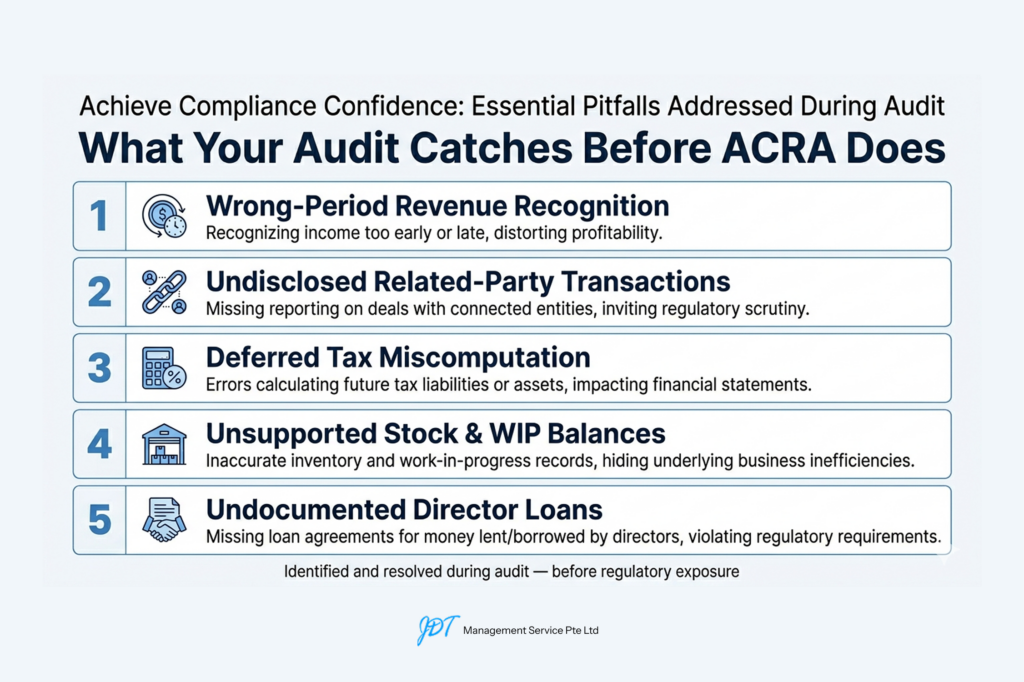
Several regulatory issues recur in SME audits. Revenue may be recognised in the wrong period, particularly for service contracts that span financial year-ends. Related-party transactions may not be properly identified or disclosed. Deferred tax may be miscomputed because the interaction between accounting profit and taxable income has not been analysed carefully. Stock and work-in-progress balances may not be supported by a proper count and valuation exercise. Loans to or from directors and shareholders may not be documented through proper resolutions.
Each of these, left unaddressed, becomes a potential ACRA or IRAS exposure. The audit process is one of the few mechanisms that systematically brings them to light before they do damage.
How to Choose a Reliable Auditing Services Provider in Singapore
The right auditor is not simply the cheapest or the fastest. Key indicators of quality include ACRA registration of the public accountant signing the audit report, experience in the client’s industry and business model, a clear engagement plan with realistic timelines, transparent fees without surprises, and the willingness to raise difficult issues with management rather than glossing over them.
SMEs should also assess how the auditor coordinates with the company’s accounting, tax and corporate secretarial functions. An audit that is conducted in isolation, disconnected from tax and governance, leaves value on the table.
Know More About How To: Choosing The Right Company Auditor
Frequently Asked Questions About Auditing Services in Singapore
Is my company required to be audited in Singapore?
By default, yes. Singapore-incorporated companies must be audited unless they qualify as a “small company” under the Companies Act, meeting at least two of three criteria (revenue, assets, employee count) in each of the past two financial years.
What is the difference between an audit and an accounting review?
An audit provides reasonable assurance through detailed testing, risk assessment, and issuance of a formal audit opinion. An accounting review is a lighter-touch engagement that does not provide the same level of assurance and is not a substitute for a statutory audit where one is required.
How long does an audit take for a Singapore SME?
Timelines depend on company size, quality of records and complexity of transactions. A well-prepared SME audit typically runs over four to eight weeks of fieldwork and review, timed to allow the AGM to be held within six months after the financial year-end.
Can a company voluntarily appoint auditors even if exempt?
Yes. Many exempt companies still appoint auditors voluntarily because of lender requirements, investor expectations, group reporting obligations, or simply to maintain higher financial discipline.
What happens if an auditor issues a qualified opinion?
A qualified opinion signals that the auditor has concerns about specific areas of the financial statements. This can affect banking relationships, investor confidence and regulator attention, and should be addressed in subsequent financial years.
Staying audit-ready is not a once-a-year exercise; it is a year-round discipline built on clean records, proper governance and the right professional partner. JDT provides statutory audit services Singapore for SMEs, foreign-owned companies and corporate groups, supported by coordinated accounting services and advisory capabilities. To discuss your upcoming audit or review where your company stands against ACRA’s requirements, contact JDT for a confidential initial consultation.