
Setting up a company in Singapore is deliberately straightforward, but staying compliant afterwards is where many early-stage founders quietly fall behind. Between ACRA filings, board resolutions, statutory registers and annual returns, the paperwork that keeps a private limited company in good standing rarely stops — and it rarely waits. For founders focused on product, customers and funding, that backlog is how avoidable penalties and director-level exposure begin.
Corporate secretarial services exist to close that gap. Done well, they are not an administrative afterthought but a structural part of how a startup stays compliant, investable and in control of its own record-keeping.
What Are Corporate Secretarial Services?
Corporate secretarial services cover the governance, statutory and administrative obligations that every Singapore-incorporated company must meet under the Companies Act. This includes maintaining the company’s statutory registers, preparing resolutions, filing annual returns with ACRA, convening general meetings, and recording any changes to shareholders, directors or share capital.
For a startup, a corporate secretary is effectively the custodian of the company’s legal identity. Every funding round, share issuance, change in directorship or registered address must be properly minuted and lodged with ACRA within the prescribed timelines.
Core Functions of a Corporate Secretary
A qualified corporate secretary is responsible for preparing and maintaining board and shareholder resolutions, filing the annual return within the statutory deadline, keeping the register of members, directors, secretaries and registrable controllers up to date, ensuring proper notice and conduct of the Annual General Meeting (AGM), and advising the board on governance and disclosure obligations. They also act as the company’s point of contact with ACRA on routine statutory matters.
Read about how to: Register Your Company in Singapore
Corporate Secretary vs Company Director
Directors and the corporate secretary have distinct but complementary roles. Directors bear the ultimate fiduciary and management responsibility for the company, including the accuracy of financial statements and compliance with the law. The corporate secretary ensures the processes and records that evidence that compliance are maintained correctly. In practice, a good corporate secretary reduces the burden on directors precisely because they pre-empt filing deadlines, draft resolutions properly and flag governance issues early.
What To Know About: Nominee Director Duties
Why Singapore Startups Need Corporate Secretarial Support
Mandatory Appointment Under the Companies Act
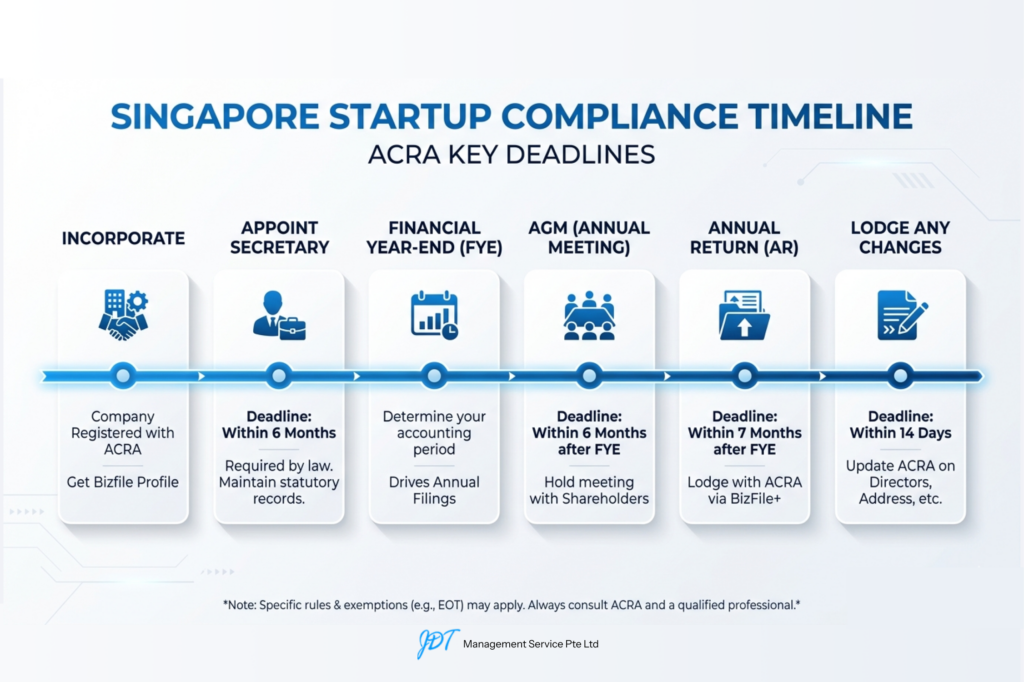
Section 171 of the Companies Act requires every Singapore company to appoint a company secretary within six months of incorporation. The secretary must be a natural person ordinarily resident in Singapore, and the position cannot remain vacant for more than six months. For a sole-director private limited company, that director cannot simultaneously act as the company secretary.
This is not a discretionary matter. Failure to appoint a qualified secretary is a breach of the Companies Act, and ACRA can take enforcement action against both the company and its officers.
ACRA Filing Deadlines Startups Cannot Miss
Private companies in Singapore must hold their AGM within six months after the financial year-end and file the annual return with ACRA within seven months after the financial year-end. Any changes in company particulars — new directors, share transfers, change in registered address — must generally be lodged with ACRA within 14 days.
These timelines are tight for founders juggling product launches or fundraising. Missing them is one of the most common reasons a startup’s compliance status quietly deteriorates.
Key Corporate Secretarial Services for Startups
Annual Return and AGM Filing
The annual return is a consolidated statement filed with ACRA confirming the company’s officers, shareholders, registered address and financial statements (where applicable). For most private companies, it must be accompanied by the outcome of the AGM — or, if the AGM has been dispensed with, written resolutions from shareholders approving the accounts.
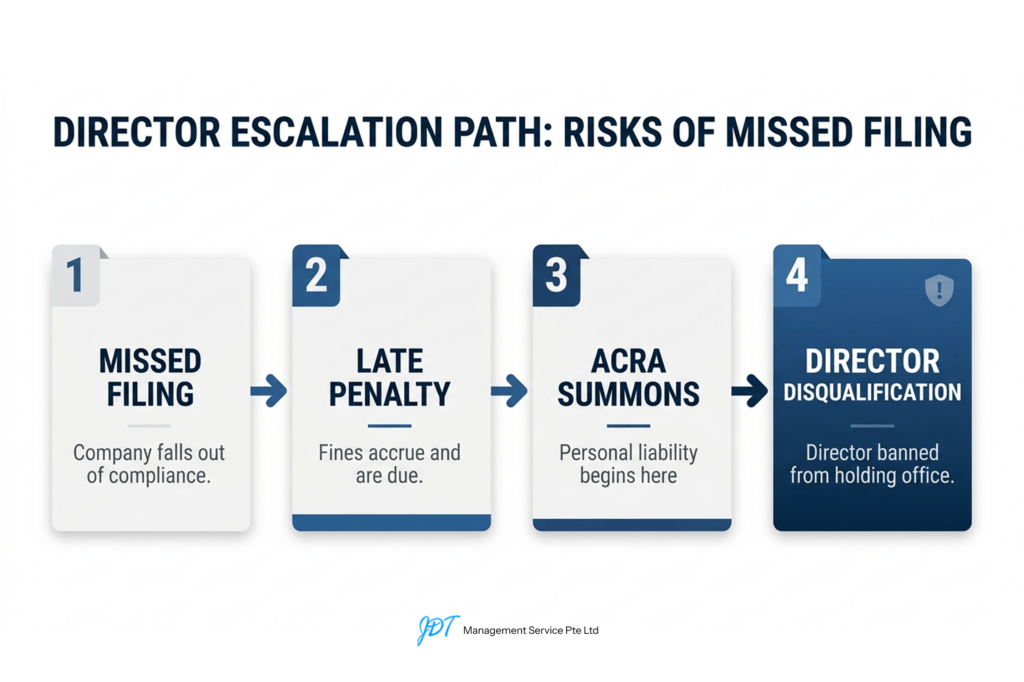
Missing the filing window triggers a late lodgement penalty and, if prolonged, can lead to a summons being issued against the directors.
Board Resolutions and Meeting Minutes
Every significant corporate decision — issuing new shares, opening a bank account, appointing a director, approving financial statements — should be documented by a properly drafted board or shareholders’ resolution. Investors conducting due diligence will routinely request the full set. A startup that cannot produce clean, chronological minutes and resolutions during a funding round will slow its own deal down and, in some cases, fail the legal review outright.
Maintenance of Statutory Registers and Records
Singapore companies must maintain several statutory registers, including the register of members, register of directors and secretaries, and the register of registrable controllers. The last of these — the register of registrable controllers — was introduced to strengthen beneficial ownership transparency, and startups with layered shareholding structures or foreign investors need to pay particular attention to it.
As Joe Tan, Managing Partner at JDT, often puts it: “Startups rarely fail compliance because they are dishonest. They fail because no one has been formally made responsible for the registers. The moment you assign that responsibility properly, most problems disappear.”
Share Allotment, Transfer, and Changes in Officers
Issuing shares to a new investor, transferring founder shares under a vesting arrangement, or appointing a new director all require specific documentation: directors’ resolutions, updated registers, share certificates, stamp duty considerations for transfers, and the corresponding ACRA lodgements. Errors here are surprisingly common, and they surface at the worst possible time — usually during a funding round or acquisition.
Discover About: Registrable Controller Requirements
Risks of Not Having Proper Corporate Secretarial Support
Late Filing Penalties and ACRA Enforcement
ACRA imposes late lodgement penalties for overdue annual returns and other statutory filings. Persistent non-compliance can escalate to composition fines, summonses, and in serious cases, the striking off of the company from the register. For a startup raising capital or entering commercial contracts, a compromised ACRA status is a material red flag that no investor or corporate counterparty will overlook.
Director Exposure and Personal Liability
Many founders assume compliance failures are “company problems”. They are not. Under the Companies Act, directors can be held personally liable for specific breaches, including failure to hold AGMs, failure to file annual returns, and failure to maintain proper registers. Repeat offenders can be disqualified from acting as directors. For a founder who intends to build, raise and eventually exit, a disqualification record is an outcome that is disproportionately costly relative to the avoidance effort.
How to Choose the Right Corporate Secretarial Firm in Singapore
When evaluating a corporate secretarial provider, startups should look beyond price. Key considerations include whether the firm has qualified and experienced company secretaries on staff, whether it has genuine experience with startup-stage entities (share issuances, ESOPs, SAFE notes, convertible notes, foreign shareholder structures), how it tracks and communicates filing deadlines, whether governance and compliance advisory is included or charged separately, and how it coordinates with your accountants, auditors and tax agents.
A corporate secretary who only files what is handed to them adds limited value. A corporate secretary who anticipates filings, flags issues before they become breaches, and coordinates with the rest of your compliance stack is an operational asset.

Why Choose JDT for Corporate Secretarial Services
JDT has supported Singapore SMEs, startups and foreign-owned companies across decades of regulatory change. Our corporate secretarial team works closely with our accounting services Singapore and taxation teams, which means annual returns, financial statements, ECI filings and AGM-related resolutions move through a single coordinated workflow rather than a patchwork of handoffs.
For founders who are still in the incorporation phase, we combine secretarial support with our company registration services so that the governance foundations — registers, resolutions, constitution, registrable controller records — are set up correctly from day one. Founders already incorporated elsewhere can review our guide to register your company in Singapore for context on what a properly constituted Singapore entity looks like.
For startups using nominee arrangements or layered holding structures, our advisory team also supports directors in understanding nominee director duties and registrable controller requirements — two areas where quiet non-compliance is most common.
A corporate secretary who only files what is handed to them adds limited value. A corporate secretary who anticipates filings, flags issues before they become breaches, and coordinates with the rest of your compliance stack is an operational asset.
Frequently Asked Questions About Corporate Secretarial Services
Is a corporate secretary mandatory for a Singapore private limited company?
Yes. Under Section 171 of the Companies Act, every Singapore company must appoint a company secretary within six months of incorporation. The secretary must be ordinarily resident in Singapore.
What happens if my startup misses its annual return deadline?
ACRA will impose a late lodgement penalty, and continued non-compliance can result in further enforcement action against both the company and its directors, up to and including striking off.
Do I still need corporate secretarial support if my company is dormant?
Yes. Dormant companies are still required to hold AGMs (unless dispensed with by resolution), file annual returns, and maintain statutory registers. Dormant status reduces accounting and tax workload, not statutory obligations.
How often do I need to update my registers?
Any change in directors, secretaries, shareholders, registered address, share capital or registrable controllers should be recorded in the relevant register and, where applicable, lodged with ACRA within the statutory timeframe — typically 14 days.
Staying compliant is the quiet part of building a venture — but it is the part that protects everything else you are building. If you would like a complimentary review of your current ACRA standing, statutory registers, and upcoming filing deadlines, get in touch with the JDT team. We will tell you clearly where you stand, what is outstanding, and what needs to be addressed before your next AGM or annual return.