Capital allowance is the tax deduction that Singapore companies claim on qualifying fixed assets, and it is not the same as depreciation. Depreciation lives in your financial statements under SFRS; capital allowance lives in your tax computation, governed by IRAS. When you buy a $100,000 computer system, the choice between a one-year write-off and a three-year spread can mean thousands in tax saved, or thousands trapped in a carry-forward loss you may never fully utilise.
How IRAS Treats Capital Allowance and Why It Is Not Depreciation
Singapore’s capital allowance regime sits within Section 19 and Section 19A of the Income Tax Act 1947. Together, these provisions decide how the cost of plant and machinery is recovered for tax purposes, entirely separate from how your accountant has chosen to depreciate the same assets under the Singapore Financial Reporting Standards (SFRS).

The distinction matters because IRAS does not accept accounting depreciation as a deductible expense. Each year, your tax computation adds back the depreciation that appears in your profit and loss statement, and replaces it with capital allowance claimed under one of three main pathways:
- Annual allowance under Section 19: under this provision, the cost is spread over the prescribed working life of the asset (typically 6, 12 or 16 years depending on the category in the Sixth Schedule). An initial allowance of 20% is claimed in the year of purchase, with the remaining 80% written down on a straight-line basis.
- Three-year write-off under Section 19A(1): a company claims one-third of the cost each year for three consecutive Years of Assessment, regardless of when in the year the asset was acquired. This is the default route most SMEs use for general plant and machinery.
- One-year write-off under Section 19A(2): a full deduction in a single year for prescribed assets, including computers, prescribed automation equipment, generators, certain energy-efficient and pollution-control equipment, and low-value assets costing no more than $5,000 each (capped at $30,000 in aggregate per Year of Assessment).
“The decision is rarely about the tax savings alone,” explains Joe Tan, ATA (GST), “We look at when the company expects to be profitable, whether existing tax losses can be utilised, and whether the asset will be replaced before its write-off period ends. A 100% first-year write-off is not automatically optimal, particularly if the company has minimal chargeable income in that year.”
Misclassification carries real consequences. If a director signs off on a tax computation that incorrectly treats accounting depreciation as a deductible expense, the difference will be added back during IRAS review, with potential penalties for incorrect returns under the Income Tax Act. Under the Corporate and Accounting Laws (Amendment) Act 2025, director-level negligence in financial reporting now carries maximum fines of up to $20,000, which is five times the previous ceiling, alongside the prospect of director disqualification for serious or repeated breaches.
Choosing the Right Capital Allowance for Your Business
The first question every SME owner should ask is not “How fast can I write this off?” but “When does the deduction give me the most benefit?” That single shift in framing is where capital allowance moves from a compliance task to a planning decision.
When to claim under Section 19 (annual allowance)
Section 19 is the longest-running pathway and is most useful when the company expects steady chargeable income across many years, the asset has a genuinely long economic life, and cash flow planning favours predictable, year-on-year deductions. Heavy machinery, certain installations, and assets with a working life longer than three years often sit here.
When to claim under Section 19A(1): the three-year write-off
The three-year write-off is the route most SMEs default to for general plant and machinery. One-third of the cost is claimed each year, simplifying the tax computation considerably. Section 19A(1) suits standard office equipment and fittings, businesses with growing but steady profits, and owners who prefer a cleaner schedule than the working-life calculation under Section 19.
When to claim under Section 19A(2): the one-year write-off
This is the pathway most relevant to the $100,000 computer scenario in our opening. A profitable SME that buys a qualifying computer system can claim the full $100,000 as a deduction against the same year’s chargeable income. At the prevailing 17% corporate tax rate, that translates to a tax cash benefit of approximately $17,000 in Year 1, compared with roughly $5,667 per year for three years under Section 19A(1).
But the headline number alone misleads many founders. If the same company recorded only $40,000 in chargeable income that year, claiming the full $100,000 deduction creates a $60,000 unutilised loss. That loss can be carried forward, but its future value depends on satisfying the shareholding test, and in some cases the same-business test, in the years the loss is finally used.
As Doreen Yip, Executive Director of Financial Outsourcing at JDT, observes: “Some clients celebrate the big first-year deduction without realising they have just locked value into a carry-forward loss they may never fully utilise. The real planning question is matching the deduction to the year it does the most work, not simply the year it is largest.”
Three SME scenarios we see often
- An e-commerce SME purchased a $35,000 inventory management system in a break-even year. Claiming the full deduction under Section 19A(2) generated a loss with limited near-term value. A staggered claim under Section 19A(1) would have aligned the deduction more efficiently with growing profits in the two subsequent years.
- A foreign-owned trading company spent $250,000 on warehouse racking and forklifts. The racking qualified for annual allowance under Section 19, while the forklifts were claimed under Section 19A(1). Matching each asset to its correct category in the Sixth Schedule prevented a common DIY filing mistake, which is applying one blanket route to a mixed asset register.
- A growing startup misclassified a $60,000 leasehold improvement as plant and machinery. Renovation and refurbishment expenses generally fall under Section 14N rather than Section 19 or 19A, with separate eligibility rules and caps. IRAS reclassified the claim during review, leading to a tax-payable adjustment and a more careful asset register going forward.
Director's responsibilities under the new penalty regime
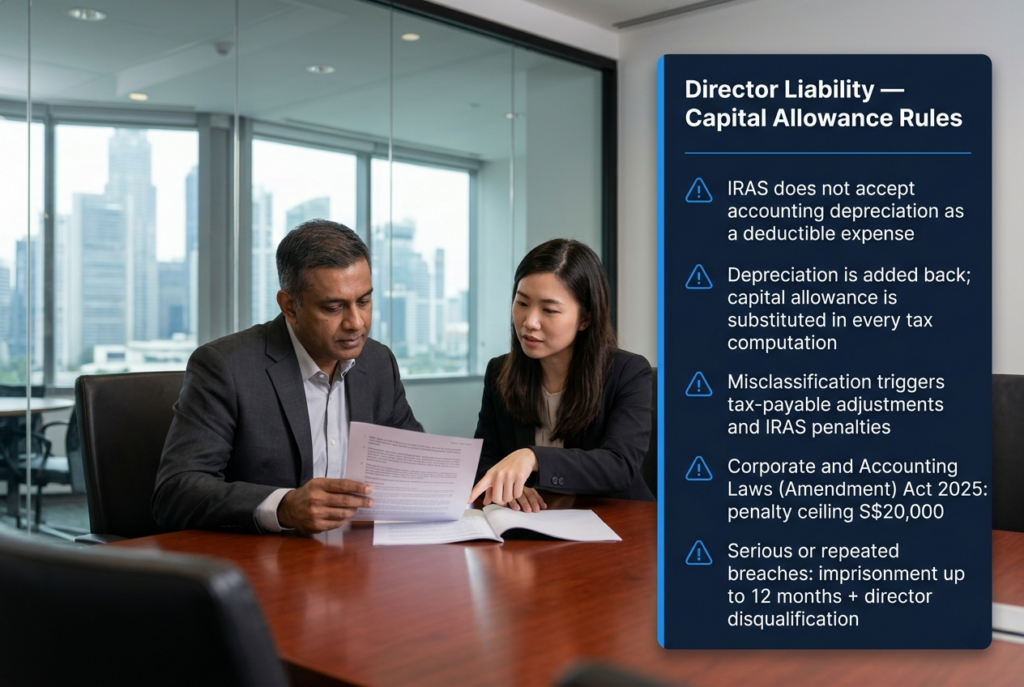
Directors carry personal responsibility for the accuracy of the tax computation. Signing off on a return that materially misstates capital allowance, whether through accidental misclassification or aggressive interpretation, can attract penalties to both the company and the individual. Under the Corporate and Accounting Laws (Amendment) Act 2025, the penalty ceiling is significantly higher, and serious breaches may now carry imprisonment of up to 12 months.
Maintaining a structured asset register is the most reliable defence. Every claim should be tied to its tax category under Sections 19, 19A(1), or 19A(2); its acquisition date and cost; its working-life schedule where relevant; and its disposal treatment if the asset is later sold. Where assets are sold for more than their tax written-down value, a balancing charge applies, restoring previously claimed capital allowance up to the original claim amount.
Planning Your Capital Allowance Position

Capital allowance planning rewards businesses that think a year or two ahead. Before approving a major asset purchase, it is worth modelling how the deduction interacts with expected chargeable income, existing carried-forward losses, and longer-term shareholder plans. The cheapest route on paper is not always the most valuable in cash terms.
JDT’s tax planning and optimisation team works with Singapore SMEs to map asset acquisitions against the most efficient capital allowance pathway. For companies building out their internal records, our financial reporting services maintain the asset registers and depreciation schedules needed to support every claim. If you are evaluating a larger capital investment programme, our business advisory for asset planning considers cash flow, tax, and financing together, so that the timing of each deduction supports the wider business plan.
Frequently Asked Questions
What is a capital allowance in Singapore?
Capital allowance is the tax deduction IRAS allows for the cost of qualifying fixed assets used in your trade. It replaces accounting depreciation for tax purposes and is governed by Sections 19 and 19A of the Income Tax Act 1947.
How does capital allowance differ from depreciation?
Depreciation is an accounting concept that spreads the asset cost over its useful life in your financial statements under SFRS. Capital allowance is a tax concept under IRAS rules. IRAS adds back depreciation in the tax computation and allows capital allowance instead. The two are computed on different bases and follow different schedules.
Can I claim 100% capital allowance in the first year?
Yes, but only for prescribed assets. Section 19A(2) permits a full one-year write-off for computers, prescribed automation equipment, generators, certain energy-efficient equipment, and low-value assets costing no more than $5,000 each (capped at $30,000 in aggregate per Year of Assessment).
What happens if I sell a fixed asset I have already claimed?
A balancing allowance or balancing charge arises. If sale proceeds are less than the tax written-down value, you may claim a further deduction for the shortfall. If proceeds exceed the written-down value, the excess is added back as taxable income, capped at the amount of capital allowance previously claimed.
Does my company need to claim capital allowance every year?
No. Capital allowance is a claim, not an automatic deduction. Companies may defer claims to a more advantageous year, subject to the shareholding test and, where applicable, the same-business test for loss utilisation. Deferred claims should be documented clearly in the tax computation to support future audits.
Are renovation costs eligible for capital allowance?
Most renovation and refurbishment costs are not eligible under Section 19 or 19A. They fall instead under Section 14N, which has its own eligibility rules, qualifying expenditure categories, and an expenditure cap reviewed by IRAS. Misclassifying renovation as plant and machinery is one of the most common SME filing errors.