
The Singapore transfer pricing rules apply to any company that transacts with a related party, and the S$10 million revenue threshold that triggers mandatory documentation obligations catches far more businesses than most SME owners realize. If your Singapore entity charges management fees to or from an overseas parent, extends an interest-free loan to a related company, or sells goods to a sister entity below market rate, the Inland Revenue Authority of Singapore has the authority to review, adjust, and surcharge those transactions. Understanding where you sit within the transfer pricing framework is not a matter reserved for multinationals. For family-owned business groups, subsidiaries of foreign parents, and companies scaling toward and beyond S$10 million in revenue, it is an active compliance obligation.
The Regulatory Framework: What IRAS Requires and Why
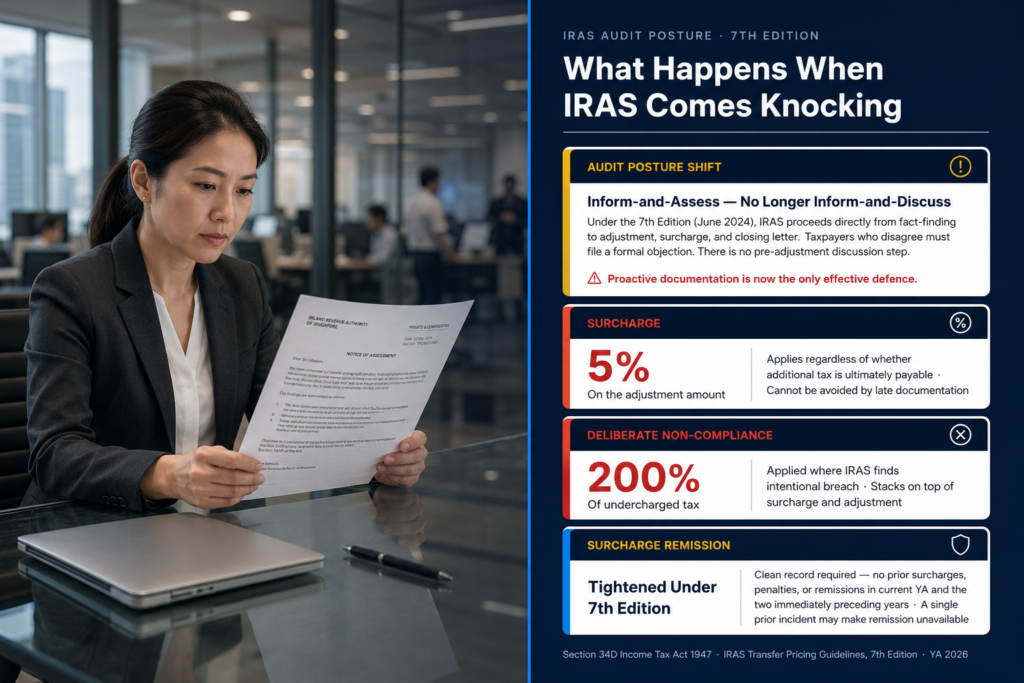
Singapore’s transfer pricing regime is anchored in Section 34D of the Income Tax Act 1947, which codifies the arm’s length principle as the standard that all related party transactions must meet. The arm’s length principle requires that the pricing of any transaction between related parties — whether for goods, services, loans, intellectual property licenses, or guarantees — must reflect what independent parties dealing at arm’s length would have agreed under comparable circumstances. Where a transaction deviates from this standard and results in understated profits or overstated losses for the Singapore entity, IRAS is empowered under Section 34D(1A) to make an upward transfer pricing adjustment, impose a 5% surcharge on the adjustment amount, and, where deliberate non-compliance is found, apply penalties of up to 200% on the undercharged tax.
The documentation requirements that sit alongside the arm’s length principle are governed by Section 34F of the Income Tax Act 1947 and the Income Tax (Transfer Pricing Documentation) Rules 2018, most recently updated by the 2024 Amendments, which took effect on 10 June 2024. Under Section 34F, a company is required to prepare contemporaneous transfer pricing documentation if its annual gross revenue from trade or business exceeds S$10 million, or if transfer pricing documentation was required in the immediately preceding period.
In June 2024, IRAS released the Seventh Edition of the Singapore Transfer Pricing Guidelines, the most significant update to the framework in nearly three years. Natalia Ong, Manager of Taxation at JDT, advises clients to pay close attention to two changes in particular: the increase in documentation exemption thresholds for certain transaction categories, and IRAS’s shift to a markedly more assertive audit posture. From Year of Assessment 2026 onwards, the exemption threshold for transaction categories, including services, movable property licenses, leases, guarantees and other transactions, was raised from S$1 million to S$2 million per category. This is a welcome reduction in compliance burden for companies with smaller related party transaction volumes. However, it is critical to understand that this exemption applies only to the obligation to prepare formal transfer pricing documentation — not to the underlying obligation to price transactions on an arm’s length basis. IRAS retains full authority to audit and adjust any related-party transaction that is not at arm’s length, regardless of whether documentation was required.
The 7th Edition also introduced a significant change to the audit process. Previously, IRAS would engage in an inform-and-discuss step before issuing a transfer pricing adjustment. Under the updated guidelines, IRAS now operates on an inform-and-assess basis: after the fact-finding exercise, IRAS will proceed directly to adjust, impose the surcharge, and issue a closing letter. Taxpayers who disagree must file a formal objection. This is a consequential shift that makes proactive compliance — and the maintenance of adequate supporting documentation — more important than ever.
The 5% surcharge applies regardless of whether additional tax is ultimately payable as a result of the adjustment. IRAS may remit the surcharge in whole or in part for good cause. Still, from the 7th Edition onwards the criteria for remission have tightened: a taxpayer must have no history of surcharges or penalties being imposed, compounded, or remitted in the current year of assessment and the two immediately preceding years. Companies with even a single prior compliance incident may find surcharge remission unavailable.
The S$10 Million Trap: Why Your Business May Already Be Caught
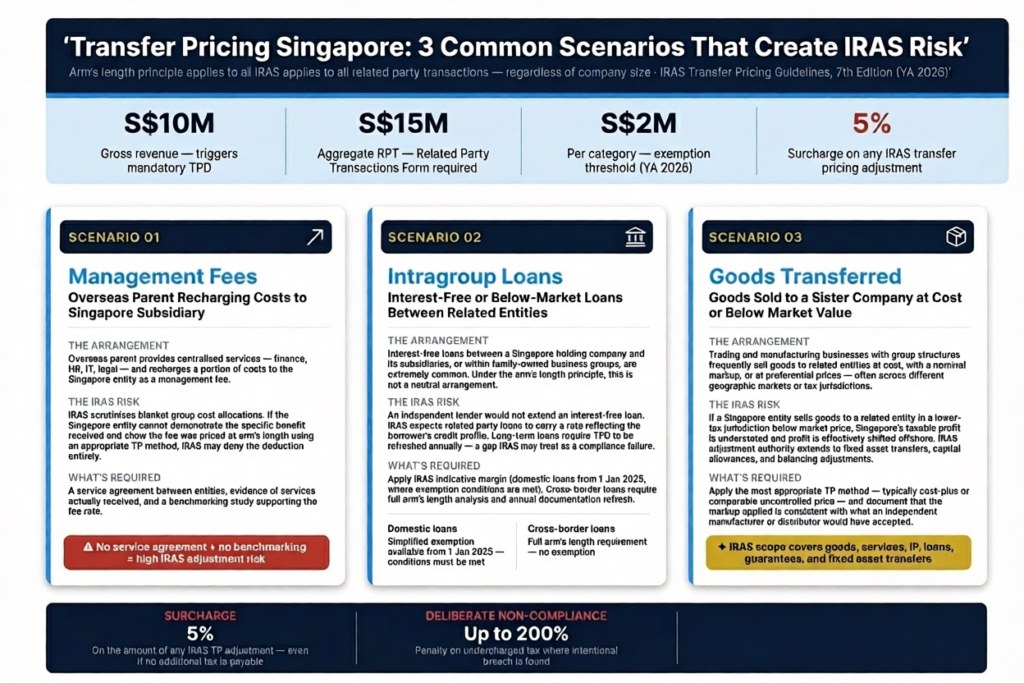
The S$10 million gross revenue threshold is the most commonly misunderstood element of Singapore’s transfer pricing framework. Many SME owners believe that because they have not reached that level of turnover, transfer pricing is not relevant to them. That assumption contains two significant blind spots.
First, the arm’s length principle applies to all related-party transactions, irrespective of revenue size. A company with S$3 million in annual revenue that charges a below-market management fee to its parent company overseas, or that receives an interest-free loan from a related entity, is still required to price those transactions on an arm’s length basis. If IRAS audits those transactions and finds them non-compliant, it has the authority to make adjustments and impose the 5% surcharge. The documentation exemption does not create a compliance exemption.
Second, the S$10 million threshold is measured against gross revenue from trade or business — not profit. For a trading company with high turnover and thin margins, or a distribution business with significant cost of goods sold, the S$10 million mark is reached sooner than many directors anticipate. Once that threshold is crossed in a given financial year, mandatory transfer pricing documentation must be prepared contemporaneously for that period. Contemporaneous means the documentation must be prepared before the due date for filing the corporate income tax return for that year of assessment — it cannot be reconstructed after the fact.
Three Common Scenarios Where Singapore SMEs Create Transfer Pricing Risk
The following situations arise regularly in JDT’s advisory practice, and each carries meaningful transfer pricing exposure if not structured and documented correctly.
Scenario 1: Management Fees Charged by an Overseas Parent to Its Singapore Subsidiary
This is one of the most prevalent transfer pricing arrangements in Singapore, particularly for foreign-owned companies with regional headquarters structures. The overseas parent provides centralized services — finance, HR, IT, legal — and recharges a portion of those costs to the Singapore entity as a management fee. The issue is not the arrangement itself but whether the fee reflects what an independent service provider would have charged for the same services under comparable conditions. Preston Jansz Charles, Director of Business Advisory at JDT, notes that a recurring problem is the blanket allocation of group costs without adequate evidence of the actual services received. IRAS treats these fees with particular scrutiny. If the Singapore entity cannot demonstrate the specific benefit it received from the services, and cannot show that the fee rate was determined on an arm’s length basis using an appropriate transfer pricing method, IRAS may deny the deduction entirely and apply the surcharge. A recent advisory engagement at JDT involved a subsidiary that had been accepting a management fee recharge from its parent for three years without any service agreement or benchmarking study in place. The process of retrospectively establishing an arm’s length position was considerably more complex and costly than proactive documentation would have been.
Scenario 2: Interest-Free or Below-Market Loans Between Related Entities
Interest-free loans between related parties are extremely common within family-owned business groups and between Singapore holding companies and their subsidiaries. Under the arm’s length principle, an interest-free loan is not a neutral arrangement — it represents a benefit that an independent lender would not have extended. IRAS expects related-party loans to bear an interest rate that reflects what an independent lender would have charged, given the borrower’s credit profile and the terms of the loan.
The 7th Edition of the IRAS Transfer Pricing Guidelines introduced a simplified framework for related party domestic loans entered into on or after 1 January 2025. Where neither the lender nor the borrower is in the business of borrowing and lending, and the IRAS indicative margin is applied, the loan is exempt from the transfer pricing documentation requirement. This is a meaningful simplification for intragroup treasury arrangements within Singapore. For cross-border related-party loans, however, the arm’s length requirement applies in full, and documentation must be prepared when the relevant thresholds are met.
Doreen Yip, Executive Director of Financial Outsourcing at JDT, advises clients to review the interest rates on all outstanding related-party loans annually. Long-term loans require TPD to be updated and refreshed each year — a requirement that the 7th Edition explicitly confirmed. A loan agreement set up years ago with an interest rate that was once at arm’s length may no longer be so, given changes in market conditions. Failing to refresh the analysis creates an undocumented gap that IRAS may treat as a compliance failure.
Scenario 3: Goods Sold to a Sister Company at Cost or Below Market Value
Trading and manufacturing businesses with group structures frequently sell goods between related entities at cost, with a nominal markup, or at preferential prices for commercial convenience. This is particularly common in family-owned business groups where related entities serve different geographic markets or distribution functions. From an IRAS perspective, a cost-plus pricing arrangement is only at arm’s length if the markup applied is consistent with what an independent manufacturer or distributor would have accepted from an unrelated buyer performing comparable functions.
The practical risk is straightforward: if the Singapore entity sells goods to a related entity in a lower-tax jurisdiction at below-market prices, Singapore’s taxable profit is understated, and the profit is effectively shifted offshore. IRAS has made it clear in the 7th Edition that it applies the arm’s length principle not only to standard transactions but also to the sale and transfer of fixed assets, with the authority to make adjustments through the calculation of capital allowances and balancing adjustments. The scope of IRAS’s adjustment authority is broader than many business owners appreciate.
What Contemporaneous Transfer Pricing Documentation Must Contain
Where a company is required to prepare transfer pricing documentation under Section 34F, that documentation must be prepared before the due date for filing the corporate income tax return for the relevant year of assessment. The documentation must cover each category of related party transaction and generally includes the following:
- A description of the group structure and the Singapore entity’s position within it
- An analysis of the controlled transaction, including the functions performed, assets used, and risks borne by each party
- Selection and application of the most appropriate transfer pricing method
- A benchmarking study comparing the controlled transaction to comparable transactions between independent parties
- A conclusion on whether the controlled transaction is at arm’s length
- For companies using the simplified TPD option, the date of preparation must be clearly documented to confirm that the documentation was not prepared with hindsight.
Wilson Yeoh, Director of Audit and Advisory at JDT, notes that the quality of the benchmarking analysis is where transfer pricing documentation most often falls short: “Many companies prepare documentation that describes the transaction well but does not adequately demonstrate comparability with independent market data. IRAS is not satisfied with a cursory benchmarking exercise. The analysis needs to be rigorous enough to withstand scrutiny in a formal audit, and for long-term arrangements, it needs to be refreshed annually.”
The Related Party Transactions Form: An Often-Overlooked Disclosure Requirement
Separate from the transfer pricing documentation requirement, companies with aggregated related-party transactions exceeding S$15 million in a financial year are required to complete the Related Party Transactions Form as part of their corporate income tax return. This form requires disclosure of the types and amounts of related party transactions undertaken during the year. Failing to complete this form accurately or omitting transactions that should be disclosed creates an audit risk that is entirely avoidable with proper accounting infrastructure.
At JDT, we guide SMEs through these requirements daily, ensuring compliance without unnecessary complexity. Setting up proper related party transaction accounting at the outset — with clearly documented intercompany agreements, agreed pricing policies, and regular benchmarking reviews — prevents the kind of costly remediation that arises when IRAS initiates an audit, and the evidence is incomplete.
Frequently Asked Questions About Transfer Pricing Singapore
- What is transfer pricing in Singapore?
Transfer pricing refers to the prices set for transactions between related parties — such as a parent company and its subsidiary, or two entities under common ownership. In Singapore, the Inland Revenue Authority of Singapore requires all such transactions to be priced on an arm’s length basis under Section 34D of the Income Tax Act 1947. This means the pricing must reflect what independent parties would have agreed under comparable conditions.
- Who is required to prepare transfer pricing documentation in Singapore?
Companies with annual gross revenue from trade or business exceeding S$10 million are required to prepare contemporaneous transfer pricing documentation under Section 34F of the Income Tax Act 1947. Documentation is also required where it was mandatory in the immediately preceding period. Smaller companies are exempt from formal documentation obligations but must still ensure that all related-party transactions are at arm’s length.
- What are the transfer pricing documentation exemption thresholds for YA 2026?
From Year of Assessment 2026 onwards, the exemption threshold for certain categories of related party transactions — including services, movable property licenses, leases, guarantees and other transactions — was raised from S$1 million to S$2 million per category. This means companies whose related party transactions in these categories fall below S$2 million per category are exempt from preparing formal TPD for those transactions. However, the arm’s length principle still applies.
- What is the penalty for non-compliant transfer pricing in Singapore?
Where IRAS makes a transfer pricing adjustment under Section 34D, a 5% surcharge is imposed on the amount of the adjustment. This surcharge applies even if no additional tax is payable after the adjustment. In cases of deliberate non-compliance, IRAS may also impose penalties of up to 200% on the undercharged tax. Surcharge remission may be available for taxpayers with a clean compliance record, but the criteria have tightened under the 7th Edition of the IRAS Transfer Pricing Guidelines.
- Does the arm’s length principle apply to interest-free loans between related parties?
Yes. An interest-free loan between related parties is not at arm’s length because an independent lender would require an appropriate return on the funds lent. For related party domestic loans entered into on or after 1 January 2025, a simplified exemption from TPD is available where neither party is in the business of borrowing and lending and the IRAS indicative margin is applied. Cross-border related-party loans are subject to the full arm’s-length requirement.
- What is the Related Party Transactions Form?
The Related Party Transactions Form is a disclosure form that forms part of the corporate income tax return for companies with aggregated related party transactions exceeding S$15 million in a financial year. It requires disclosure of the types and amounts of related party transactions. Failure to complete this form accurately is an independent compliance risk separate from the transfer pricing documentation requirement.
- What did the IRAS 7th Edition Transfer Pricing Guidelines change?
The 7th Edition, released in June 2024 and effective from YA 2026, introduced several key changes: the transaction category exemption threshold was raised from S$1 million to S$2 million; domestic related party loans meeting specific conditions entered into from 1 January 2025 are exempt from TPD requirements; IRAS shifted to a more assertive audit approach that no longer requires pre-adjustment discussion with the taxpayer; and the criteria for surcharge remission were tightened.
Addressing Transfer Pricing Before IRAS Does
Transfer pricing compliance in Singapore is not a one-time task. It is an ongoing discipline that requires documented intercompany agreements, annual benchmarking reviews, and timely preparation of contemporaneous documentation where the S$10 million gross revenue threshold is met. The businesses most exposed to IRAS scrutiny are not those with the most complex structures — they are the ones that have grown into related-party arrangements without ever putting a compliance framework in place.
If your business has related party transactions in place — whether management fees, intragroup loans, or goods transferred between related entities — and those arrangements have not been reviewed against the arm’s length standard under the 7th Edition guidelines, now is the right time to address them. Our transfer pricing advisory services are designed to help SMEs and growing businesses establish defensible pricing policies, prepare contemporaneous documentation, and maintain compliance as their structures evolve. For businesses that need to review how related-party transactions flow through their accounts, our related-party transaction accounting service provides the financial process infrastructure that underpins a sound TP position. For companies considering restructuring group arrangements for operational or tax efficiency reasons, our corporate structuring advisory team can model the implications across entities before any changes are made.