


What Is IRAS GST ASK? A Guide for Singapore Businesses

The GST ASK (Assisted Self-Help Kit) is a free self-assessment tool from IRAS that helps Singapore businesses check the accuracy of their GST returns and uncover errors before an audit does. Introduced in April 2010, ASK provides a structured framework for reviewing GST processes, pre-filing checks, and annual compliance, giving SME owners a practical way to stay on the right side of IRAS without needing a full-time tax team. 

Why GST Compliance Is More Demanding Than Most SME Owners Expect


Singapore business owner reviewing GST ASK compliance checklist

Singapore’s GST regime operates on a self-assessment basis. Once your business is registered, mandatory when taxable turnover exceeds S$1 million over any rolling 12-month period, IRAS expects accurate quarterly returns filed via the myTax Portal, supported by proper documentation and correct tax treatment across every transaction. The current GST rate is 9%, effective from 1 January 2024.

The compliance consequences are specific and immediate. A GST F5 return that is not filed by its due date triggers a $200 late submission penalty, with a further $200 for every complete month it remains outstanding, capped at $10,000 per return. Late payment attracts a separate 5% penalty on the tax owed, and if the amount remains unpaid after 60 days, an additional 2% per month can be imposed. These are not theoretical figures. In FY2023/2024, IRAS completed over 2,500 GST audits across various industries, recovering $162 million in tax and penalties.

Many of these audits surface errors that are not deliberate; they stem from misclassified supplies, incorrect input tax claims, or reporting that does not reconcile with source documents. A standard-rated supply was mistakenly treated as zero-rated. An input tax claim on an expense that should have been apportioned. A failure to apply the reverse charge mechanism on imported services. Each of these creates a tax shortfall that only becomes visible when IRAS reviews the return.

This is the compliance gap ASK was designed to close. As Joe Tan, ATA (GST), at JDT, explains: “Most GST errors we see are process failures, not knowledge failures. The business owner understands what GST is. The problem is that their systems, the way transactions are recorded, coded, and reported, are not set up to capture the right treatment consistently. ASK gives you a structured way to test that.”

At JDT, our tax professionals are accredited with the Singapore Chartered Tax Professionals (SCTP) as Accredited Tax Advisors (GST), qualified to perform and certify the ASK Annual Review. We guide GST-registered businesses through the self-assessment process daily, ensuring compliance is maintained without unnecessary complexity.

How GST ASK Works: The Three Sections

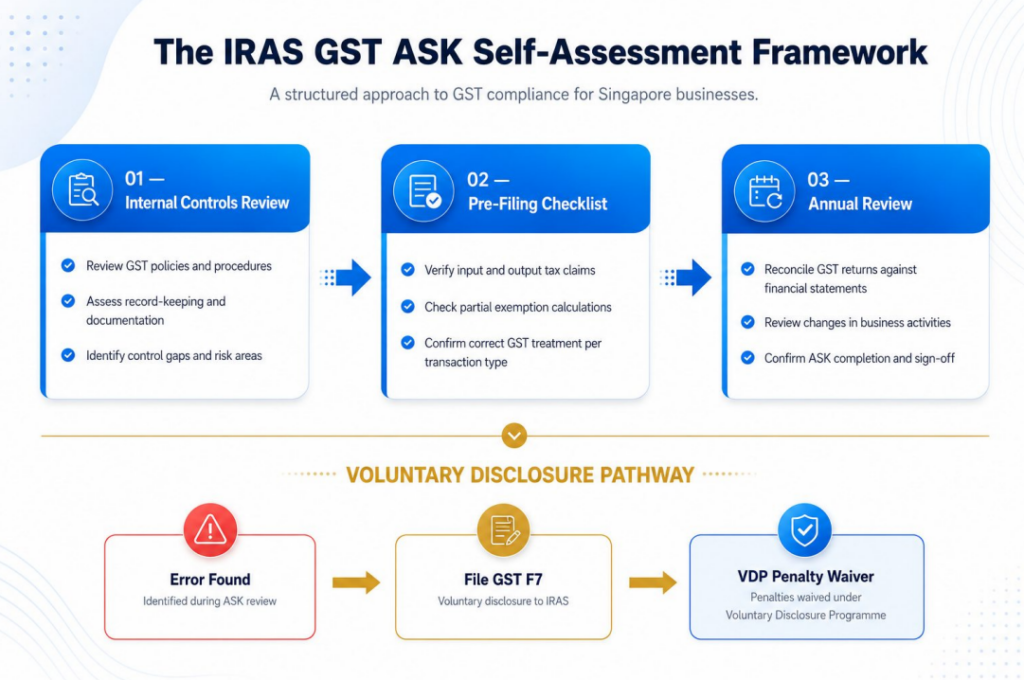
RAS GST ASK self-assessment framework and the voluntary disclosure pathway.

IRAS GST ASK self-assessment framework and the voluntary disclosure pathway.

ASK is structured into three sections. Each addresses a different stage of the compliance lifecycle, and businesses can adopt them individually or as a complete framework.

IRAS GST ASK self-assessment framework and the voluntary disclosure pathway.

ASK is structured into three sections. Each addresses a different stage of the compliance lifecycle, and businesses can adopt them individually or as a complete framework.

Section 1: Internal Controls Review

This section examines whether your business has the right processes in place to handle GST correctly from the point of transaction. It covers how your accounting software applies tax codes, whether staff understand the distinction between standard-rated, zero-rated, and exempt supplies, and whether supporting documents, tax invoices, import permits, and contracts are properly maintained. For newly registered businesses, this is where the most foundational errors are caught: a default tax code set to the old 8% rate, a missing GST registration number on invoices, or a failure to account for GST on intercompany charges.

Section 2: Pre-Filing Checklist

Designed to be completed before each quarterly GST F5 submission, this section is a structured quality check. It walks you through a series of yes/no questions to verify that all taxable supplies have been captured, input tax claims are supported by valid documentation, adjustments for private or exempt use have been made, and the figures in your return reconcile with your accounting records. Think of it as a pre-flight checklist for your F5 return, a simple discipline that can prevent costly errors from being submitted to IRAS.

Section 3: Annual Review

The Annual Review is the most substantive component. It involves a post-submission review of your GST declarations for the preceding financial year, using IRAS’s prescribed methodology. The review includes both process-level checks and transaction-level testing, sampling individual invoices and import documents to verify that the GST treatment applied matches the underlying transaction.

The Annual Review can be conducted by the business itself, but must be certified by a SCTP-accredited ATA (GST) or ATP (GST). Alternatively, the entire review can be performed by an external accredited professional. Upon completion, a Declaration Form is submitted to IRAS, even if no errors are found, to demonstrate the business’s commitment to compliance.

When You Should Be Using GST ASK

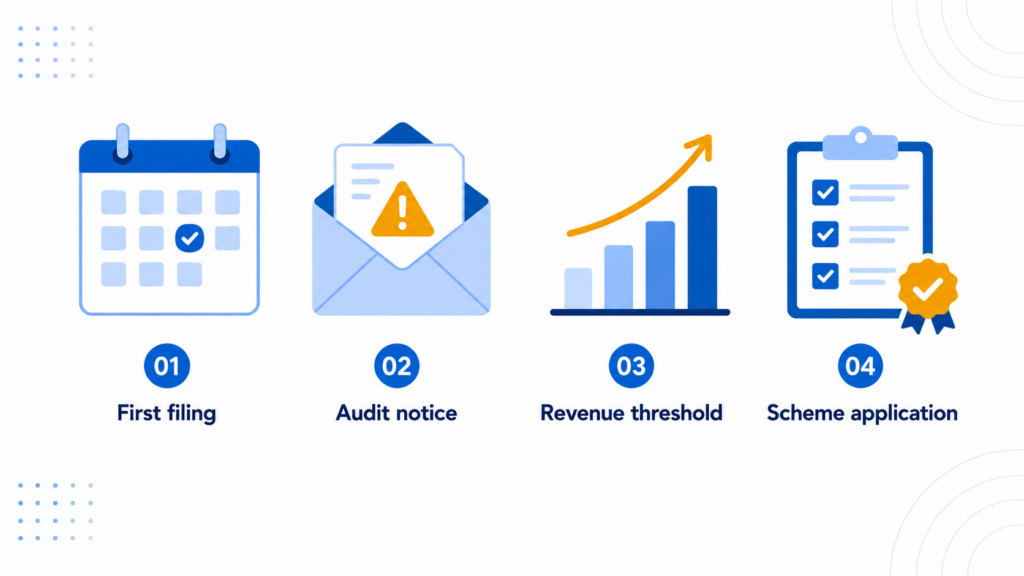
Four situations when Singapore businesses should use the GST ASK compliance tool.

ASK is voluntary for most GST-registered businesses. But there are specific moments where it becomes either highly advisable or compulsory.

Filing your first GST return. The transition from non-registered to GST-registered is where the most errors occur. Your accounting processes, invoicing templates, and financial reporting all need to be reconfigured. The Section 1 diagnostic and Section 2 checklist are particularly valuable at this stage. One JDT client, a technology consultancy that crossed the S$1 million threshold mid-year, discovered during their Section 1 review that several recurring invoice templates were still applying the old 8% GST rate. Without the review, this error would have compounded across four quarterly returns before detection.

Receiving an IRAS audit notice. Conducting an ASK Annual Review before the audit commences does not undo the audit, but it allows you to identify and voluntarily disclose errors through IRAS’s Voluntary Disclosure Programme (VDP). Under the VDP, errors disclosed within one year of the statutory filing date of your last GST return for the reviewed financial year attract zero late payment penalty. Disclosures after one year still qualify for a reduced penalty of 5% of the tax undercharged, significantly lower than penalties imposed when errors are discovered during an IRAS-initiated audit.

Revenue growth crossing the S$1 million mark. Businesses that approach or cross the threshold must register within 30 days. Late registration can result in IRAS backdating your registration and requiring you to pay output tax on past sales from your own margin, even if you never collected it from customers. ASK’s Section 1 review helps establish correct GST infrastructure from day one.

Applying for or renewing GST schemes. For businesses on the Major Exporter Scheme (MES), Import GST Deferment Scheme (IGDS), Approved Contract Manufacturer and Trader (ACMT) Scheme, or other IRAS-approved schemes, completing the ASK Annual Review is compulsory. The review must be performed or certified by a SCTP-accredited professional, and the Declaration Form must be submitted with the application. IRAS will not process the application without it.


Four situations when Singapore businesses should use the GST ASK compliance tool.

GST ASK vs Professional Tax Advisory: What Each Costs

A common question: does ASK replace the need for a tax agent? The short answer is no, but it changes the equation. ASK provides the framework and methodology for self-assessment. It does not interpret complex GST treatments, advise on scheme eligibility, or handle IRAS correspondence on your behalf.

ApproachTypical Annual CostBest Suited For
GST ASK (self-managed)No direct cost (internal time only)Simple domestic businesses, newly registered entities
ASK + periodic professional reviewS$1,500–S$3,000Growing SMEs approaching complexity thresholds
Full-service GST advisory retainerS$3,000–S$8,000+International operations, GST scheme holders, high-volume traders

As Doreen Yip, Executive Director of Financial Outsourcing at JDT, notes: “We recommend ASK as a starting point for newly registered businesses, it builds internal understanding of how GST flows through your operations. But as your transaction volume grows and you begin dealing with cross-border supplies, reverse charges, or scheme-specific reporting, the risk of self-managed compliance increases. At that point, professional oversight is not a cost; it is a safeguard.

The InvoiceNow Factor

From April 2026, all new voluntary GST registrants must use InvoiceNow-compliant software to transmit invoice data to IRAS via the Peppol network. This requirement is being extended progressively to all GST-registered businesses. The shift to structured digital invoicing has a direct impact on ASK: businesses that adopt InvoiceNow-ready software will find the Section 2 pre-filing checklist and Section 3 Annual Review significantly easier to complete, as the data needed for self-assessment will already be in a structured, accessible format. If you are considering voluntary GST registration, confirm that your accounting software is InvoiceNow-certified before applying.

Next Steps: Getting Your GST Compliance Right

JDT taxation team SCTP-accredited GST ASK professionals in Singapore.


Getting GST right is not just about avoiding penalties; it is about building the compliance infrastructure that supports your business as it scales. Whether you are preparing your first F5 return, evaluating whether your current GST processes are fit for purpose, or need to complete an Annual Review for a scheme application, having the right framework matters.

JDT’s SCTP-accredited taxation team provides GST ASK services in Singapore, including certified Annual Reviews and voluntary disclosure support. For businesses that need broader corporate tax compliance guidance, from quarterly filings to tax planning, our team works alongside your operations to keep your GST position clean and audit-ready.

If you are newly registered and need accounting support for SMEs that integrates GST compliance into your day-to-day financial processes, our team can help you establish the right infrastructure from the outset, so your first return is filed correctly. Every return after that follows the same standard.

Frequently Asked Questions About GST ASK

Is GST ASK mandatory?

ASK is voluntary for most GST-registered businesses. It becomes compulsory when you apply for, or renew, certain IRAS-approved GST schemes. The two most common are:

  • Major Exporter Scheme (MES): Under MES, GST on non-dutiable goods is suspended at the point of import, and also when the goods are removed from Zero GST warehouses. This eases the cash-flow burden for businesses that import substantially for re-export.
  • Import GST Deferment Scheme (IGDS): Under IGDS, approved GST-registered businesses pay import GST when their monthly GST returns are due, instead of at the point of importation.

The Approved Contract Manufacturer and Trader (ACMT) Scheme carries the same requirement. For any of these schemes, the ASK Annual Review must be certified by a SCTP-accredited professional, and IRAS will not process the application without it.

What are the three sections of ASK?

Section 1 reviews internal controls and GST processes. Section 2 is a pre-filing checklist used before each quarterly F5 return. Section 3 is an annual post-submission review of GST declarations.

Who can perform the ASK Annual Review?

The review can be conducted by the business itself, but must be certified by an SCTP-accredited Accredited Tax Advisor (GST) or Accredited Tax Practitioner (GST). Alternatively, an external accredited professional can perform the entire review.

What happens if I find errors during the review?

Correct the errors and file a GST F7 for the affected periods. Errors disclosed voluntarily through ASK qualify for IRAS’s Voluntary Disclosure Programme. Within one year, the 5% late payment penalty is fully waived. After one year, a reduced 5% penalty on the undercharged tax applies.

How much does GST ASK cost?

The ASK toolkit is free from IRAS. If you engage an external accredited professional for the Annual Review, fees typically range from S$1,500 to S$3,000, depending on business complexity.

Does completing ASK prevent an IRAS audit?

No. IRAS retains the right to audit any GST-registered business. However, regular ASK Annual Reviews with clean Declaration Forms demonstrate a compliance track record that is positive within IRAS’s risk assessment framework.

Leave a Reply

Your email address will not be published. Required fields are marked *

准备好提升您的业务运营了吗?

立即联系 JDT Management Services!我们敬业的专业团队深耕行业多年,为您量身定制专属解决方案,助您实现业务目标。

Ready to elevate your business?

Get in touch with JDT Management Services today! Our dedicated team of professionals is ready to discuss how we can support your business goals with customized solutions.