In Singapore, an audit is more than a regulatory requirement. It is a signal of financial credibility, governance discipline, and long-term sustainability. For SMEs, growth-stage companies, and foreign-owned businesses, understanding when and why an audit is required, and what it actually achieves, is critical.
After working with Singapore companies across industries for decades, one pattern is clear: audits rarely become a problem on their own. They become a problem when businesses underestimate their importance, misunderstand the requirements, or treat them as a last-minute formality.
This article explains audit services: the role of audits in Singapore, what companies are required to comply with under ACRA regulations, how audits support business credibility, and why engaging the right audit firm matters.
Understanding the Types of Audit Required in Singapore
In Singapore, audits generally fall into several categories, each serving a different purpose.
The most common is the statutory audit, required under the Companies Act for companies that do not qualify for audit exemption. This audit focuses on whether financial statements present a true and fair view in accordance with Singapore Financial Reporting Standards.
Other types of audits include:
- Internal audits, often adopted by larger SMEs to strengthen controls and governance
- Special purpose audits, such as grant audits or compliance audits
- Investor-required audits, commonly requested by shareholders, lenders, or potential buyers
Each type of audit serves a different stakeholder, but all share a common objective: independent assurance over financial information.
Why Audit Improves Financial Credibility for SMEs and Investors
For SMEs, an audit is not just about compliance. It directly impacts how the business is perceived.
Audited financial statements:
- Build trust with banks and financial institutions
- Support financing and credit applications
- Improve confidence among investors and shareholders
- Strengthen business valuations during fundraising or exit discussions
Many directors only appreciate the value of an audit when it is requested by an external party. At that point, timelines are tight and risks are higher. Proactive audit planning avoids this pressure and positions the business as credible and well-governed.
ACRA Audit Requirements — What Every Company Must Know
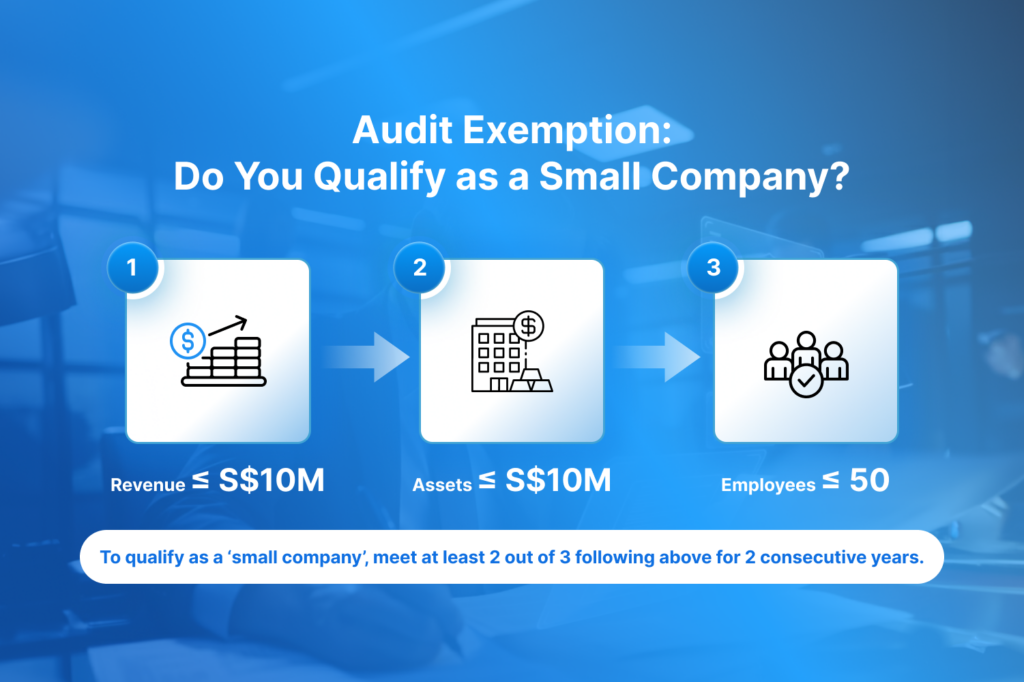
Under Singapore law, companies are required to have their accounts audited unless they qualify for audit exemption.
To qualify as a small company, a private company must meet at least two of the following three criteria for the past two financial years:
- Total revenue not more than S$10 million
- Total assets not more than S$10 million
- Number of employees not more than 50
For groups, both the holding company and the group must meet the small company criteria to qualify for exemption.
In addition to thresholds, companies must also meet:
- Proper documentation standards
- Timely preparation of financial statements
- Statutory filing deadlines with ACRA
Failure to comply can result in penalties, regulatory scrutiny, and director accountability.
Related Insight: Auditing Services and Regulatory Rules
Audit Exemption in Singapore: Who Qualifies and Who Does Not
Audit exemption is often misunderstood. Qualifying today does not guarantee qualification in future years.
Common misconceptions include:
- Assuming newly incorporated companies are automatically exempt
- Ignoring group-level thresholds
- Failing to monitor growth that breaches audit exemption criteria
Once exemption is lost, an audit becomes mandatory. Retrospective audits are costly and disruptive. Regular review of exemption status is essential, particularly for fast-growing SMEs and foreign-owned companies.
How an Audit Helps SMEs, Startups, and Foreign Companies Grow Safely
Beyond compliance, audits provide meaningful business insight.
A properly conducted audit helps to:
- Detect weaknesses in internal controls
- Reduce fraud and financial misstatements
- Improve accuracy of financial reporting
- Strengthen governance and accountability
As Wilson Yeoh, Director of Audit and Advisory at JDT, often highlights, audits are not designed to catch businesses out. They are meant to provide assurance and highlight areas where systems and controls can be strengthened before issues escalate.
For foreign-owned companies, audits also provide comfort to overseas shareholders who rely on independently verified financial information.
See Our Guide On: Choosing the Right Company Auditor
Common Audit-Related Issues Businesses Face
Many audit challenges stem from preparation, not complexity.
Typical issues include:
- Poor accounting records or late closing of accounts
- Inadequate documentation for key balances
- Weak internal controls in owner-managed businesses
- Misalignment between management expectations and audit scope
As Alexander Tan, Audit Partner at JDT, often observes, “most audit delays and issues arise because businesses are not audit-ready. When records are properly maintained throughout the year, the audit process becomes significantly smoother and more efficient.”

Why Work With JDT for Reliable Audit Services in Singapore
Choosing the right audit firm is critical. Audits require technical expertise, regulatory familiarity, and practical judgement, particularly for SMEs and foreign-owned companies.
Businesses work with JDT because of:
- Over 20 years of experience in Singapore audit and compliance
- Strong focus on SMEs, startups, and foreign-owned entities
- Clear communication and practical guidance
- Deep familiarity with ACRA requirements and expectations
- A risk-aware, compliance-first approach
Audit findings can also have implications for director accountability, including the responsibilities of nominee directors, particularly in foreign-owned companies. In this context, JDT’s audit services are designed not only to meet statutory requirements, but also to support financial clarity and long-term stability.
Know More: Role of Auditing in Compliance
Get a Professional Audit Consultation from JDT
If you are unsure whether your company requires an audit, qualifies for exemption, or is adequately prepared, an early discussion can prevent costly delays and compliance issues.
Learn more about audit services Singapore and speak with an audit specialist to:
- Clarify your audit obligations
- Review your exemption status
- Assess audit readiness before statutory deadlines
Early planning reduces risk and ensures compliance, especially as your business grows. Combining audit supports with accounting services and advisory services can also help strengthen your companies internal controls and prepare for its future expansion. When you’re ready to take the next step, get an audit consultation with our team today.