
Singapore’s reputation as a trusted financial and corporate jurisdiction is not accidental. It is held up by a regulatory framework that is clear, enforced, and internationally credible — and by an audit profession that sits quietly at the centre of it. For companies operating in Singapore, particularly SMEs and foreign-owned entities, understanding how auditing services plug into this framework is not just a matter of technical interest. It determines how the company interacts with ACRA, IRAS, banks and other regulators over time.
This article examines the specific role auditing services play in upholding compliance within Singapore’s regulatory architecture, and what that means in practical terms for directors and finance teams.
Understanding Singapore's Regulatory Framework for Businesses
Key Regulatory Bodies: ACRA, IRAS, and MAS
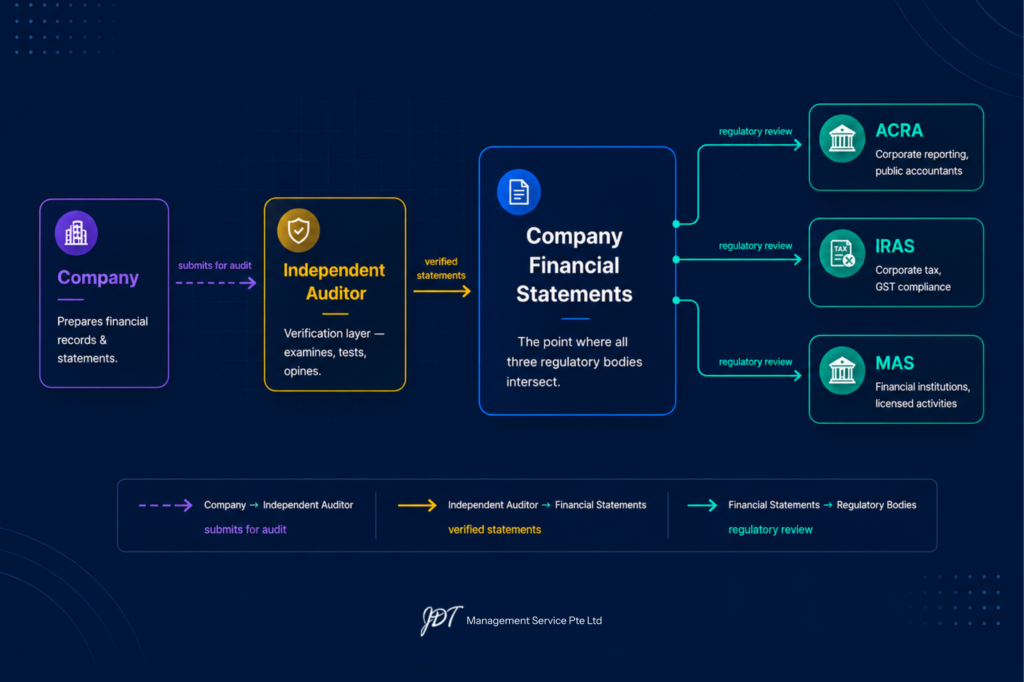
Three regulators dominate the compliance landscape for most Singapore companies. ACRA, the Accounting and Corporate Regulatory Authority, oversees company incorporation, corporate reporting and the regulation of public accountants. IRAS, the Inland Revenue Authority of Singapore, administers corporate tax, GST and related tax matters. MAS, the Monetary Authority of Singapore, regulates financial institutions and licensed financial activities. Each has distinct remit, but their expectations intersect at the company’s financial statements and supporting records.
For regulated entities, additional bodies may be involved. Listed companies are subject to SGX rules. Firms with specific licences face sector-specific regulators. Across all of them, the audited financial statements remain a central reference point.
Where Auditing Fits Within the Compliance Ecosystem
The Companies Act places primary responsibility for financial statements on directors. The audit is the independent check that those statements are prepared in accordance with SFRS and give a true and fair view. Without a robust audit, the entire downstream compliance chain — tax filings, regulatory returns, stakeholder disclosures — rests on unverified figures. With a robust audit, those filings carry far more weight, and the company’s overall regulatory exposure is materially reduced.
How Auditing Services Ensure Regulatory Compliance
Financial Statement Accuracy and SFRS Alignment
Auditors test whether the company’s accounting policies align with SFRS, whether those policies have been consistently applied, and whether significant judgements — revenue recognition, asset impairment, provisions, deferred tax — are supportable. Where management has used estimates, the auditor assesses whether the methodology and inputs are reasonable. This process ensures that the accounts filed with ACRA and relied on by IRAS are not merely internally consistent but aligned with the standards Singapore’s regulatory framework actually requires.
Detection of Material Misstatements and Fraud
Auditors are required to design procedures that provide reasonable assurance of detecting material misstatements, whether caused by error or fraud. This does not make an audit a forensic investigation, but it does require the auditor to understand the business, identify risk areas, test controls, perform substantive testing and exercise professional scepticism. Where fraud or serious non-compliance with laws or regulations is suspected, auditors have specific reporting obligations that extend beyond the client itself.
Independent Verification for Stakeholder Assurance
The independent audit opinion is what allows external stakeholders to rely on the accounts without conducting their own verification. Banks extending credit, investors performing due diligence, counterparties entering material contracts — all benefit from this independent layer of assurance. The regulatory framework is designed around that assurance, and its absence in cases of audit exemption is one reason lenders and investors still often ask exempt companies for audited accounts.
The Statutory Audit Process in Singapore
Planning and Risk Assessment
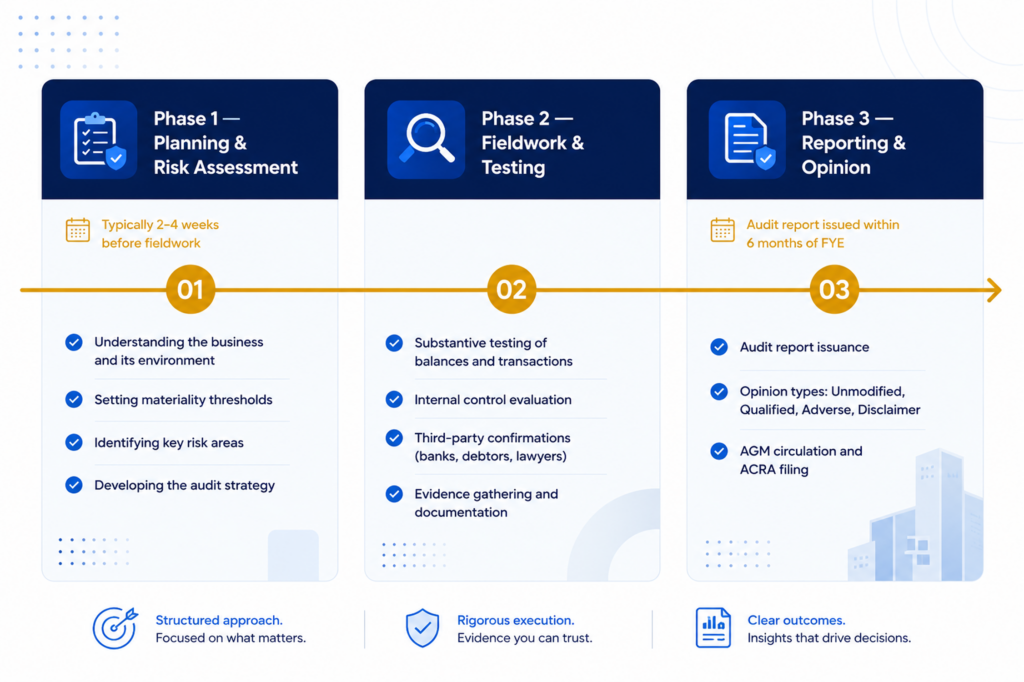
A statutory audit begins with engagement acceptance and planning. The auditor develops an understanding of the business, the industry, the internal control environment, and the areas most likely to give rise to material misstatement. Materiality is set, the audit strategy is developed, and a testing plan is designed. Proper planning is what distinguishes an audit that adds value from one that merely ticks boxes.
Fieldwork, Testing, and Evidence Gathering
During fieldwork, auditors perform substantive testing of balances and transactions, evaluate the design and operating effectiveness of controls where relevant, and gather audit evidence to support their conclusions. This includes confirmations with third parties (banks, customers, suppliers), inspection of documentation, recalculations, analytical procedures, and enquiries of management and staff.
Reporting and Auditor's Opinion
The engagement concludes with the issuance of the audit report, which is circulated to shareholders and filed with the financial statements. An unmodified (clean) opinion indicates that the accounts give a true and fair view. A qualified opinion, adverse opinion or disclaimer indicates specific or pervasive issues. Each variant has implications for how the company is perceived by regulators and stakeholders.
Consequences of Non-Compliance with Audit Requirements
ACRA Penalties and Director Liability
Failing to appoint an auditor where required, filing unaudited accounts in breach of the Companies Act, or persistently delaying annual filings can result in composition fines and further enforcement action. Directors are personally accountable for these breaches, and repeated non-compliance can lead to disqualification. These consequences extend beyond the company’s balance sheet into the personal records of its officers.
Impact on Investor and Lender Confidence
Banks, investors and potential acquirers treat audit issues as leading indicators of deeper governance problems. A qualified audit opinion, a delayed audit, or an unexplained change of auditor will almost always prompt additional scrutiny. In competitive financing or M&A situations, these signals can materially affect pricing or kill a deal entirely.
Preston Jansz Charles, Director of Business Advisory at JDT, puts it plainly: “When we review a target company for a client, the first thing we look at is the audit history. Not just the opinion, but the timeliness, the consistency of the auditor, and how management handled prior findings. Those details tell you more about a business than any pitch deck.”
How SMEs Can Stay Audit-Ready Year-Round
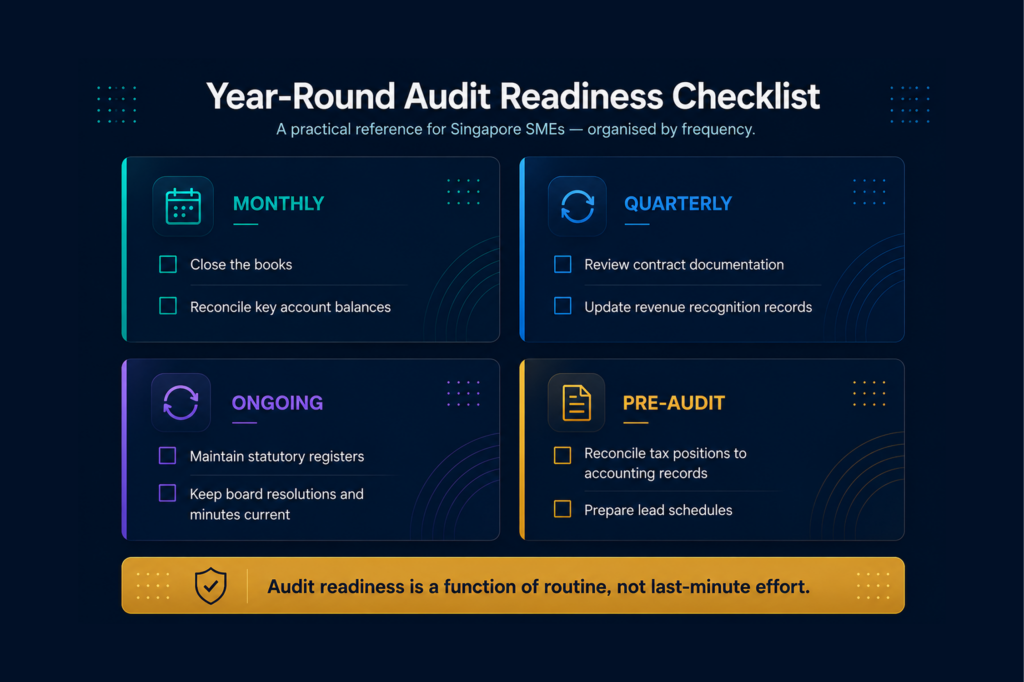
Audit readiness is a function of routine, not last-minute effort. SMEs that close their books monthly, reconcile key balances regularly, maintain proper contract and revenue documentation, keep board resolutions and statutory registers current, and reconcile their tax positions to their accounting records tend to experience audits as a structured review rather than a disruptive event.
Doreen Yip, Executive Director of Financial Outsourcing & Business Advisory at JDT, often summarises the principle for SME clients: “The audit you want is the one that confirms what you already know about your numbers. Getting there is less about the audit itself and more about how the finance function is run for the other eleven months of the year.”
Why Choose JDT for Auditing Services in Singapore
JDT’s audit services Singapore are built around the realities of SMEs, foreign-owned companies and corporate groups operating within Singapore’s regulatory framework. Our audit work is coordinated with our tax compliance services so that audit findings and tax positions are considered together, not in isolation. This matters particularly in areas where the accounting treatment and tax treatment diverge — deferred tax, provisions, related-party transactions and revenue recognition among them.
For readers seeking further context, our articles on the importance of auditing services and choosing a company auditor provide complementary perspectives on how auditing fits within a wider compliance strategy.
Frequently Asked Questions About Auditing and Regulatory Compliance
Does every Singapore company need a statutory audit?
No. Companies that meet the small company audit exemption criteria under the Companies Act are exempt. All other Singapore-incorporated companies must have their financial statements audited annually by an ACRA-registered public accountant.
How does an audit affect my corporate tax filing?
Audited financial statements strengthen the accuracy and defensibility of the tax position filed with IRAS. While not always mandatory for submission, audited accounts reduce the likelihood of IRAS queries escalating and support a smoother tax compliance cycle.
What is the deadline for completing the statutory audit?
Private companies must hold an AGM within six months after the financial year-end and file the annual return within seven months. The audit must be completed in time to meet these deadlines, which usually means fieldwork starts several months before the AGM.
What happens if the auditor identifies non-compliance with laws or regulations?
Auditors have specific reporting obligations under professional standards and the Companies Act. Depending on the nature and materiality of the non-compliance, this may involve reporting to those charged with governance, modifying the audit opinion, or, in serious cases, reporting to the relevant authorities.
Can JDT act as both auditor and tax agent for the same company?
Independence rules restrict certain combinations of services with the same client. JDT’s teams are structured to comply with these requirements, and we will advise on the appropriate engagement model during the initial consultation.
A credible audit is one of the most efficient investments a Singapore company can make in its own regulatory standing. If you would like to review your current audit readiness, discuss a change of auditor, or get an audit consultation ahead of your next financial year-end, JDT’s audit team is available for a confidential initial discussion. Early conversations lead to better-planned audits — and far fewer surprises when the fieldwork begins.