Choosing a company auditor is one of the more consequential governance decisions a Singapore business will make — and one of the most underestimated. The auditor signs off on the numbers that ACRA sees, that IRAS relies on, that banks lend against, and that investors assess. The right auditor strengthens the company’s credibility and internal discipline. The wrong one creates friction, risk and, in some cases, remediation work that outlasts the engagement itself.
For SME owners, foreign-owned companies and founders approaching their first statutory audit, the challenge is knowing what to look for. Audit is a specialised field, and not every public accountant is the right fit for every business.
What Does a Company Auditor Do?
Statutory Duties Under the Companies Act
A company auditor in Singapore is a public accountant registered with ACRA, appointed by the shareholders to examine the financial statements prepared by the directors. Their statutory duty is to form an independent opinion on whether those financial statements give a true and fair view of the company’s financial position and performance in accordance with the Singapore Financial Reporting Standards and the Companies Act.
The auditor’s work is independent of management. They are not the company’s advocate, and they are not there to prepare the accounts. This independence is what gives the audit opinion its value to shareholders, regulators and external stakeholders.
The Auditor's Reporting Obligations
Auditors issue an audit report addressed to the members of the company, stating their opinion on the financial statements. Where material issues are identified that management has not resolved, auditors may issue a qualified opinion, a disclaimer, or an adverse opinion. In specific cases, auditors are also required to report matters to the relevant authorities, particularly where fraud or serious non-compliance with laws or regulations is suspected.
Why Choosing the Right Company Auditor Matters
The audit engagement typically lasts several years. Switching auditors mid-engagement is possible but costly in time and information handover, and frequent changes can raise questions from stakeholders. Selecting the right auditor from the start saves the company from inheriting a poor audit file, inconsistent judgements across years, or a relationship that does not scale as the business grows.
A good auditor will also challenge the company’s accounting policies where necessary. That friction is constructive — it strengthens the accounts and, by extension, the company’s credibility with ACRA, IRAS, lenders and investors.
Key Factors to Consider When Selecting a Company Auditor
ACRA Registration and Professional Standing
Only a public accountant registered with ACRA can sign an audit report in Singapore. Confirming the registration status of the partner who will sign off on the audit — not just the firm — is a basic but essential first step. Beyond registration, professional standing matters: membership of ISCA, participation in peer review programmes, and a clean record with regulators are all relevant indicators of quality.
Industry Experience and SME Focus
An auditor with genuine experience in the client’s industry can navigate the specific accounting judgements that apply — revenue recognition for software and subscription businesses, inventory valuation for trading companies, project accounting for construction and engineering firms, and so on. SMEs in particular benefit from auditors who understand the realities of smaller finance teams: limited segregation of duties, owner-manager dynamics and lean record-keeping.
Transparent and Predictable Fee Structure
Fees should reflect the scope and complexity of the engagement, and should be presented clearly at the outset. Unusually low quotations are often a warning sign: they can lead to rushed fieldwork, inadequate testing, or a scope that quietly excludes areas where issues are most likely to arise. A reputable auditor will explain their fee basis, the scope covered, and the circumstances under which additional fees may apply.
Responsiveness, Communication, and Accessibility
Audit season is demanding. Responsive communication — from the engagement partner, the manager, and the field team — is critical. Founders and finance teams should assess how the auditor responds to enquiries during the proposal stage; that behaviour typically predicts how they will perform during fieldwork.
Capacity to Handle Your Company's Complexity
A company with foreign subsidiaries, complex share structures, cross-border transactions or regulated activities needs an auditor who can handle that complexity credibly. Conversely, a small domestic company does not need to pay for capabilities it will never use. Matching the auditor’s capacity to the company’s actual profile is often more important than choosing the largest available firm.
Red Flags to Watch for When Engaging an Auditor
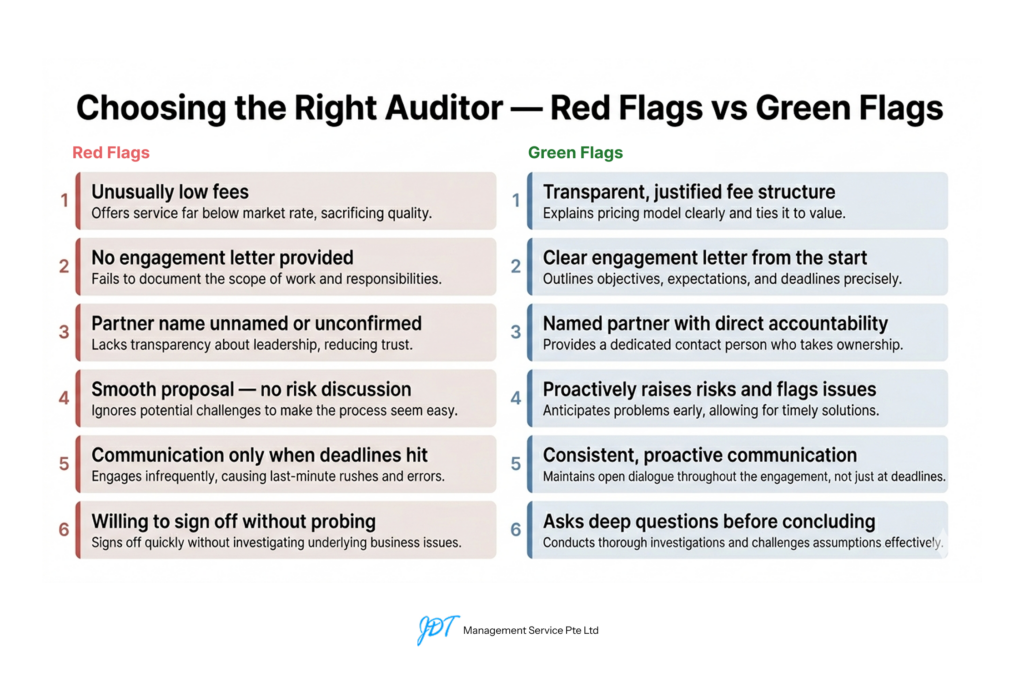
Several warning signs should prompt a second look. These include fees that are significantly below market without a clear explanation; reluctance to commit to a clear engagement letter and scope; lack of a named engagement partner accountable for the audit; limited communication until the day the report is due; and a willingness to sign off on accounts without probing unusual items. Any of these should be treated as structural issues, not personality quirks.
As Alexander Tan, Audit Partner at JDT, observes: “A serious auditor will ask uncomfortable questions early. If the proposal stage feels too smooth, with no real discussion of risks, scope or accounting judgements, that is usually not a good sign for what the engagement will be like.”
Questions to Ask Before Appointing Your Company Auditor
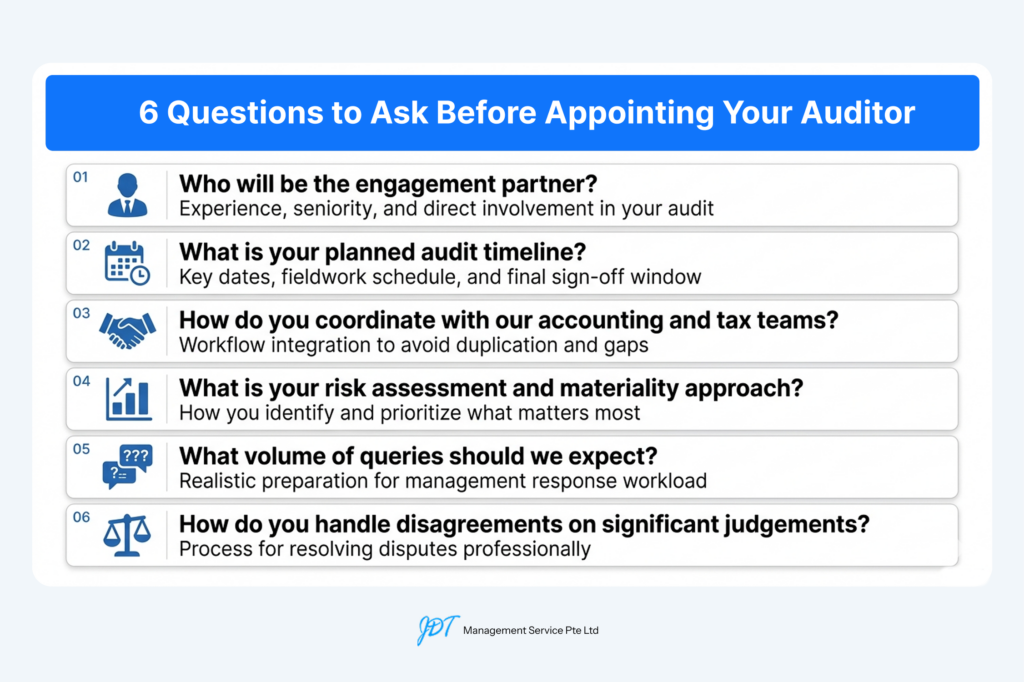
Before finalising an appointment, directors should ask: who will be the engagement partner and manager, and what is their relevant experience; what is the planned audit timeline; how will the auditor coordinate with the company’s accounting and tax functions; how does the firm approach risk assessment and materiality; what is the expected volume of queries and sample testing; and how does the firm handle disagreements with management on significant judgements. The quality of the answers matters more than the length.
Why JDT Is a Trusted Company Auditor in Singapore
JDT’s audit practice has supported SMEs, foreign-owned companies and corporate groups across decades of engagements. Our partners and managers combine technical depth with practical judgement, and our audit work is deliberately coordinated with our accounting and tax teams so that audit findings translate into operational improvements rather than isolated observations.
Clients choose JDT audit services for the clarity of our engagement scope, the seniority of the attention they receive, and the alignment of our audit work with their broader compliance picture. For complex situations involving restructuring, valuations or cross-border considerations, our business advisory team works alongside the audit engagement so that the company gets a coherent view, not fragmented advice.
Readers weighing up their options may also find our articles on the importance of auditing services and why audit is critical for compliance useful context before a formal appointment.
Frequently Asked Questions About Choosing a Company Auditor
How often should a company change its auditor in Singapore?
There is no fixed rotation requirement for most private companies. Public-interest entities are subject to specific rules. For others, what matters is the continued independence and quality of the auditor rather than a rigid change cycle.
Can I appoint an auditor from outside Singapore?
A statutory audit report in Singapore must be signed by a public accountant registered with ACRA. Foreign auditors may support multinational group audits, but the Singapore statutory audit opinion itself must be issued by an ACRA-registered public accountant.
What should an auditor's engagement letter cover?
A proper engagement letter should set out the scope of the audit, management and auditor responsibilities, fee basis, timeline, reporting deliverables, and the conditions under which additional work or fees may be required. Ambiguity in the engagement letter tends to become friction later.
How do I know if my auditor is independent?
Auditors must comply with independence requirements under the relevant professional codes. This includes restrictions on the services they can provide alongside the audit and on personal or financial relationships with the client. Any doubts should be raised with the engagement partner directly.
When should I start the process of selecting an auditor?
For companies approaching their first audit, selection should begin well before the financial year-end — ideally at least three to four months in advance — to give the auditor time to plan, understand the business and address any issues identified in the planning phase.
Choosing the right auditor is a decision with long consequences. If you would like an objective view of what your audit should look like, the scope it should cover, and how it should align with your accounting and tax position, speak to our audit team. JDT offers a confidential initial consultation and a clear, written proposal — so you can make the decision with full visibility.