



If your financial year end is 31 December, the work you do this December decides how smoothly January goes, when the auditor’s request list arrives, and half the team is still on leave. This financial year-end checklist sets out eight tasks to finish before the books close.
The checklist at a glance
- Reconcile bank, GST and intercompany balances.
- Review old receivables and write off bad debts with evidence.
- Count stock and update the fixed asset register.
- Time qualifying asset purchases for this year’s capital allowance claim.
- Accrue bonuses and prepare director fees for approval.
- Check whether the company still qualifies for audit exemption.
- Get payroll records ready for IR8A.
- Book the ECI, audit, AGM and annual return timeline for 2027.
Why the Financial Year End Matters for Singapore Companies
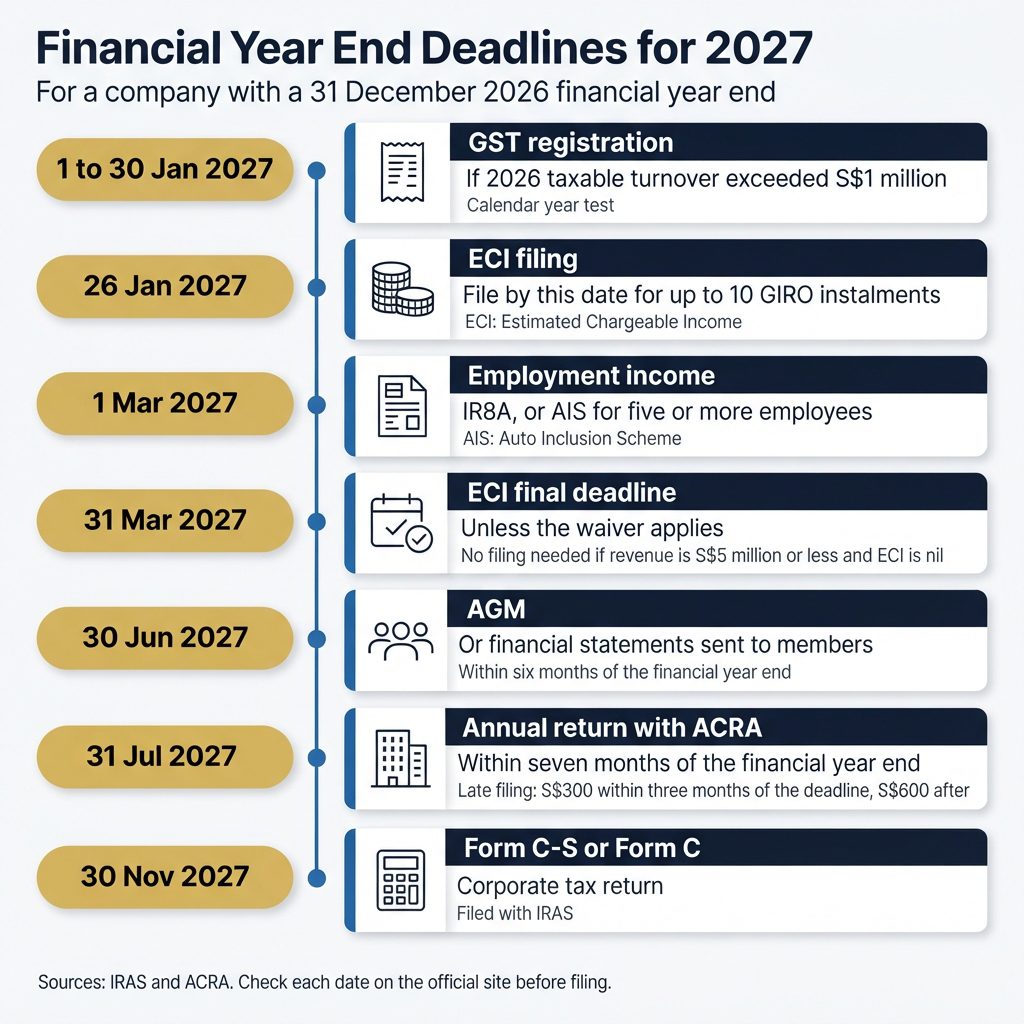
Your year-end is the date your accounts are made up to, and it starts several statutory clocks at once. IRAS expects your Estimated Chargeable Income (ECI) within three months of the year end, unless your revenue is S$5 million or less and your ECI is nil. Filing early also helps cash flow: a company on GIRO that files by the 26th of the first month after its year end can pay its tax in up to 10 monthly instalments, falling to 8 and then 6 for later filings, and none after the third month.
ACRA’s deadlines follow the same dates. A private company must hold its AGM, or send its financial statements to members, within six months of its financial year end, and file its annual return within seven months. A late annual return costs S$300 if it is filed within three months of the deadline and S$600 after that. The corporate tax return, Form C-S or Form C, is due by 30 November.
Every one of those filings is built on the closing balances you agree in December. An unreconciled bank account, a forgotten accrual or a missing asset register becomes an audit adjustment, an amended tax computation or a query from IRAS months later, when it is harder and more expensive to fix. Directors carry the responsibility: the Companies Act requires a company to keep accounting records that properly explain its transactions and financial position, and since 6 May 2026 the maximum fine for a director who fails to act with reasonable diligence has risen from S$5,000 to S$20,000.
At JDT, we guide SMEs through the year-end close every December, so that compliance starts from clean numbers. Doreen Yip, our Executive Director of Financial Outsourcing, sees the same pattern each year: companies that start their audit preparation in December have the quietest January.
The 8 Tasks to Complete Before Your Financial Year End
Year-end closing should start in early December. Each task below names the person who usually owns it.
1. Reconcile bank, GST and intercompany balances
Agree every bank account, including foreign currency and credit card accounts, to the statement balance at 31 December, and clear or explain old reconciling items. If you are GST registered, compare your GST returns for the year with the GST accounts in your ledger. Where you trade with related companies, confirm that both sides record the same intercompany balance. Differences found now take minutes to explain; differences found by the auditor in March take much longer. Owner: your accountant or bookkeeper, with sign-off from a director.
2. Review old receivables and write off bad debts with evidence
Go through the aged receivables list and decide, customer by customer, what is still collectable. IRAS generally allows a deduction for specific provisions or write-offs on trade debts that are supported by evidence, but not for a general percentage provision across all debtors. Keep the reminders, demand letters and correspondence that show why each debt is doubtful, because that file is what supports the deduction. Owner: finance, with input from whoever manages the customer relationship.
3. Count stock and update the fixed asset register
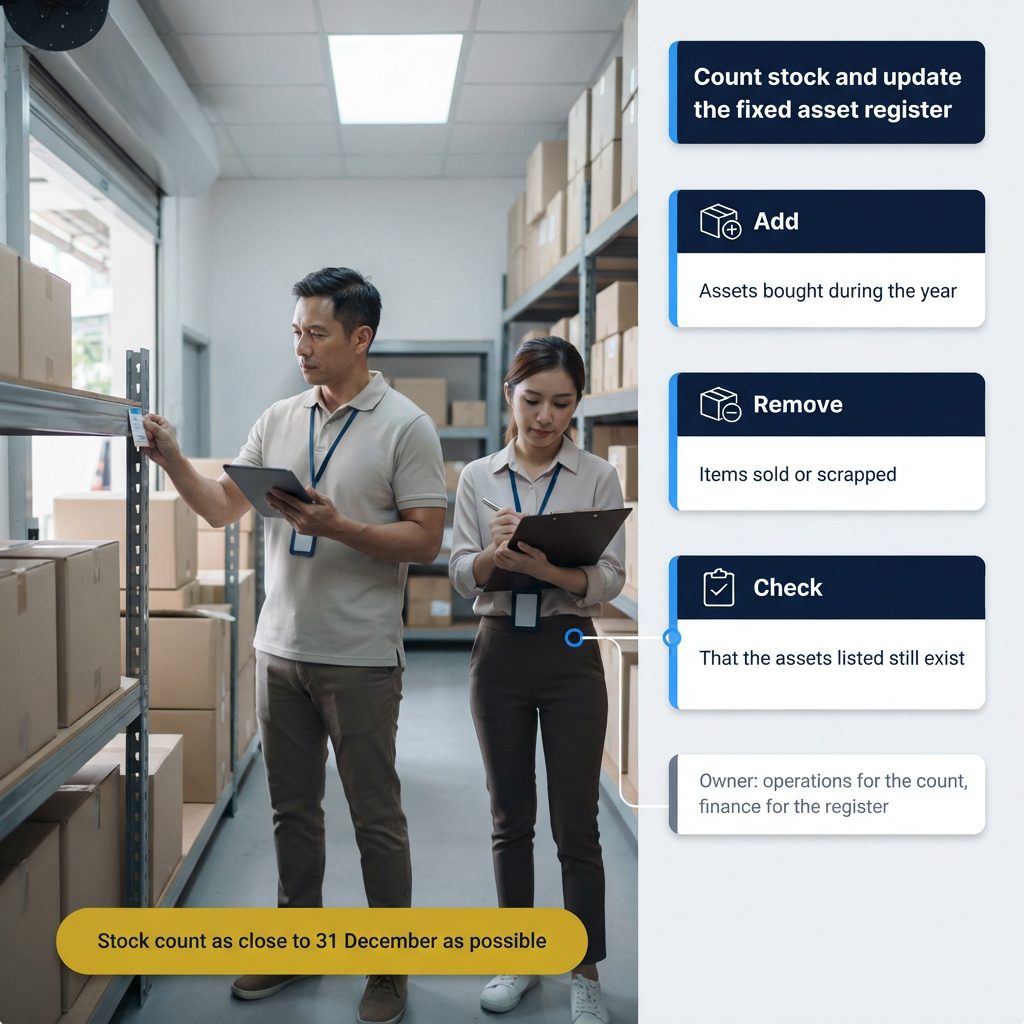
If you hold inventory, plan a stock count as close to 31 December as possible and record damaged or slow-moving items separately. IRAS treats a specific provision for obsolete stock as deductible but not a general one, so the same item-by-item approach applies. At the same time, update the asset register: add assets bought during the year, remove items sold or scrapped, and check that the assets listed still exist. A current register supports your capital allowance claim and makes the auditor’s asset testing much faster. Owner: operations for the count, finance for the register.
4. Time qualifying asset purchases for this year’s capital allowance claim
If you were already planning to buy equipment early in 2027, consider whether it makes sense to buy it before the year-end. Capital allowances are generally claimed for the year of assessment that relates to the financial year in which an asset is acquired, so an asset bought and in use by 31 December 2026 is claimed in YA 2027 rather than YA 2028. Computers, prescribed automation equipment and low-value assets costing S$5,000 or less each can be written off in one year, with low-value assets capped at S$30,000 a year. The purchase should still make business sense on its own; the earlier claim is a side benefit. Owner: directors, with advice from your tax team.
5. Accrue bonuses and prepare director fees for approval
Record the bonuses the company has committed to for 2026, even if they will be paid in 2027, so that the profit for the year is right. The tax timing differs for employees: IRAS taxes a contractual bonus in the year it relates to, while a non-contractual bonus is taxed when it is paid. Director fees approved in arrears become the director’s income on the date they are approved at the AGM. Write down the basis for each accrual now, because IRAS has specific rules on when accrued bonuses and director fees are deductible for the company. Owner: directors and finance.
6. Check whether the company still qualifies for audit exemption
A private company is generally exempt from audit if it meets at least two of the three small company criteria for each of the past two financial years: annual revenue of S$10 million or less, total assets of S$10 million or less, and 50 employees or fewer. Subsidiaries are tested on a consolidated group basis, and shareholders holding at least 5 per cent of the shares can still require an audit. ACRA has been reviewing the audit exemption framework since February 2026, but the current criteria apply until any change takes effect, so do not stop an audit on the strength of a proposal. If 2026 was a strong year, check the numbers before you assume nothing has changed. Owner: directors, with your auditor or accountant.
7. Get payroll records ready for IR8A
Employers must report 2026 employment income to IRAS by 1 March 2027, and companies with five or more employees must do so through the Auto Inclusion Scheme. December is the right time to confirm year-end bonuses, director fees and benefits in kind while the information is fresh. Our IR8A guide, published in December, covers the six things to prepare in detail. Owner: HR or payroll, with finance.
8. Book the ECI, audit, AGM and annual return timeline for 2027
Finish the year by putting every 2027 deadline into one shared calendar, with an owner beside each date. For a 31 December 2026 year-end, the key dates are set out below. If your taxable turnover for 2026 exceeded S$1 million and you are not yet registered for GST, the first deadline arrives quickly: IRAS expects the application between 1 and 30 January.
Financial year end Singapore deadlines for 2027
|
Obligation (31 December 2026 year end)
|
Deadline
|
|---|---|
Sources: IRAS and ACRA. Check each date on the official site before filing.
Not sure whether your company still qualifies for audit exemption, or which assets to buy before 31 December?
WhatsApp our Accounting Team or send your question through our enquiry form, and we will look at your numbers.
Common Year End Situations
The situations below are illustrations of what SME owners commonly face in December, rather than accounts of individual clients.
The company that crossed S$1 million during the year
A trading company that grew quickly in 2026 closes the year with taxable turnover just above S$1 million. Because the calendar year test is applied at 31 December, it must apply for GST registration in January, and it needs clean sales records to show IRAS when the threshold was crossed. The bank and GST reconciliations in task 1 make that application straightforward.
The first year: company closing its books
A company incorporated in early 2026 reaches its first financial year end with no asset register, receipts kept in email and no stock records. Tasks 1 to 3 take the longest in a first close, and the asset register and stock records set up now carry into every later year-end.
A company with a 31 December year end that made a loss does not need to file ECI if its revenue is S$5 million or less and its ECI is nil, because both conditions of the waiver are met. A company with revenue above S$5 million must still file, even if its ECI is nil.
Frequently Asked Questions about Financial Year End Checklist
What is a financial year end?
It is the last day of the period your company’s accounts cover. Many Singapore companies use 31 December. It sets the deadlines for ECI, the AGM, the annual return and tax filing.
When is ECI due for a 31 December financial year end?
ECI is due by 31 March 2027. Filing by 26 January 2027 gives up to 10 GIRO instalments. No filing is needed if revenue is S$5 million or less and ECI is nil.
Does my company need an audit this year?
A private company is generally exempt if it meets 2 of the 3 small company criteria for the past two financial years. The criteria are revenue of S$10 million or less, total assets of S$10 million or less, and 50 employees or fewer.
Can I claim capital allowances on assets bought in December?
Generally yes, if the asset is bought and in use for the business before the year-end. The claim then falls in YA 2027 rather than YA 2028.
What is a fixed asset register?
It is a list of the assets your company owns, with cost, purchase date, location and depreciation. It supports capital allowance claims and speeds up the audit.
When must my company register for GST?
Registration is compulsory when taxable turnover for a calendar year exceeds S$1 million, or is expected to in the next 12 months. Under the calendar year test, apply between 1 and 30 January.
Planning Your Financial Year End with JDT

If you would like support with the close, our accounting services Singapore page explains how we handle monthly bookkeeping, year end accounts and the tax filings that follow, and our audit services Singapore page covers companies that no longer qualify for exemption. In December we will also look at a broader question: whether your SME should outsource accounting altogether in 2027. Whatever you decide, a financial year end that is planned in early December is far easier to sign off in the new year.


