E invoice Singapore rules, known as the GST InvoiceNow Requirement, oblige GST registered businesses to send structured invoice data to IRAS through the InvoiceNow network. Each submission must carry the mandatory data elements, such as supplier and customer UEN, GST registration numbers and a valid GST category code, or IRAS rejects it automatically.
Why the Mandatory Data Elements Matter
The GST InvoiceNow Requirement sits on top of the existing GST framework. A tax invoice must still contain the particulars set out in Regulation 11 of the GST (General) Regulations, and IRAS has stated that the mandatory data elements are broadly in line with those particulars. What has changed is the delivery. Invoice data is now sent as structured XML through the InvoiceNow network, which is built on Peppol and operated through IMDA accredited Access Point Providers, and IRAS receives a copy directly.
The rollout is phased. Newly incorporated companies applying for voluntary GST registration came first on 1 November 2025, followed by all voluntary registrants from 1 April 2026. From 1 April 2028 the requirement extends to existing GST registered businesses in stages, ending on 1 April 2031 for businesses with annual supplies above S$4 million.
The compliance consequences are practical rather than dramatic, but they are real. If a mandatory data element is missing, the data is rejected automatically. Businesses that register for GST voluntarily may find that an application is not approved, or that registration is revoked, if they do not comply. IRAS has said it will take a calibrated approach to genuine mistakes in the early phases, but it has also said that enforcement action may be taken against businesses that remain non compliant once their phase begins. Because a valid tax invoice supports an input tax claim, poor invoice data can also weaken a claim during an IRAS audit. Records must still be kept for at least five years, and GST returns must still be filed as before. Directors should also note that the Corporate and Accounting Laws (Amendment) Act 2025 increased maximum fines for certain breaches of director duties to S$20,000, a reminder that oversight of finance systems is a governance responsibility.
Natalia Ong, Manager, Taxation at JDT, points out that most InvoiceNow problems start in master data, such as missing customer UENs and unmapped tax codes, rather than in the technology itself. At JDT, we guide SMEs through these requirements daily, ensuring compliance without unnecessary complexity.
Which Phase Applies to Your Business?
|
Start date
|
Who is covered
|
|---|---|
For existing registrants, the phase depends on total standard rated, zero rated and exempt supplies in the prescribed accounting periods ending in calendar year 2025. Nil returns count as returns filed, so a dormant company with S$0 supplies falls into the April 2028 phase. For the wider picture, see our InvoiceNow overview and timeline.
The Mandatory Data Elements, Field by Field
|
Element
|
What IRAS expects
|
Watch point
|
|---|---|---|
You do not need to validate customer details, because you rely on what the customer provides, but you must keep documents that support them. Peppol invoices do not have to show the words “Tax Invoice”, provided the other Regulation 11 particulars are present. Invoices issued outside the network should still show them.
GST Category Codes From Annex E
IRAS publishes the prescribed GST category codes in Annex E of its e Tax Guide on adopting the requirement. You may keep your internal tax codes, but each one must be mapped to the prescribed list before submission. A single invoice can carry several codes, one per line item, so standard rated and zero rated lines can sit on the same document.
The codes you will meet most often are SR for standard rated supplies, TX for taxable purchases on which input tax is claimed, and OP for purchases on which it is not. The codes used by supplier and customer do not have to match. A supplier may charge GST and use SR, while the customer decides not to claim and uses OP.
POS and Petty Cash Purchases
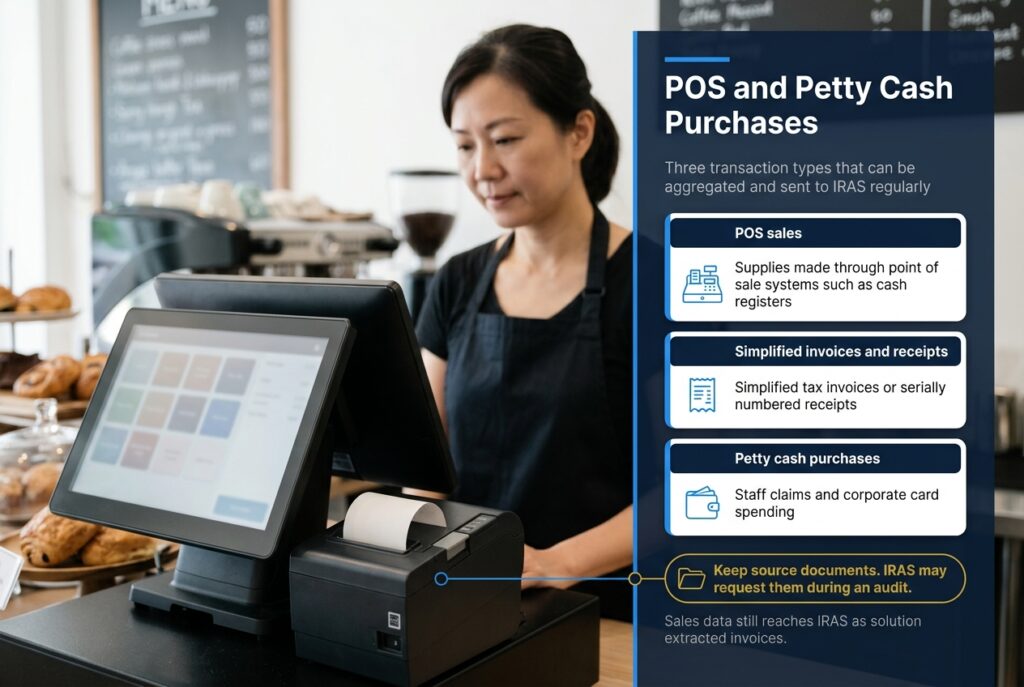
Three types of transaction may be aggregated and sent on a regular basis:
- Supplies made through point of sale systems such as cash registers.
- Supplies for which simplified tax invoices or serially numbered receipts are issued.
- Petty cash purchases, such as staff claims and corporate card spending.
A restaurant, for example, may continue to issue receipts to diners without Peppol invoices, but the sales data must still reach IRAS as solution extracted invoices. Aggregation does not remove the need to keep source documents, which IRAS may request during an audit.
Transmission Deadlines
What is the deadline for sending invoice data to IRAS? All invoice data must reach IRAS by the earlier of the date the GST return is filed or the filing due date of that return. Peppol invoices are copied to IRAS in real time or near real time once they are sent to the customer, provided the submission feature has been activated. Non Peppol sales, purchases and self billed invoices can be scheduled through your solution. Each successful transmission returns an acknowledgement ID, and a single submission must not exceed 10MB.
What the Process Looks Like for a Business Owner
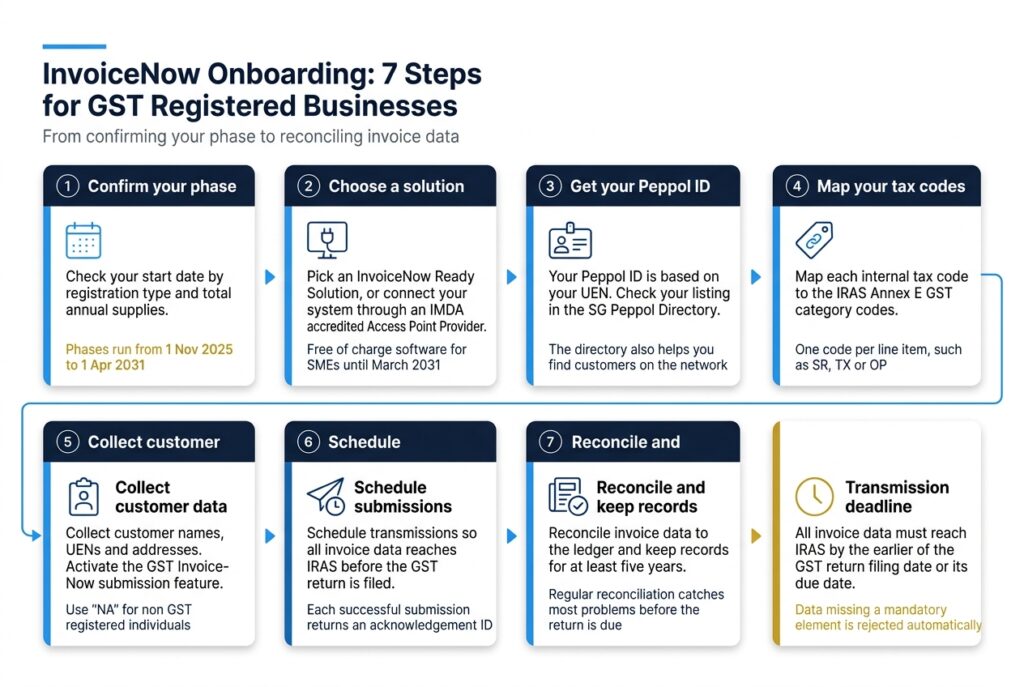
For most SMEs, onboarding follows a clear sequence.
- Confirm your phase using the table above.
- Choose an InvoiceNow Ready Solution, or connect your system through an IMDA accredited Access Point Provider.
- Obtain your Peppol ID, which is based on your UEN, and check your listing in the SG Peppol Directory.
- Map your internal tax codes to the Annex E list.
- Collect customer UENs and addresses, and activate the GST InvoiceNow submission feature.
- Schedule submissions so that everything is transmitted before the GST return is filed.
- Reconcile invoice data to the ledger and keep records for five years.
Consider three situations we see often. A growing business may have a handful of customers on the InvoiceNow network and many who are not. Invoices to the first group travel as Peppol invoices, while the rest are recorded in the solution and sent to IRAS as solution extracted data. Both routes need the same mandatory elements, so customer UENs must be collected either way, and the SG Peppol Directory helps find the Peppol ID of customers who are on the network.
A foreign owned company may use an overseas shared service centre to issue invoices. The centre can submit the data, but the Singapore company must appear as the supplier, with its UEN in the Supplier ID field.
A newly registered voluntary registrant has no transition period. Compliance applies from registration, and non compliance can put the registration itself at risk, so the system should be ready before the application is filed.
On cost and timing, expectations should be realistic. Free of charge InvoiceNow Ready software is available to SMEs until March 2031, and IRAS has said a grant of up to S$1,000 will be introduced, with the existing Productivity Solutions Grant covering up to 50% of eligible software subscription costs. A standard cloud accounting package can usually be connected within days to a few weeks, depending on tax code mapping and how clean the customer data is. Customised ERP systems take longer. Setting up proper accounting infrastructure now prevents costly corrections later.
Doreen Yip, Executive Director, Financial Outsourcing at JDT, notes that a monthly reconciliation of invoice data against the ledger catches most problems well before the return is due.
Common Errors and How to Fix Them
|
Area
|
Position under TPG7
|
Position under TPG8
|
|---|---|---|
Where an error has already flowed into a filed GST return, for example an input tax claim on an invoice that did not qualify, the question becomes one of correction. Small errors can sometimes be corrected in a later Form GST F5, while larger ones are generally reported through Form GST F7 as a voluntary disclosure. IRAS has said that differences between invoice data and the GST return are not penalised where they arise for legitimate reasons, such as timing, and where records can be produced on request. Disclosing an error before IRAS raises it is generally viewed more favourably than waiting for an audit.
Common Questions on InvoiceNow for GST Businesses
What is e invoice Singapore under GST InvoiceNow?
It is the requirement for GST registered businesses to send invoice data to IRAS through the InvoiceNow network. It is being introduced in phases from 2025 to 2031.
What are mandatory data elements?
They are the fields IRAS requires in every submission. Examples include supplier and customer UEN, GST registration number, amounts and GST category code.
What happens if a mandatory field is missing?
IRAS rejects the data automatically. The business must correct the record and submit it again.
Do POS and petty cash purchases need individual submissions?
No. POS sales, simplified invoices and petty cash purchases may be aggregated and sent regularly. Source documents must still be kept.
Do I still file GST returns and keep records?
Yes. InvoiceNow does not replace existing duties. Businesses must file returns and keep records for at least five years.
Can small businesses opt out?
No. Only overseas entities and entities registered wholly because of the reverse charge regime are excluded. Free of charge software is available for SMEs until March 2031.
Next Steps
If you are choosing a solution, mapping tax codes or cleaning customer data ahead of your phase, a short review now is easier than correcting rejected submissions later. Our InvoiceNow implementation support helps businesses prepare, our accounting system setup service aligns your ledger and invoicing workflow with the mandatory data elements, and our GST compliance services cover returns, corrections and IRAS correspondence. Each engagement starts with a conversation about your phase, your systems and your customers. For further reading, see our GST compliance assistance article.