The IRAS transfer pricing guidelines, now in their 8th edition (TPG8), introduce a simplified safe harbour for routine distributors, relief for certain domestic related party loans and firmer expectations on documentation. IRAS issued TPG8 on 19 November 2025, and the Simplified and Streamlined Approach runs as a pilot from 1 January 2026 to 31 December 2028.
Why the 8th Edition Matters to Singapore Businesses
Transfer pricing is the requirement that related companies deal with each other on the same terms that independent parties would agree. Singapore calls this the arm’s length principle, and IRAS enforces it through Section 34D of the Income Tax Act 1947. The rules apply to any business with related party transactions, whether the other party sits in Singapore or overseas, and they cover goods, services, royalties and loans.
TPG8 is best read as a mix of relief and reinforcement rather than a rewrite. The relief is real. Routine domestic loans are easier to manage, simplified documentation has been clarified, and the new Simplified and Streamlined Approach (SSA), which is Singapore’s pilot of the OECD’s Amount B, gives routine distributors a pricing matrix in place of a full benchmarking study. The tightening is quieter but just as important. IRAS expects a dated declaration to accompany simplified documentation, and it has issued firmer guidance on costs that are passed through without a mark up.
The stakes remain concrete. Where IRAS makes a transfer pricing adjustment, a surcharge of 5% of the adjustment applies, even if no additional tax is payable. Companies with gross revenue above S$10 million that also exceed the prescribed related party transaction thresholds must prepare contemporaneous documentation by the due date of the income tax return, keep it for five years and give it to IRAS within 30 days of a request. Failing to prepare it can lead to a fine of up to S$10,000. Directors should also note that the Corporate and Accounting Laws (Amendment) Act 2025 raised maximum fines for certain director duty breaches to S$20,000, which makes approval of intercompany policies a governance matter and not only a tax one.
Natalia Ong, Manager, Taxation at JDT, encourages SME clients to begin with a simple question: which related party transactions do we actually have, and which of them now qualify for relief? At JDT, we guide SMEs through these requirements daily, ensuring compliance without unnecessary complexity.
TPG7 and TPG8 Side by Side
|
Area
|
Position under TPG7
|
Position under TPG8
|
|---|---|---|
What the Process Looks Like for a Business Owner
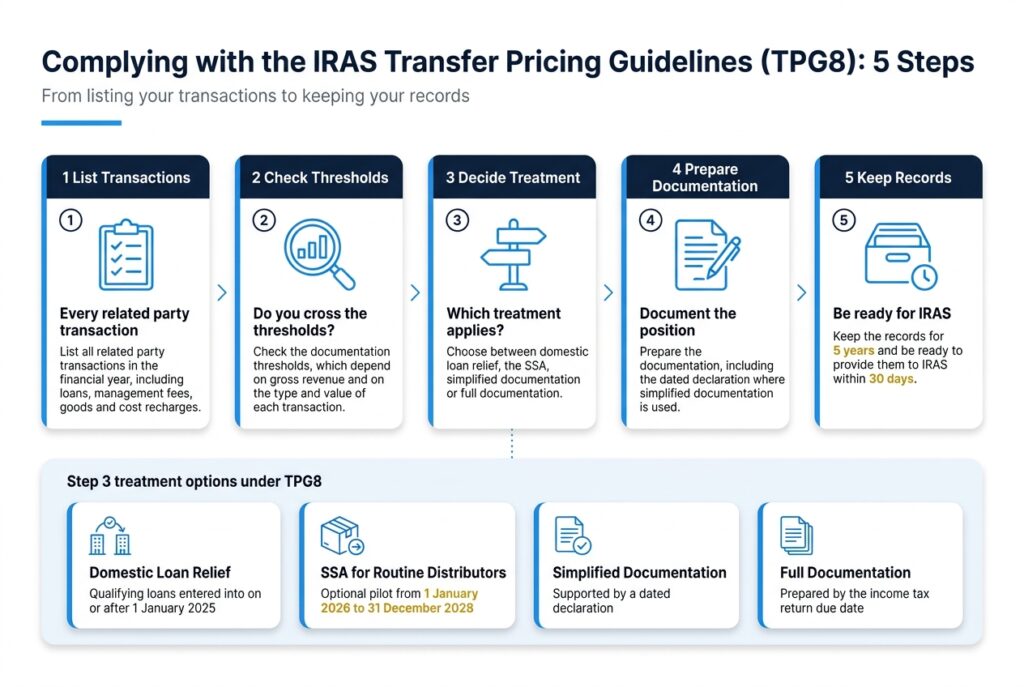
Most SME owners meet transfer pricing indirectly, usually when an accountant asks about a loan from a director’s other company or an invoice from an overseas parent. The practical path has five steps.
- List every related party transaction in the financial year, including loans, management fees, goods and cost recharges.
- Check whether you cross the documentation thresholds, which depend on gross revenue and on the type and value of each transaction.
- Decide which treatment applies: the domestic loan relief, the SSA, simplified documentation or full documentation.
- Prepare the documentation, including the dated declaration where simplified documentation is used.
- Keep the records for five years and be ready to provide them to IRAS within 30 days.
Our TP documentation guide explains step four in detail, and our TP basics article is a helpful starting point if the subject is new to your finance team.
Consider how this plays out in situations we see often. Two Singapore companies owned by the same family sometimes lend to each other without charging interest. For loans entered into on or after 1 January 2025, where neither company is in the business of lending or borrowing, IRAS will not make an adjustment under Section 34D and does not require transfer pricing documentation, even if no interest is charged. That is genuine relief. It does not settle whether interest paid by the borrower is deductible, which remains a separate tax question, and loans outside these conditions must still be priced at arm’s length through an analysis or the IRAS indicative margin.
A foreign owned company that distributes products in Singapore for its overseas parent faces a different decision. Under the SSA, a qualifying distributor reads its return on sales from a pricing matrix based on industry grouping, net operating asset intensity and operating expense intensity, and then applies an operating expense cross check. The main conditions are:
- The activity must genuinely be wholesale distribution or sales agency.
- Annual operating expenses must fall between 3% and 30% of net revenue.
- The Singapore entity must be the correct tested party under traditional methods.
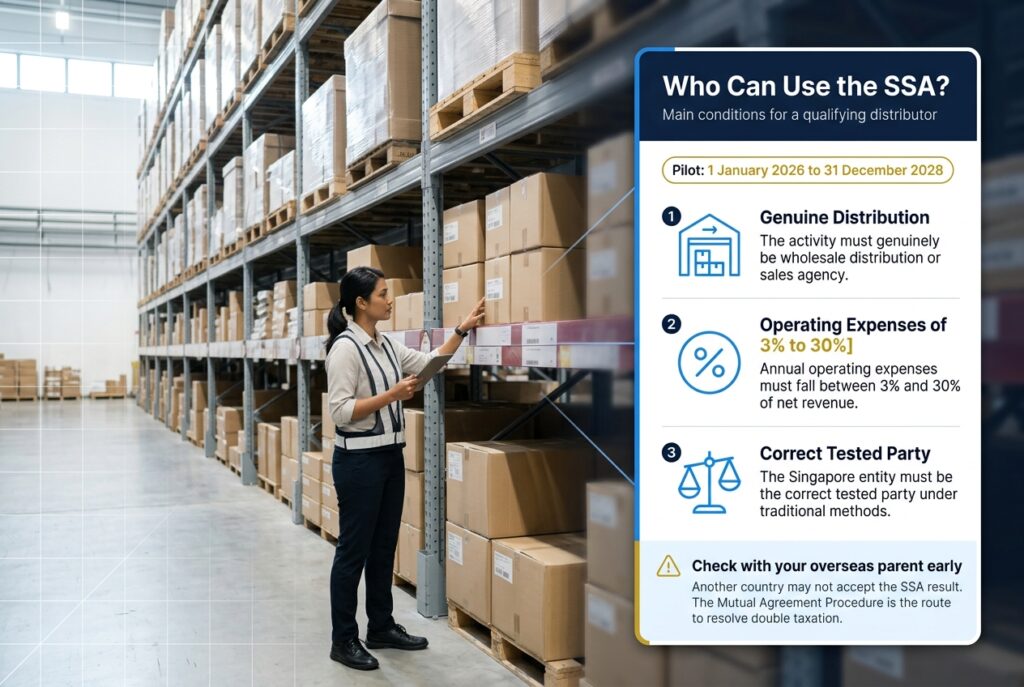
Preston Jansz Charles, Director, Business Advisory at JDT, notes that foreign groups should speak to their overseas parent early, because another country may not accept the SSA result. IRAS recognises that double taxation can arise in that case and points to the Mutual Agreement Procedure as the route to resolve it.
Smaller details also matter. Recharges treated as pure pass through costs need clear contracts and invoices to support that treatment. Clean intercompany records kept throughout the year make the annual exercise far easier, a point Doreen Yip, Executive Director, Financial Outsourcing at JDT, sees across client files. Consistent invoicing also supports GST compliance, and our guide to the GST InvoiceNow requirement explains how invoice data is now exchanged.
On timing and cost, expectations should be realistic. For a business with a few straightforward intercompany transactions, simplified documentation is typically a matter of weeks once the accounts are final, not days. An SSA assessment takes longer because operating assets and expenses must be separated for the qualifying activity. Any provider promising a guaranteed outcome or a very quick turnaround deserves caution, because IRAS reviews the substance of an arrangement and not only the paperwork.
Common Questions on IRAS Transfer Pricing Guidelines (TPG8)
What is TPG8?
TPG8 is the 8th edition of the IRAS Transfer Pricing Guidelines. IRAS issued it on 19 November 2025. It updates guidance on loans, documentation and distributor pricing.
What is the Simplified and Streamlined Approach?
The SSA is an optional safe harbour for baseline distribution activities. It runs as a pilot from 1 January 2026 to 31 December 2028. Qualifying taxpayers use a pricing matrix instead of a benchmarking study.
Do domestic related party loans still need transfer pricing documentation?
Not always. For qualifying loans entered into on or after 1 January 2025, IRAS will not make a Section 34D adjustment. Documentation is not required for these loans. Other loans must still be at arm’s length.
When must transfer pricing documentation be prepared?
Qualifying companies must prepare it by the income tax return due date. They must give it to IRAS within 30 days of a request. Records should be kept for five years.
What penalty applies to a transfer pricing adjustment?
IRAS applies a surcharge of 5% of the adjustment. This applies even when no additional tax is payable.
Next Steps
If your business has related party loans, a distribution arrangement or a documentation deadline approaching, a measured review now is far easier than responding to an IRAS query later. Our transfer pricing compliance services cover policy design and IRAS submissions, our regulatory compliance advisory helps directors understand their governance obligations, and our TP documentation preparation support turns your accounting records into a document that is ready to produce on request. Each engagement begins with a conversation about which transactions you have and which treatment applies, so you know where you stand before any work begins.