The GST InvoiceNow requirement obliges specific groups of GST-registered businesses in Singapore to issue and transmit invoice data through the InvoiceNow network, which connects directly to the Inland Revenue Authority of Singapore for near-real-time tax reporting. For SME owners, understanding who is affected, and by when, is essential to remaining compliant without last-minute disruption to invoicing and accounting workflows.
What the GST InvoiceNow Requirement Actually Means
InvoiceNow is Singapore’s nationwide e-invoicing network, built on the international Peppol standard and administered by the Infocomm Media Development Authority together with IRAS. Rather than emailing PDF invoices or issuing paper copies, businesses on the network exchange invoice data directly between accounting systems in a structured digital format. The GST InvoiceNow requirement extends this infrastructure specifically for tax purposes: newly registered GST businesses transmit invoice data to IRAS via the network as part of their compliance obligations, providing the authority with earlier visibility into transaction data and reducing the scope for reporting discrepancies at the point of GST filing.
The requirement was first announced as part of Singapore’s broader digitalisation of tax administration and has been rolled out in phases rather than applied to all GST registered entities at once. Newly incorporated companies that register for GST voluntarily were the first cohort brought into scope, with the requirement subsequently extending to all new voluntary GST registrants. Businesses that were already GST registered before the relevant phase, and companies that register for GST because they have crossed the mandatory S$1 million turnover threshold, fall under separate timelines that JDT’s tax team tracks on behalf of clients as IRAS refines its implementation schedule.
The consequences of getting this wrong are practical rather than merely administrative. A business that has not connected an InvoiceNow-ready accounting system by its applicable start date may find itself unable to issue compliant invoices to counterparties on the network, and may need to correct or resubmit transaction records to IRAS. Where InvoiceNow adoption is a condition of voluntary GST registration, non-compliance can also affect the standing of that registration. As Natalia Ong, Manager for Taxation at JDT, notes, “the businesses that struggle most are not the ones without accounting systems, but the ones running systems that were never designed to talk to a Peppol network. Readiness is really a systems question dressed up as a compliance one.”
Doreen Yip, Executive Director for Financial Outsourcing at JDT, adds that the transition tends to go smoothly once the underlying bookkeeping is clean. “InvoiceNow does not tolerate messy chart of accounts structures or inconsistent customer records. Businesses that come to us already organised move onto the network in a matter of weeks. Businesses that have been patching together spreadsheets for years need a proper clean-up first.” At JDT, we guide SMEs through these requirements daily, helping them assess whether InvoiceNow currently applies, prepare their systems, and stay compliant without unnecessary complexity.
Who Needs to Prepare, and What the Client Journey Looks Like
For most SME owners, the InvoiceNow requirement surfaces at one of a handful of predictable moments. Understanding where your business sits in that sequence makes the practical steps far clearer.
For most SME owners, the InvoiceNow requirement surfaces at one of a handful of predictable moments. Understanding where your business sits in that sequence makes the practical steps far clearer.
1. Newly incorporated companies registering for GST voluntarily
This is the group most directly affected by the current phase of the requirement. A founder who incorporates a new company and chooses to register for GST voluntarily, often to recover input tax on start-up costs, should assume that InvoiceNow readiness is part of the registration process rather than an optional add-on. The practical blocker we see most often is founders selecting an accounting package based on price or familiarity, only to discover later that it has no native Peppol connectivity, which then requires a costly mid-year system change.
2. Growing businesses approaching mandatory GST registration
Companies tracking towards the S$1 million annual turnover threshold, and registering for GST on a mandatory basis, should not assume the voluntary registrant timeline applies to them in the same way, but they should still treat e-invoicing readiness as part of their GST registration planning rather than an afterthought. Many of these businesses are also weighing whether to register early, and the InvoiceNow question is a sensible factor to bring into that decision alongside the more familiar input tax recovery calculation.
3. Existing GST registered businesses reviewing their systems
Even businesses outside the current mandatory scope are increasingly choosing to adopt InvoiceNow ahead of any requirement, both to future-proof their accounting infrastructure and because a growing number of larger counterparties, particularly government agencies and multinational clients, now expect Peppol-enabled invoicing as a matter of course. Waiting until adoption becomes compulsory can mean scrambling to migrate at the same time as every other business in the same position, which places unnecessary pressure on accounting software vendors and implementation partners alike.
Common blockers we see in practice
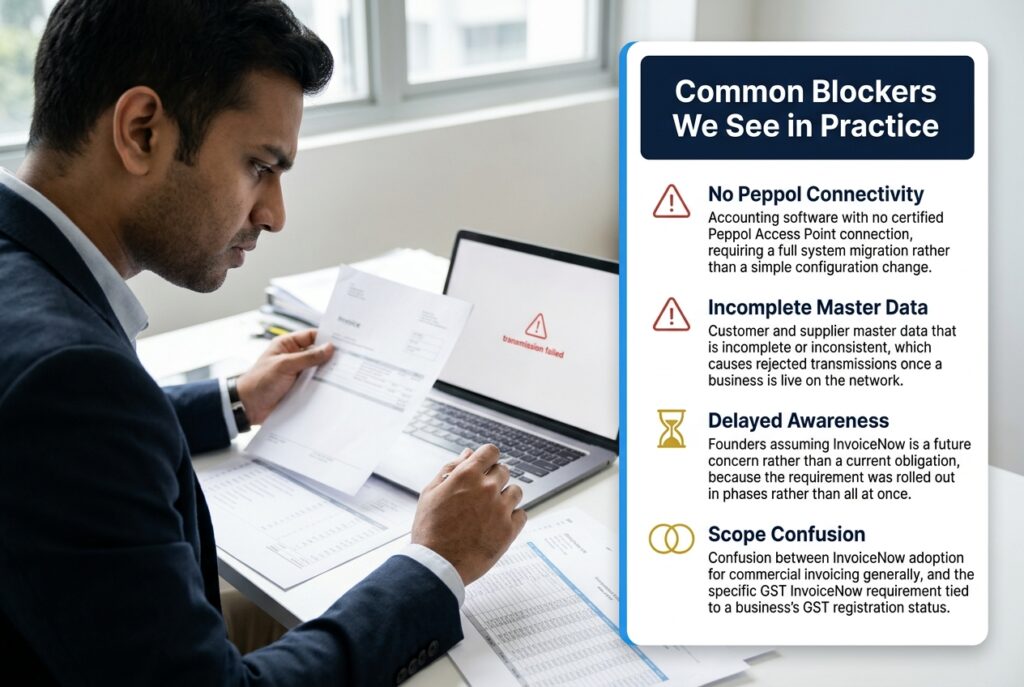
- Accounting software with no certified Peppol Access Point connection, requiring a full system migration rather than a simple configuration change.
- Customer and supplier master data that is incomplete or inconsistent, which causes rejected transmissions once a business is live on the network.
- Founders assuming InvoiceNow is a future concern rather than a current obligation, because the requirement was rolled out in phases rather than all at once.
- Confusion between InvoiceNow adoption for commercial invoicing generally, and the specific GST InvoiceNow requirement tied to a business’s GST registration status.
A realistic client scenario
A recent client in the retail and e-commerce sector incorporated a new entity and opted into voluntary GST registration to recover GST on inventory purchases ahead of launch. The founders had budgeted for the registration itself but had not accounted for the accounting system change needed to meet the GST InvoiceNow requirement, and their original bookkeeping software had no Peppol connectivity roadmap. Working through JDT’s financial outsourcing team, the business migrated to a Peppol-ready platform, cleaned up its customer records, and was transmitting compliant invoices within a few weeks, well ahead of its filing deadline. The lesson is a simple one: factor e-invoicing readiness into the registration decision itself, rather than treating it as a separate project to be solved later.
Step by step: getting InvoiceNow ready
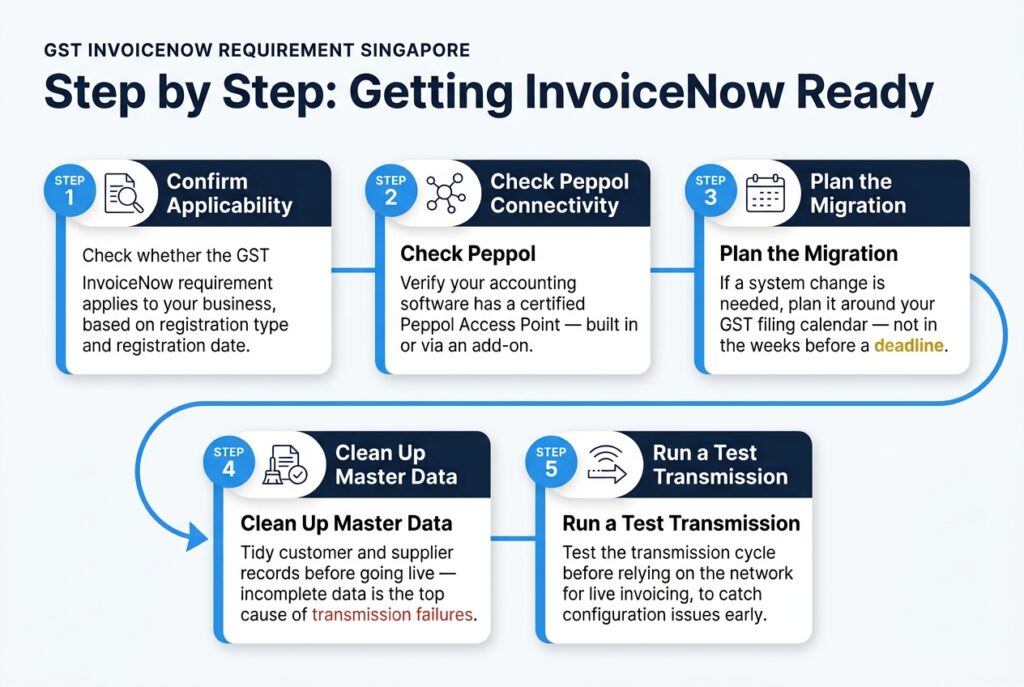
- Confirm whether the GST InvoiceNow requirement currently applies to your business, based on your registration type and registration date.
- Check whether your existing accounting software has a certified Peppol Access Point, either built in or through an add-on.
- Where a system change is needed, plan the migration around your GST filing calendar rather than in the weeks immediately before a deadline.
- Clean up customer and supplier master data before going live, as incomplete records are the most common cause of transmission failures.
- Run a test transmission cycle before relying on the network for live invoicing, to catch configuration issues early.
Common Questions on GST InvoiceNow Requirement Singapore
What is the GST InvoiceNow requirement?
It is IRAS’s requirement for specific groups of GST registered businesses to transmit invoice data to the authority through the InvoiceNow or Peppol network, rather than relying solely on traditional invoicing methods.
Does the GST InvoiceNow requirement apply to all GST registered businesses?
No. It has been introduced in phases, beginning with newly incorporated companies that register for GST voluntarily, before extending more broadly. Businesses should confirm their specific obligations based on registration type and date.
What happens if a business is not InvoiceNow ready by its applicable date?
The business may be unable to issue compliant invoices to counterparties on the network and may need to correct transaction records submitted to IRAS, which can complicate GST filing and, in some cases, affect the standing of a voluntary registration.
Next Steps
Whether you are incorporating a new company and weighing up voluntary GST registration, or reviewing an existing accounting system ahead of a mandatory registration, InvoiceNow readiness is worth building into your planning from the outset rather than treating as a separate, later concern. Our GST registration and compliance service walks new and growing businesses through registration timing, system readiness, and ongoing filing obligations. For businesses that need broader support, our GST advisory services cover both mandatory and voluntary registration decisions, while our GST accounting setup service helps ensure your bookkeeping and invoicing systems are structured correctly from day one.