Transfer pricing documentation is the contemporaneous record that a business must prepare to show that its transactions with related parties are priced on an arm’s length basis. Under IRAS rules, it becomes mandatory once a business crosses specific revenue and transaction thresholds set out in the Income Tax Act and IRAS’s Transfer Pricing Guidelines.
The Regulatory Framework Behind Transfer Pricing in Singapore
The arm’s length principle sits at the centre of Singapore’s transfer pricing regime. It requires that transactions between related parties, whether between a Singapore parent and its overseas subsidiary or between two entities under common control, be priced as they would be between independent parties dealing at arm’s length. IRAS uses this principle to ensure that profit is not shifted out of Singapore or into it through non-market pricing in intercompany transactions.
Section 34F of the Income Tax Act gives IRAS the legal basis to require contemporaneous transfer pricing documentation, meaning documentation prepared at the time the transactions take place rather than reconstructed later when a query arises. IRAS’s Transfer Pricing Guidelines set out what this documentation should include, such as a description of the business, related-party transactions, the pricing methodology applied, and supporting economic analysis.
What happens if IRAS makes a transfer pricing adjustment? Under Section 94D of the Income Tax Act, IRAS may impose a surcharge of 5 per cent on the amount of any transfer pricing adjustment, payable regardless of whether the adjustment results in additional tax payable. This surcharge applies on top of any tax and penalties that follow from the adjustment itself, which is why documentation quality matters well before an audit is ever raised.
At JDT, we guide SMEs through requirements like this daily, ensuring compliance without unnecessary complexity. As Natalia Ong, Manager, Taxation at JDT, observes, the businesses most exposed are often not the large multinationals with dedicated tax teams, but rather growing Singapore SMEs that cross the documentation threshold for the first time without realizing that their related-party dealings now require formal support.
Read More: Singapore transfer pricing guide SMEs
Who Needs Transfer Pricing Documentation, and What It Involves
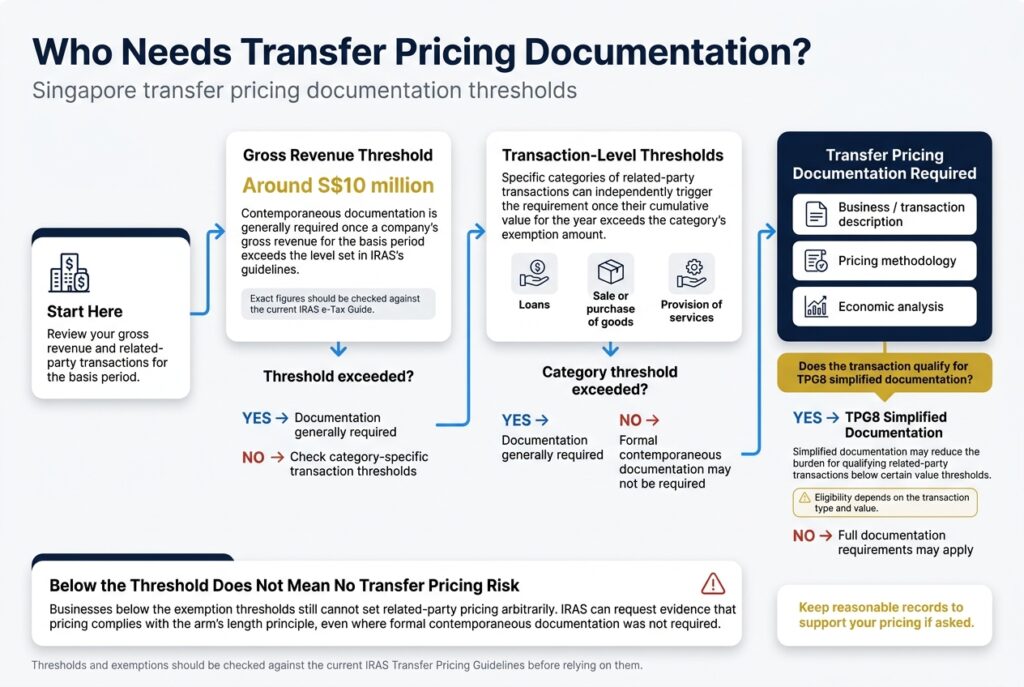
IRAS does not require every company to prepare full transfer pricing documentation. Broadly, the requirement is triggered once a business’s gross revenue for the basis period exceeds a set threshold, or once its related-party transactions in a given category exceed the exemption amount for that category. The exact figures are reviewed periodically by IRAS, so the ranges below should be checked against the current e-Tax Guide before being quoted to a client.
- Gross revenue threshold: contemporaneous documentation is generally required once a company’s gross revenue for the basis period exceeds the level set in IRAS’s guidelines, commonly cited around S$10 million.
- Transaction-level thresholds: even below the revenue threshold, specific categories of related-party transactions, such as loans, sale or purchase of goods, or provision of services, can independently trigger the requirement once their cumulative value for the year exceeds the category’s exemption amount.
- Once required, generally required again: a company that was required to prepare documentation in one basis period is typically expected to continue doing so in the following period, even if revenue temporarily dips below the threshold.
A Point Worth Clarifying Directly
Businesses that fall below the exemption thresholds still cannot set related-party pricing arbitrarily. IRAS can request evidence that pricing complies with the arm’s length principle, even where formal contemporaneous documentation was not required. IRAS generally expects businesses below the threshold to keep records reasonable enough to support their pricing if asked.
What This Looks Like for a Growing SME
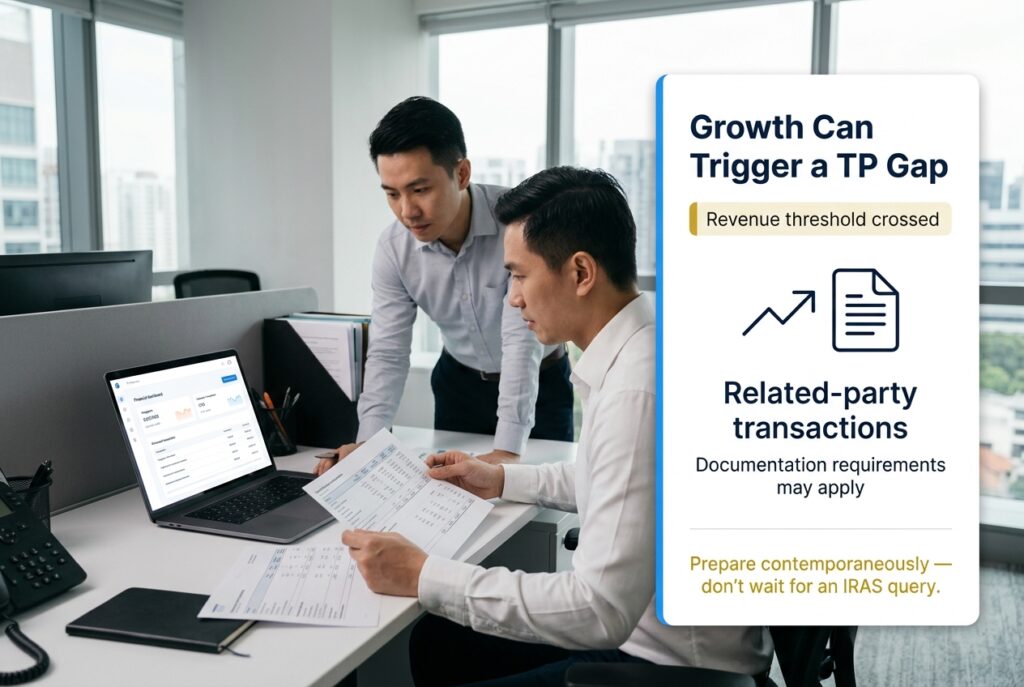
Many Singapore SMEs first encounter transfer pricing requirements not because of an aggressive tax position, but because ordinary business growth pushes them over a threshold mid-year. A regional trading company that begins routing purchases through a related Singapore entity, or a services business that starts charging management fees to an overseas subsidiary, can trigger the requirement without anyone flagging it as a transfer pricing question at the time.
A recent example from an SME in the trading sector illustrates this. The business had been dealing with a related overseas entity for several years on an informal pricing basis. Once its Singapore revenue crossed the documentation threshold, the absence of contemporaneous transfer pricing documentation became a live gap, one that had to be reconstructed retrospectively when IRAS raised queries, at considerably more cost and disruption than preparing it contemporaneously would have taken.
This is where IRAS’s TPG8 update matters for smaller businesses. It introduced a simplified documentation option for qualifying related-party transactions below certain value thresholds, reducing the burden for SMEs that would otherwise need to prepare the full economic analysis expected of larger, more complex groups. Not every business qualifies; eligibility depends on the transaction type and value, so it is worth checking rather than assuming.
The risk-aware approach is to treat transfer pricing documentation as part of ordinary year-end preparation rather than a reactive exercise once IRAS makes contact. While some advisers offer a minimal, template-based approach to keep costs down, documentation that does not genuinely reflect the business’s actual pricing methodology and related-party relationships offers limited protection if IRAS looks closely, and can leave a company exposed to the Section 94D surcharge on any resulting adjustment.
For businesses unsure whether they have crossed a threshold, the practical starting point is a review of related-party transactions for the current and prior basis period, checked against both the overall revenue threshold and the category-specific transaction thresholds, followed by a decision on whether full or simplified documentation applies.
Common Questions on Singapore Transfer Pricing Documentation Requirements
Does every Singapore company need transfer pricing documentation?
No. It generally applies once gross revenue or specific related-party transaction values exceed the thresholds set in IRAS’s Transfer Pricing Guidelines.
What is the arm’s length principle?
The requirement is that related-party transactions be priced as they would be between independent parties, so that profit is not shifted through non-market pricing.
What happens if IRAS adjusts a company’s transfer prices?
IRAS may impose a 5 per cent surcharge on the adjustment amount under Section 94D, in addition to any resulting tax.
Is there a simplified option for smaller related-party transactions?
TPG8 introduced simplified documentation for qualifying transactions below certain value thresholds, though eligibility depends on the transaction type.
Next Steps
If your business has crossed, or may be approaching, IRAS’s transfer pricing thresholds, our transfer pricing documentation services help you assess your exposure and prepare contemporaneous documentation that reflects how your related-party transactions actually work. For businesses building the underlying records this depends on, our financial documentation and compliance support keeps books audit-ready year-round. And where transfer pricing is one part of a wider tax position, our tax planning advisory helps you plan rather than react once a query arrives. For a closer look at the basics, see our guide to TP basics for SMEs, and our update on TPG8 simplified documentation.