GST InvoiceNow is Singapore’s new requirement for GST-registered businesses to transmit invoice data directly to IRAS through the Peppol network, replacing the PDF and paper invoices most companies still rely on. The rollout began on 1 November 2025 and will eventually apply to every GST-registered business, in phases determined by registration type and revenue.
What Is GST InvoiceNow, and Why Is IRAS Introducing It?
InvoiceNow is Singapore’s national e-invoicing network, built on the Peppol standard and jointly overseen by the Infocomm Media Development Authority and the Inland Revenue Authority of Singapore. It allows structured invoice data to move directly between accounting systems, rather than as a PDF attached to an email or a printed copy handed across a counter. For GST-registered businesses, IRAS is extending this infrastructure into a compliance requirement, commonly referred to as the IRAS InvoiceNow requirement: instead of relying solely on periodic GST returns, businesses will transmit invoice data to IRAS through InvoiceNow as part of their normal invoicing process, giving the authority far earlier visibility into taxable supplies than it has traditionally had.
The change sits within a broader shift towards digital tax administration that IRAS has been building towards for several years, and follows the same direction of travel as other recent tightening of Singapore’s corporate compliance environment, including heavier penalties for company directors under the Corporate and Accounting Laws (Amendment) Act 2025. For GST purposes specifically, the mechanics rest on two things: a Peppol ID assigned to each participating entity, typically linked to its Unique Entity Number and established around the point of GST registration, and a defined set of mandatory data elements that every InvoiceNow transaction must contain before IRAS will accept it as valid.
This distinction matters because many business owners assume that switching to electronic invoicing, or emailing invoices as PDFs, already satisfies the requirement. It does not. A PDF sent by email, however professionally formatted, is not InvoiceNow compliant, because it never transmits structured data through the Peppol network to IRAS. Natalia Ong, Manager for Taxation at JDT, notes that this is the most common misunderstanding her team encounters when clients first ask about GST InvoiceNow, and it is usually the reason a business discovers, later than it should, that its existing invoicing process needs to change before InvoiceNow becomes mandatory for its particular phase.
At JDT, we guide SMEs through these requirements daily, ensuring compliance without unnecessary complexity. With GST InvoiceNow, that starts with a simple question: which phase applies to this business, and what is its InvoiceNow implementation date? From there, we work backwards from that date to give the finance team enough time to test their systems properly, rather than migrating under pressure in the final weeks before the deadline.
Which InvoiceNow Phase Applies to Your Business?
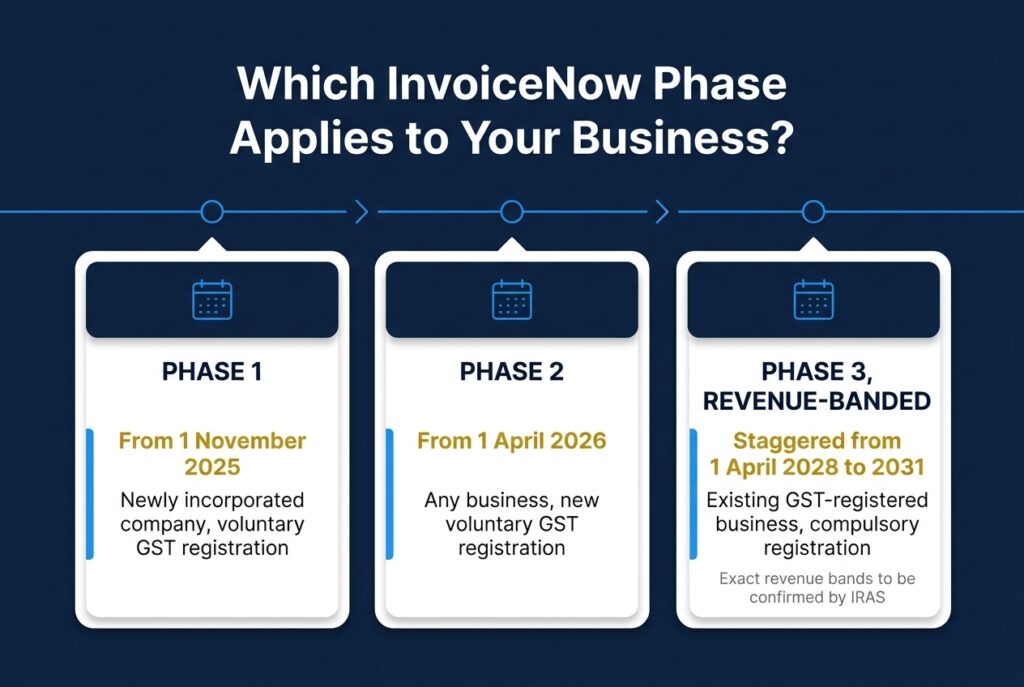
The question every business owner actually wants answered is simple. Which phase applies to me, and by when? The answer depends on how, and when, your business is registered for GST.
If your company was newly incorporated and is registering for GST voluntarily, with that registration taking effect on or after 1 November 2025, you fall into the first phase, and the InvoiceNow requirement already applies to you. If you are registering for GST voluntarily for any other reason, from 1 April 2026 you will need to be ready as well, a step closely tied to GST registration and InvoiceNow being introduced together for new voluntary registrants. If your business is already GST-registered under compulsory registration, your compliance date falls between 1 April 2028 and 2031, staggered according to annual revenue. IRAS has indicated that the exact bands will be confirmed closer to each phase, so it is worth checking directly with IRAS or your adviser rather than assuming a specific year in advance.
|
Your situation
|
Phase
|
InvoiceNow implementation date
|
|---|---|---|
Whichever phase applies, one point holds across all three. A PDF invoice emailed to a customer is not InvoiceNow compliant, regardless of how the underlying GST registration came about. The format the customer receives is a separate question from whether the underlying data has actually been transmitted to IRAS through Peppol.
What to Expect When You Make the Switch
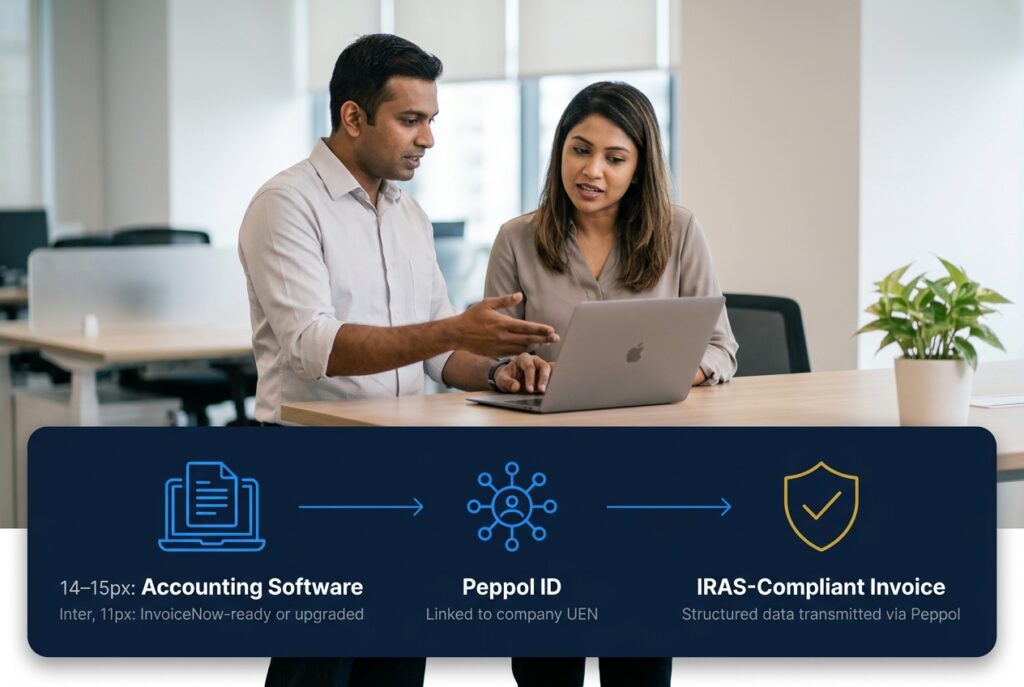
Once a business knows which phase applies to it, the practical work begins well before the compliance date itself. The first step is establishing whether the existing accounting or invoicing software already supports InvoiceNow, or whether it needs an add-on, an upgrade, or a change of provider. Most of the accounting platforms commonly used by Singapore SMEs now offer InvoiceNow connectivity, either natively or through an approved solution provider. The second step is registering, or reactivating, a Peppol ID linked to the company’s Unique Entity Number, which is what allows the business to send and receive invoices on the network at all. Only once both pieces are in place, the software and the Peppol ID, can a business actually issue an InvoiceNow-compliant invoice.
This is usually where the first real blocker appears. A business may have modern accounting software but discover it has never activated the InvoiceNow module, or it may have registered a Peppol ID some years ago for a different purpose and needs to confirm it is still active and correctly linked. Finance teams handling this for the first time often underestimate how much lead time is needed to test the connection properly, particularly if invoices need to flow between the accounting system and a separate point of sale or inventory platform before they reach IRAS.
A second common scenario involves businesses that already send invoices electronically and assume this satisfies the requirement. It does not. Emailing a PDF invoice, generating a QR code, or uploading a scanned copy to a client portal are all common current practices, and none of them constitutes InvoiceNow compliance, because none of them transmits structured invoice data through the Peppol network to IRAS. Clarifying this distinction early avoids a difficult conversation close to the compliance deadline, when there is little time left to make the switch properly.
A third scenario, increasingly common as the voluntary registration phases take effect, involves newly incorporated companies that register for GST early to reclaim input tax on start-up costs, without realising that voluntary registration now brings the InvoiceNow requirement with it from day one. A founder focused on getting the business running can reasonably not think to ask about e-invoicing infrastructure at the same time as opening a bank account and hiring the first employee, which is exactly why this point is worth raising during incorporation, not afterwards.
While some providers offer to get a business InvoiceNow ready as a quick add-on, compliance is rarely just a software switch. It usually touches how invoices are numbered, how customer and product data is structured, and how the finance team’s existing workflow needs to change to keep that data accurate at the point of entry. Doreen Yip, Executive Director for Financial Outsourcing at JDT, works with clients on exactly this layer, the accounting process behind the software, and typically recommends a parallel test period before a business’s compliance date, so that any data or formatting issues surface while there is still time to fix them, rather than during the first live filing period.
Setting up this infrastructure properly, even for businesses whose compliance date is still some years away, tends to prevent far costlier corrections later. A recent client in the retail sector began the transition nearly a year ahead of its phase and used the extra time to clean up product and customer records that had accumulated small inconsistencies over several years, inconsistencies that would otherwise have surfaced as rejected InvoiceNow transmissions once the requirement became mandatory. Businesses that leave the switch until the weeks before their compliance date rarely have that luxury.
Getting Started
GST InvoiceNow touches both compliance and day-to-day accounting, and the businesses that manage the transition most smoothly are usually the ones that treat it as both from the start. If you are still working out which mandatory data elements your invoices need to include, our mandatory data elements guide walks through the technical requirements in full. For GST-registered businesses weighing up their broader filing obligations alongside this change, our GST compliance and InvoiceNow support service covers both the registration and the ongoing reporting side, while our GST filing services team can take on the periodic filing side of things if you would rather hand that off entirely. And where the transition also means updating how invoices are generated day to day, our accounting system integration service is designed to fit around whichever platform your finance team already uses.
Common Questions on GST InvoiceNow
What is GST InvoiceNow?
GST InvoiceNow is the IRAS requirement for GST-registered businesses to transmit invoice data through Singapore’s Peppol-based e-invoicing network, rather than relying only on periodic GST returns.
When does GST InvoiceNow become mandatory for my business?
It depends on your registration type. Newly incorporated companies registering for GST voluntarily are first, from 1 November 2025. Other new voluntary registrants follow from 1 April 2026. Existing GST-registered businesses join in stages between 2028 and 2031, based on revenue.
Does emailing a PDF invoice meet the InvoiceNow requirement?
No. A PDF invoice, however well formatted, does not transmit structured data through the Peppol network to IRAS, so it is not InvoiceNow compliant on its own.
What is a Peppol ID, and does my business need one?
A Peppol ID is the identifier that lets a business send and receive invoices on the InvoiceNow network. Every business affected by GST InvoiceNow needs one, usually linked to its UEN.
Does a dormant company still need to comply with GST InvoiceNow?
Yes, if it remains GST-registered. A dormant company stays within the requirement once its phase applies, in the same way it must still file annual returns while registered, even without trading activity.
What happens if a business misses its InvoiceNow compliance date?
IRAS has not published a fixed-penalty schedule specifically for late adoption of InvoiceNow. Businesses should treat each compliance date as fixed and confirm their position with IRAS or an adviser well in advance.