
The CSP Act Singapore — formally the Corporate Service Providers Act 2024 — took effect on 9 June 2025 and fundamentally changed how corporate services are regulated in this country. Most business owners assume this legislation applies only to their company secretary or incorporation agent. That assumption carries real risk. If the corporate service provider your business relies on is not properly registered with the Accounting and Corporate Regulatory Authority (ACRA), your filings, your nominee director arrangement, and your company’s standing could all be at stake.
Understanding what the CSP Act requires — and what it means for your business — is no longer optional. It is a compliance baseline every Singapore company should meet.
What Is the CSP Act and Why Did Singapore Introduce It?
The Corporate Service Providers Act 2024 was passed by Parliament on 2 July 2024 as part of a broader package of legislative amendments designed to close regulatory gaps in Singapore’s corporate compliance framework. Before this Act, the regulatory regime applied primarily to Registered Filing Agents — businesses that filed transactions directly with ACRA on behalf of clients. Entities that provided corporate services without interacting directly with ACRA’s electronic systems were largely outside the scope of formal oversight.
ACRA and the Ministry of Finance identified this as a meaningful vulnerability. Corporate service providers that did not file with ACRA could still be engaged to facilitate illicit activity — including money laundering, the financing of terrorism, and the proliferation financing of weapons of mass destruction. The CSP Act was introduced specifically to eliminate this gap, extend anti-money laundering obligations across the entire corporate services sector, and align Singapore’s regulatory framework with the Financial Action Task Force (FATF) recommendations.
The practical result is a new, unified regulatory regime. From 9 June 2025 onwards, any business entity that carries on a business of providing corporate services in or from Singapore must be registered with ACRA as a Corporate Service Provider, regardless of whether it files transactions with ACRA on behalf of its clients.
What Counts as a Corporate Service Under the CSP Act?
The Act defines “corporate service” broadly. It includes any business activity that involves one or more of the following:
- Forming a corporation or other legal entity
- Acting as a director or company secretary
- Providing a registered office, business address, correspondence or administrative address for a company
- Acting as a nominee shareholder
- Carrying out designated activities in relation to the provision of accounting services
- Carrying out transactions using ACRA’s electronic transaction system on behalf of a client
If your service provider does any of these things for your business by way of business, they are a Corporate Service Provider under the Act and must be registered. Preston Jansz Charles, Director of Business Advisory at JDT, notes that foreign entrepreneurs setting up in Singapore are often most exposed here: “Many foreign founders engage a range of local service providers — for incorporation, registered office address, nominee arrangements, and accounting support — without verifying whether each provider holds the appropriate ACRA authorisation. The CSP Act means that the oversight gap now carries regulatory consequences.”
AML/CFT/PF Obligations: What Registered CSPs Must Now Do
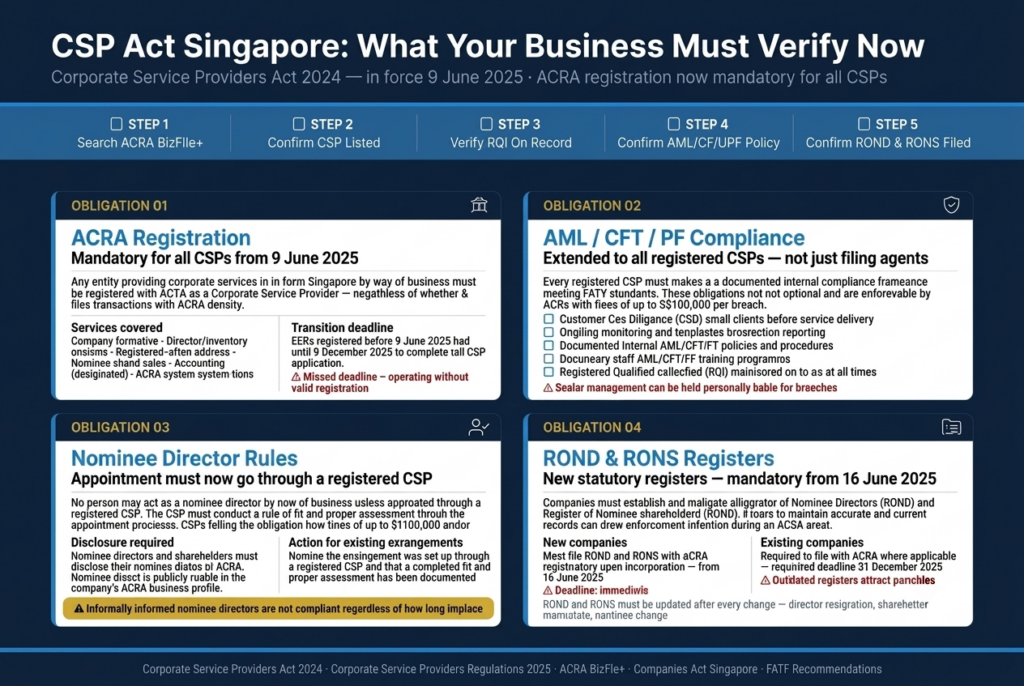
One of the most significant features of the CSP Act is the mandatory extension of AML/CFT/PF obligations to all registered CSPs. Previously, anti-money laundering and countering the financing of terrorism requirements applied only to Registered Filing Agents. The Corporate Service Providers Regulations 2025, which came into force alongside the Act, now require every registered CSP to maintain robust internal compliance frameworks.
These obligations include the following:
- Conducting Customer Due Diligence (CDD) on all clients before delivering services
- Monitoring ongoing client relationships and flagging suspicious transactions
- Maintaining documented internal AML/CFT/PF policies and procedures
- Ensuring staff complete mandatory AML/CFT/PF training
- Maintaining a Registered Qualified Individual (RQI) within the firm at all times — a professional with the required qualification and completed compliance training
Breaches of AML/CFT/PF obligations are not treated lightly. ACRA can impose fines of up to S$100,000 per breach, and senior management of the registered CSP can be held personally accountable. This personal liability dimension is a meaningful shift from the previous regime. At JDT, compliance with AML/CFT/PF obligations is embedded into every client engagement from onboarding onwards, which is precisely the standard every registered CSP in Singapore is now required to meet.
What This Means for Your Business: A Practical Guide

The Risk of Using an Unregistered CSP
The most immediate concern for business owners is straightforward: if your corporate service provider is not registered under the CSP Act, it is operating illegally. The unregistered CSP penalty is severe — a fine of up to S$50,000 and/or imprisonment for up to two years, with an additional S$2,500 per day for every day the offence continues after conviction. This penalty falls on the service provider. However, the consequences for your business are far from zero.
If your company’s filings, registered office address, or nominee director arrangement has been managed by an unregistered provider, ACRA may treat those engagements as non-compliant. Filings submitted through an unregistered provider could face scrutiny or rejection. Nominee director arrangements put in place without proper CSP oversight may be considered invalid. In a worst-case scenario, your company’s regulatory standing with ACRA is compromised before you even realise there is an issue.
A recent client engagement handled by our corporate governance advisory team involved a foreign-owned company that had been using a boutique incorporation service that was not registered as a CSP. The company’s annual returns had been filed through this provider, but the provider could not demonstrate compliance with the new AML/CFT/PF framework. JDT stepped in to conduct a compliance review, migrate the filing obligations, and file remedial documentation with ACRA — a process that could have been avoided entirely had the client verified their provider’s registration status from the outset.
Nominee Directors Under the CSP Act: New Rules, New Risks
The CSP Act introduced specific and substantive changes to how nominee directors can be appointed in Singapore. Under the previous regime, nominee director arrangements were common but lightly regulated. The Act now prohibits any person from acting as a nominee director by way of business unless their appointment has been arranged by a registered CSP and they have been assessed as fit and proper by that CSP.
This is a significant change for foreign entrepreneurs who rely on local nominee directors to satisfy the resident director requirement under the Companies Act. The nominee director must now be sourced through a registered CSP, and the CSP must carry out a formal assessment before the appointment proceeds. CSPs that fail to conduct this assessment face fines of up to S$100,000 under Section 15 of the CSP Act.
Transparency requirements have also been strengthened. Nominee directors and nominee shareholders are now required to disclose their nominee status to ACRA and identify their nominators. This information is filed with ACRA, and the nominee status is made publicly visible in the company’s business profile. While the full details of the nominator remain accessible only to law enforcement agencies, the public disclosure element is a meaningful departure from the historical opacity around nominee arrangements.
Joe Tan, Managing Partner at JDT, advises clients to review their nominee arrangements carefully: “The CSP Act has made nominee director governance a front-line compliance matter, not an afterthought. Any company that has a nominee director in place — whether for a foreign-owned company or a locally restructured entity — should confirm immediately that the arrangement was set up through a registered CSP and that the fit and proper assessment has been completed and documented.”
New Register Requirements: ROND and RONS
Alongside the CSP Act, companies incorporated from 16 June 2025 onwards must immediately establish and maintain two new statutory registers: the Register of Nominee Directors (ROND) and the Register of Nominee Shareholders (RONS). Existing companies had until 31 December 2025 to file these registers with ACRA, where applicable.
Failing to maintain accurate and up-to-date ROND and RONS records can lead to penalties, compliance audits, and reputational consequences. Wilson Yeoh, Director of Audit and Advisory at JDT, notes that many companies underestimate how quickly register obligations accumulate: “For companies with multiple shareholders or a complex ownership structure, keeping ROND and RONS current is not a one-time task. It requires a live compliance process — and one that needs to be embedded into your corporate secretarial workflow from day one.”
How to Verify Your CSP's Registration with ACRA
Verifying your corporate service provider’s registration status is straightforward but often overlooked. Business owners can confirm registration through the ACRA BizFile+ portal. A properly registered CSP will appear as a registered entity in the CSP directory that ACRA maintains. If your provider is not listed, you should pause any active engagements and seek advice on remedial steps immediately.
When verifying your CSP, confirm the following:
- The entity is listed as a registered CSP in the ACRA directory
- The CSP has at least one Registered Qualified Individual on record
- The CSP can demonstrate documented AML/CFT/PF policies if requested
- Any nominee director arrangements arranged through them are accompanied by a completed fit and proper assessment
- ROND and RONS are filed and up to date
At JDT, we guide clients through these requirements daily. JDT Management Services Pte Ltd is licensed by ACRA as a Filing Agent and is fully registered under the CSP Act, with established AML/CFT/PF compliance infrastructure and a Registered Qualified Individual on the team. Clients can verify our registration status directly through ACRA’s portal.
Common Scenarios Where the CSP Act Creates Exposure
The following situations are where SMEs and foreign-owned companies are most commonly caught off guard:
- Using a boutique incorporation agent that registered as an RFA before the CSP Act but has not upgraded to full CSP registration. While entities registered as RFAs before 9 June 2025 had until 9 December 2025 to complete their full CSP registration, any that missed this transition deadline are now operating without valid registration.
- Engaging a nominee director sourced informally — through a personal contact or a non-CSP introduction — without a formal arrangement through a registered CSP. This nominee arrangement is not compliant with the Act, regardless of how long it has been in place.
- Failing to update ROND and RONS after a change in nominee arrangements — for example, after a director resigns or a shareholder structure changes. Incomplete or outdated registers can draw enforcement attention during an ACRA audit.
- Assuming that a registered office address provided by a co-working space or virtual office operator is automatically CSP-compliant. These providers must be registered CSPs if they are providing a registered office address by way of business.
Frequently Asked Questions About the CSP Act Singapore
- What is the CSP Act Singapore?
The CSP Act Singapore — formally the Corporate Service Providers Act 2024 — is a law that took effect on 9 June 2025. It requires all entities providing corporate services in or from Singapore to register with ACRA. It also imposes AML/CFT/PF obligations on registered CSPs and introduces stricter rules for nominee director appointments.
- Who needs to register as a CSP with ACRA?
Any business entity that provides corporate services by way of business in or from Singapore must register as a CSP with ACRA. This applies even if the entity does not file transactions directly with ACRA on behalf of its clients. It includes incorporation agents, company secretaries, registered office providers, nominee director providers, and accounting service providers performing designated activities.
- What is the penalty for operating as an unregistered CSP?
The unregistered CSP penalty under the Act is a fine of up to S$50,000 and/or imprisonment for up to two years. If the offence continues after conviction, a further fine of up to S$2,500 per day may be imposed. There are no grace periods for entities that missed the 9 December 2025 transition deadline.
- What are AML/CFT/PF obligations under the CSP Act?
AML/CFT/PF obligations Singapore refers to the requirements to prevent money laundering (AML), counter the financing of terrorism (CFT), and prevent the proliferation financing of weapons of mass destruction (PF). Registered CSPs must conduct customer due diligence, monitor client risk, file suspicious transaction reports, maintain internal compliance policies, train staff, and retain a Registered Qualified Individual. Fines for breaches can reach S$100,000 per offence.
- Can a nominee director still be used for a Singapore company?
Yes, but the arrangement must now be made through a registered CSP, and the nominee must pass a fit and proper assessment conducted by that CSP before appointment. Nominee directors must also disclose their nominee status to ACRA, and the company must maintain a Register of Nominee Directors (ROND) filed with ACRA.
- How do I verify that my CSP is registered with ACRA?
You can verify CSP registration through the ACRA BizFile+ portal. Search for the entity by name and confirm it appears in the registered CSP directory. If in doubt, ask your service provider directly to provide their CSP registration number and the details of their Registered Qualified Individual.
- Does the CSP Act affect companies that already use a company secretary?
Yes. If your company secretary is providing services by way of business — rather than as an employed individual officer — they must be registered as a CSP. Most established corporate secretarial firms in Singapore have completed CSP registration. However, it is prudent to confirm this directly, particularly if you are using a smaller or newer provider.
Ensuring Your Business Is on the Right Side of the CSP Act

The CSP Act represents a material shift in Singapore’s corporate compliance landscape — one that affects not just service providers but every company that relies on them. Whether you are a local SME, a foreign entrepreneur setting up operations here, or a regional holding company with nominee arrangements in place, verifying that your corporate service providers are properly registered is a non-negotiable step in your compliance review.
If you are setting up a company in Singapore for the first time, our ACRA-licensed company registration services ensure that your incorporation is handled by a fully registered CSP from the outset, with AML/CFT/PF-compliant onboarding and nominee director arrangements managed in accordance with the Act. For companies with existing corporate service arrangements that have not been reviewed since June 2025, our corporate governance advisory team can conduct a compliance gap assessment and guide your remediation steps. Further details on JDT’s credentials, licensing, and team qualifications are available on our JDT ACRA licence and credentials page.