MES Singapore approvals must be renewed every three years, and if your Major Exporter Scheme certificate expires on 31 December 2026, your renewal window has effectively already opened. Miss the deadline and you lose immediate access to GST cash flow relief on imports, with arrears and a fresh application to follow.
What MES Does and Why Renewal Cannot Slip
The Major Exporter Scheme is an IRAS programme that allows approved exporters to import qualifying non-dutiable goods and to remove their own goods from Zero-GST warehouses, without paying GST upfront. For trading companies and exporters with significant import volumes, the relief is material: instead of paying 9% GST at the point of import and recovering it later through the quarterly GST return, MES holders defer that cash outflow entirely.
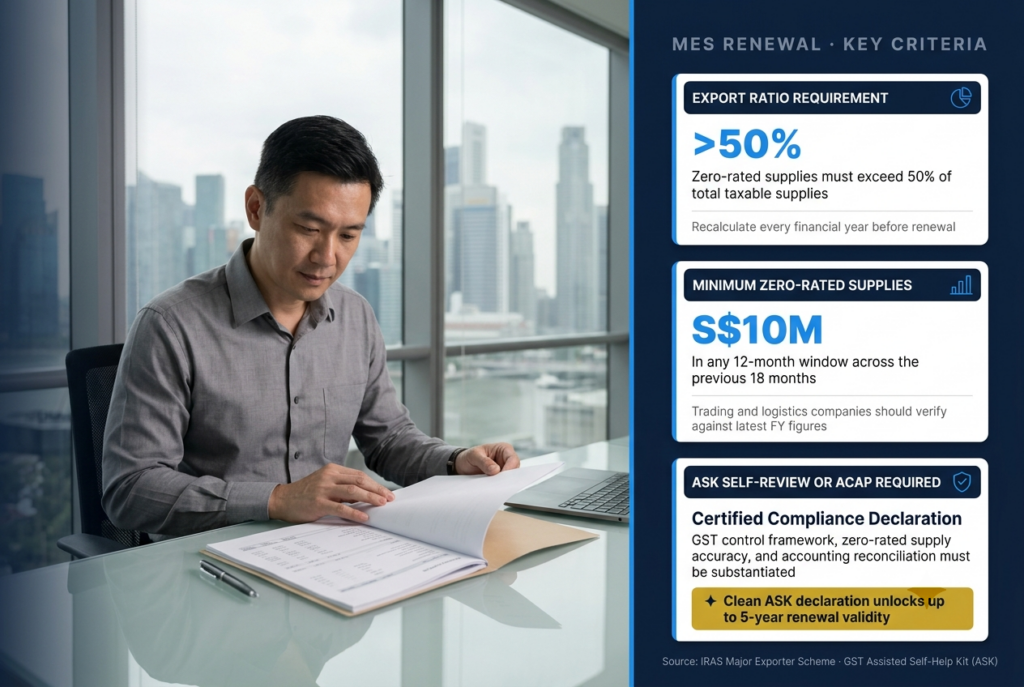
To qualify, a company must demonstrate two things. First, that its export ratio requirements are met, namely that zero-rated supplies exceed 50% of total taxable supplies. Second, that its zero-rated supplies amounted to at least S$10 million in any 12-month window across the past 18 months. New approvals run for three years. For renewals submitted with a Certified ASK declaration, IRAS has extended the validity to up to five years since January 2013, which represents a meaningful reduction in administrative burden for compliant exporters.
“For an importer handling several million dollars of inbound goods each quarter, MES is not a tax saving; it is a working capital lifeline,” explains Natalia Ong, Manager, Taxation at JDT. “Losing MES status mid-cycle forces the business to pay GST on every import and reclaim it later. The cash flow gap can run into hundreds of thousands of dollars in any given month.”
The MES scheme renewal process is therefore not a formality. IRAS reassesses eligibility against the most recent financial year’s figures, examines the strength of internal GST controls, and requires evidence, whether through a GST Assisted Self-Help Kit (ASK) Self-Review or an Assisted Compliance Assurance Programme (ACAP) submission, that the company can substantiate every zero-rated supply it reports. The IRAS MES registration renewal is submitted on Form R1 through myTax Portal, together with the certified ASK declaration.
Where the company fails to meet the renewal criteria, or fails to submit on time, MES de-registration takes effect from the expiry date. From that point forward, GST applies on every import, and any imports made between expiry and re-approval must be reconciled through standard GST returns. Repeated lapses can also affect the company’s standing for future scheme applications, and may attract a request for a banker’s letter of guarantee at the next approval. Under the Corporate and Accounting Laws (Amendment) Act 2025, director-level lapses in financial governance carry maximum fines of up to $20,000. This serves as a useful reminder that scheme compliance sits within a wider director-duty framework.
The MES Renewal Timeline: What to Do and When
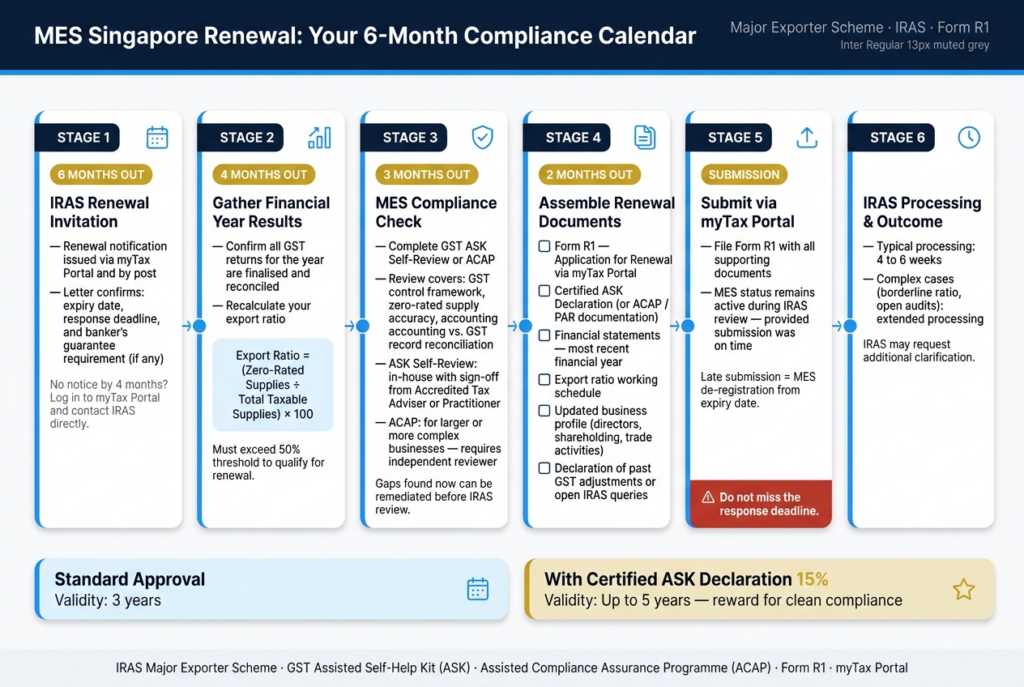
The Major Exporter Scheme renewal deadline does not arrive in isolation; it sits at the end of a sequence of preparation steps that ideally begin six months before expiry. IRAS itself typically issues the renewal invitation around six months ahead, with a response window of three months from the date of the letter. Treating those three months as preparation time, rather than a buffer, is the single biggest cause of last-minute renewal stress.
Six months out: the IRAS renewal invitation
IRAS issues the renewal notification through the myTax Portal and by post. The letter confirms the expiry date, the response deadline, and any requirement for a banker’s letter of guarantee at renewal. If the notice has not arrived within four months of your known expiry date, check the MyTax Portal and contact IRAS directly. Assumptions are not a defence here, and renewals cannot proceed until the invitation is received.
Four months out: gather your financial year results
The renewal application relies on the most recent full financial year’s GST data. Confirm with your finance team or outsourced accountant that all GST returns for the year are finalised and reconciled. This is also the right time to recalculate your export ratio.
Export ratio formula Export ratio = (Zero-rated supplies ÷ Total taxable supplies) × 100
Worked example: a trading company recorded S$12 million in zero-rated supplies and S$5 million in standard-rated supplies in the most recent financial year. Total taxable supplies were therefore S$17 million.
Export ratio = (12,000,000 ÷ 17,000,000) × 100 = 70.6%
That comfortably exceeds the 50% threshold. By contrast, a company with S$8 million in zero-rated supplies and S$9 million in standard-rated supplies would record a ratio of 47.1%, which is below the threshold, and a strong signal to review the position with IRAS before submitting. |
Three months out: the MES compliance check
Most renewals require a formal MES compliance check, completed via the GST ASK Self-Review or, for larger or more complex businesses, an ACAP. Both are structured reviews of the company’s GST control framework: policies, procedures, transaction sampling, and reconciliation between accounting and GST records. The Self-Review is performed in-house with external sign-off from an Accredited Tax Adviser or Practitioner; ACAP is a more comprehensive programme involving independent reviewer engagement.
“The ASK Self-Review is where most renewal weaknesses surface,” notes Alexander Tan, Audit Partner at JDT. “Companies are often confident their export documentation is in order, only to find that one or two zero-rated transactions cannot be properly substantiated. Catching this three months out gives you time to remediate before IRAS sees it, not after.”
Two months out: assemble your MES renewal documents
The MES renewal documents typically required include:
- Form R1 : Application for Renewal of Major Exporter Scheme, submitted via myTax Portal.
- Certified ASK declaration : or ACAP / Post-ACAP Review (PAR) documentation where applicable.
- Financial statements : for the most recent financial year, supporting the export ratio calculation.
- Export ratio working : a clear schedule showing zero-rated supplies, standard-rated supplies, and the resulting ratio.
- Updated business profile : any changes in directors, shareholding, trade activities, or imported goods categories since the last approval.
- Declaration of past GST adjustments : voluntary disclosures, audit findings, or unresolved IRAS queries from the validity period.
Submission to outcome: IRAS processing
Once submitted through myTax Portal, IRAS processing typically takes four to six weeks. Where the application requires additional clarification, such as a borderline export ratio, an open audit, or unresolved transaction issues, processing extends further. Helpfully, your MES status continues to apply during the IRAS review, which means cash flow relief is preserved while the renewal is being considered, provided the submission was made on time.
Renewals approved with a certified ASK declaration may receive a validity period of up to five years rather than the standard three. This is a meaningful reward for clean compliance, and one of the strongest practical arguments for treating the ASK Self-Review as a substantive exercise rather than a checkbox.
Three SME scenarios we see often
A regional distributor in the electronics sector recorded an export ratio of 52%, just above the threshold. A late-quarter local contract win would have tipped the ratio below 50%. Bringing the renewal forward, with supporting forward-looking projections, secured the approval before the ratio shifted.
A trading company missed its three-month response deadline because the IRAS invitation letter went to a previous registered address. By the time the lapse was discovered, MES had de-registered. The company faced six months of GST-on-import cash outflow before a fresh application succeeded.
A logistics firm completing its first ASK Self-Review uncovered two zero-rated shipments where the exporter’s records did not match the freight forwarder’s. The reconciliation took three weeks to resolve. Without the early Self-Review, those gaps would have surfaced during IRAS review, with delay and follow-up queries to match.
Where to Get Help with Your MES Renewal
The MES renewal process favours companies that begin preparing six months before expiry rather than six weeks before. Treating it as a routine GST filing exercise overlooks the strategic decisions involved: whether to maintain MES at all, whether GST ASK on its own might be more appropriate at the company’s current export profile, and how to substantiate every zero-rated supply on the books.
JDT’s GST compliance services team supports Singapore exporters through the GST ASK Self-Review, the ACAP programme, and full Form R1 renewal submissions. For the broader picture, our export tax compliance and export accounting support services keep your records, returns, and renewal evidence aligned year-round. If you are weighing whether MES still suits your business, or considering it for the first time, see our guide on how to apply for MES, or our overview of GST compliance alternatives for businesses operating below the MES threshold.

Frequently Asked Questions
What is MES Singapore?
MES Singapore, or the Major Exporter Scheme, is an IRAS programme that allows approved exporters to import qualifying goods without paying GST upfront. It eases cash flow for companies with substantial export activity, particularly trading and logistics businesses.
How long is MES approval valid?
New approvals run for three years. Renewals submitted with a certified ASK declaration may be granted for up to five years, depending on the company’s compliance history and the strength of its GST controls.
What are the export ratio requirements for MES renewal?
Your zero-rated supplies must exceed 50% of total taxable supplies. You must also have at least S$10 million in zero-rated supplies in any 12-month window across the previous 18 months.
What is the MES compliance check at renewal?
The MES compliance check is the GST ASK Self-Review (or ACAP) submission required with Form R1. It assesses your GST control framework, including the accuracy of zero-rated supply reporting and the reconciliation between accounting and GST records.
What MES renewal documents do I need?
Form R1, the certified ASK declaration (or ACAP documentation), financial statements for the most recent year, the export ratio calculation, an updated business profile, and a declaration of any past GST adjustments or open IRAS queries.
What happens if MES de-registration occurs?
GST applies on all imports from the de-registration date. The company must pay GST upfront and reclaim it through standard GST returns, creating a significant cash flow gap until a fresh application succeeds.
Can I reapply for MES after de-registration?
Yes. The company must again meet the export ratio and S$10 million zero-rated supplies thresholds, complete a fresh ASK Self-Review, and submit a new Form F10 application. A banker’s letter of guarantee may be required for high-risk profiles.