
The Major Exporter Scheme (MES) allows qualifying Singapore businesses to defer paying GST on imported goods until they are exported, directly improving working capital by eliminating the upfront 9% GST payment on imports. To qualify, your company must maintain an export ratio of at least 50%, meet IRAS’s revenue thresholds, and demonstrate a strong GST compliance track record—but most exporters overlook the annual renewal requirement that can disrupt cash flow if missed.
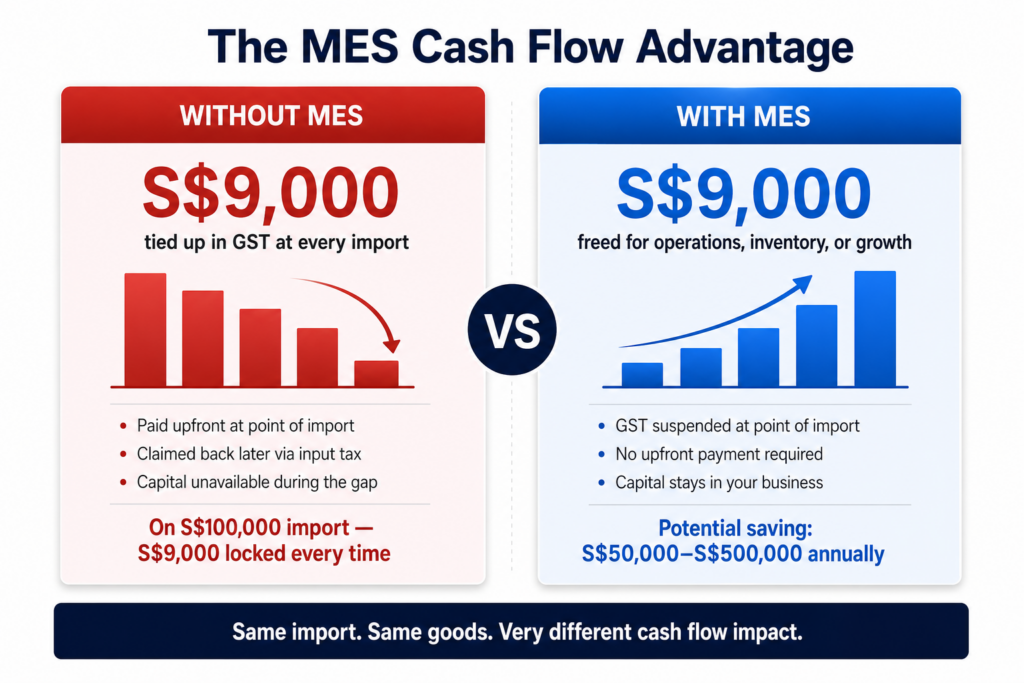
Consider the tangible impact: if your business imports S$100,000 worth of goods monthly, you’d ordinarily tie up S$9,000 in GST before selling those goods overseas. Under MES, that S$9,000 remains available for operations, inventory, or expansion—potentially freeing up S$50,000 to S$500,000 annually depending on your import volume. For export-focused businesses operating on thin margins, this isn’t just administrative convenience; it’s a strategic cash flow advantage that can determine whether you scale smoothly or struggle with working capital constraints.
Understanding the Regulatory Framework Behind MES
The Major Exporter Scheme operates under Singapore’s Goods and Services Tax Act and is administered by the Inland Revenue Authority of Singapore (IRAS). Unlike standard GST-registered businesses that must pay GST on imports and later claim input tax credits, MES participants enjoy a suspension mechanism that eliminates the cash flow gap entirely. This isn’t a tax exemption—it’s a deferral arrangement designed specifically to support businesses whose primary revenue comes from international trade.
IRAS introduced MES in recognition of a fundamental challenge faced by export-oriented companies: paying GST upfront on imported goods creates a liquidity burden, particularly when those goods are destined for overseas markets where output GST isn’t collected. For businesses importing raw materials, semi-finished goods, or finished products for re-export, the standard GST cycle means capital is locked in tax payments rather than invested in business growth.
The Three Qualifying Thresholds You Must Meet
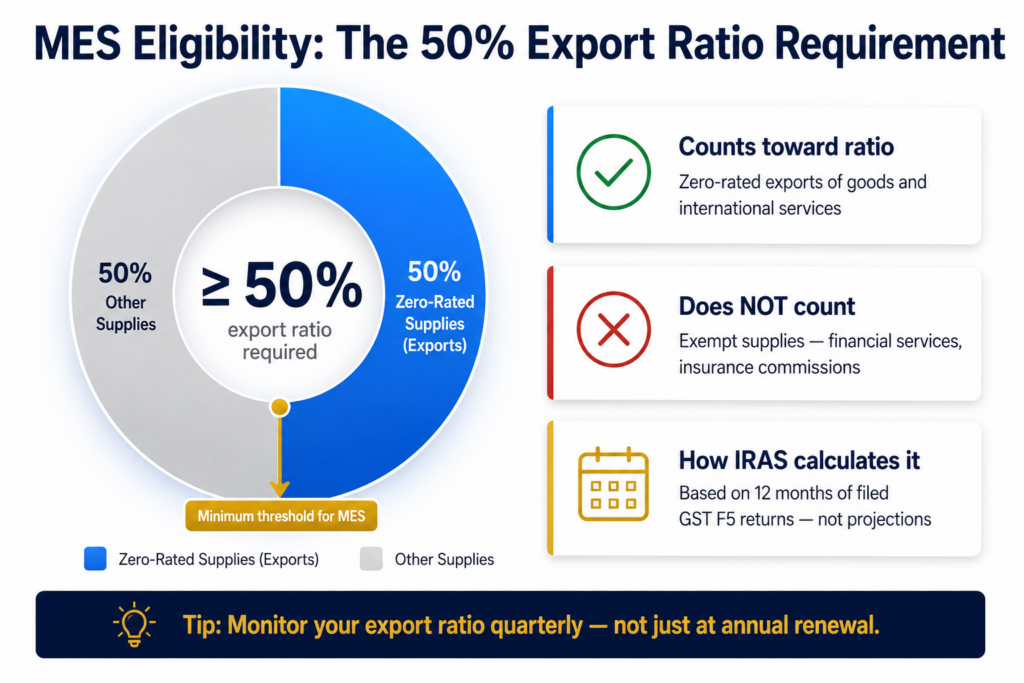
To qualify for MES, your company must satisfy three concurrent requirements, all of which IRAS monitors through your GST returns and compliance history:
Export Ratio Requirement: At least 50% of your total supplies (by value) must be zero-rated supplies, which typically means exports of goods. IRAS calculates this ratio based on your GST F5 returns over 12 months. Companies that fluctuate around the 50% threshold face approval challenges, as IRAS expects consistent export activity rather than occasional spikes.
Revenue Threshold: Your annual taxable turnover must justify GST registration. Whilst there’s no upper revenue limit for MES, companies with turnover below S$1 million aren’t required to register for GST and therefore wouldn’t benefit from the scheme. Most successful MES applicants operate with turnover well above the S$1 million voluntary registration threshold, as the cash flow benefit scales with import volume.
Compliance Track Record: IRAS requires a clean GST filing history. Companies with late filings, outstanding GST payments, or past compliance issues face rejection or mandatory rectification periods before approval. This criterion reflects IRAS’s need to ensure that MES benefits flow to responsible businesses that won’t abuse the suspension arrangement.
Why the Annual Renewal Matters More Than Most Realise
Here’s the trap many exporters fall into: MES approval isn’t perpetual. Your company must renew its MES status annually, and IRAS reviews your export ratio and compliance record with each renewal. If your export ratio dips below 50% during the qualifying period—perhaps due to a temporary pivot toward domestic sales or a major contract delay—you risk losing MES benefits mid-year.
When MES approval lapses, your business immediately reverts to standard GST treatment. That means the next import triggers a 9% GST payment, potentially catching finance teams off guard if they’ve structured cash flow around MES availability. Understanding the MES renewal process in Singapore is critical to maintaining uninterrupted cash-flow benefits.
At JDT, we guide SMEs through these requirements daily, ensuring compliance without unnecessary complexity. Joe Tan, ATA (GST), emphasises the importance of monitoring export ratios quarterly rather than annually to avoid surprises at renewal. “Many exporters only check their ratio when renewal notices arrive,” he notes. “By then, if you’ve slipped below 50%, there’s no time to course-correct before losing your MES status.”
The Compliance Consequences of Getting MES Wrong
Misusing MES provisions carries serious consequences. If IRAS determines that imported goods were diverted to local sales without proper GST accounting, your company faces:
- Retrospective GST Assessments: IRAS can assess GST on all improperly suspended imports, plus interest at the prevailing rate (currently 6% per annum).
- Penalties for Non-Compliance: Late or incorrect GST submissions attract a 5% penalty for the first month and an additional 2% for each subsequent month, capped at 50% of the tax undercharged.
- MES Revocation: Serious or repeated compliance failures result in immediate MES cancellation, forcing your business back to standard GST treatment and damaging your relationship with IRAS for future applications.
Doreen Yip, our Executive Director for Financial Outsourcing, notes that many SMEs underestimate the administrative rigour MES requires. “Exporters sometimes assume MES is a set-and-forget arrangement,” she explains. “In reality, it demands meticulous record-keeping—customs declarations, export documentation, and GST tracking must align perfectly, because IRAS conducts post-approval audits to verify compliance.”
Step-by-Step: Navigating the MES Application Process
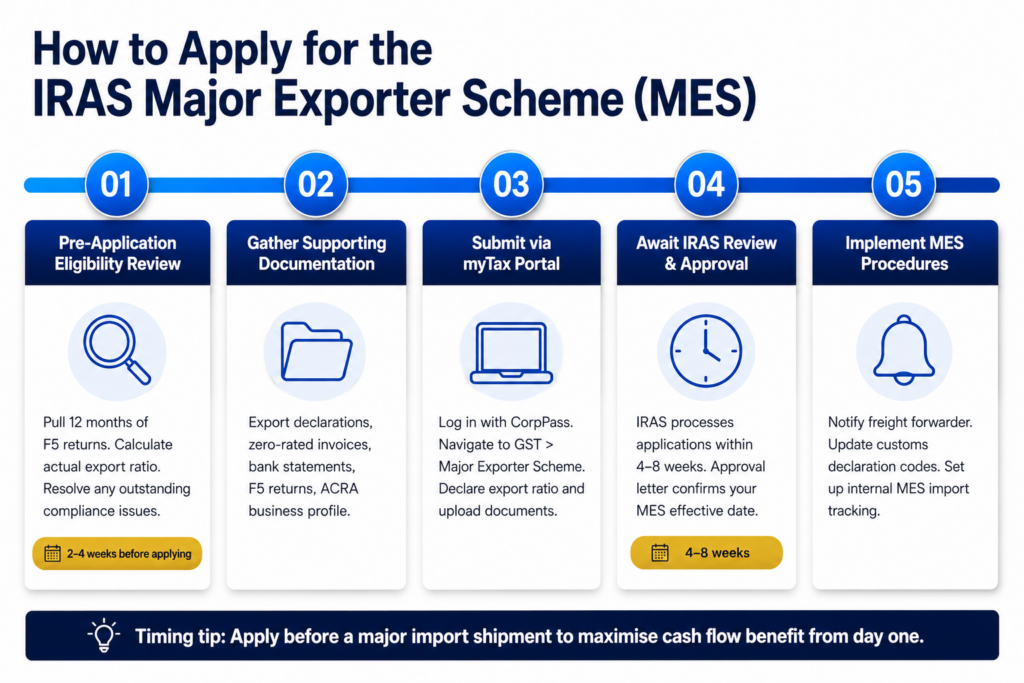
Step 1 - Conduct a Pre-Application Eligibility Review (2–4 Weeks Before Applying)
Before submitting your MES application, audit your current GST position. Pull your last 12 months of F5 returns and calculate your actual export ratio. Don’t rely on estimates—IRAS will verify these figures against your submitted returns. If you’re hovering near 50%, consider whether upcoming contracts will maintain or improve that ratio.
Review your GST compliance history. Have you filed every return on time? Are all GST payments up to date? Any outstanding issues must be resolved before IRAS will consider your application. Companies often discover historical filing gaps during this review stage—addressing them proactively prevents application rejection.
Step 2 - Gather Supporting Documentation
IRAS requires comprehensive evidence that your business genuinely operates as an exporter. Prepare:
- Export declarations and shipping documents covering the qualifying period
- Sales invoices showing zero-rated supplies to overseas customers
- Bank statements evidencing foreign currency receipts
- Completed GST F5 returns for the past 12 months
- Company registration details and ACRA business profile large contract.
The documentation standard is higher for first-time applicants than for renewals. IRAS wants to confirm that your export activity is substantial and ongoing, not a temporary spike driven by a single
Step 3 - Submit Your Application via myTax Portal
What portal do you use to apply for MES? Log in to IRAS’s myTax Portal using your CorpPass credentials. Navigate to GST > Major Exporter Scheme and complete the online application form. You’ll declare your export ratio, confirm your compliance standing, and upload supporting documents.
Be precise with your declarations. Overstating your export ratio or misrepresenting compliance history doesn’t just delay approval—it can trigger an IRAS investigation. The portal auto-calculates some fields based on your filed returns, which serves as a built-in accuracy check.
Step 4 - Await IRAS Review and Approval (4–8 Weeks)
IRAS typically processes MES applications within 4 to 8 weeks, though complex cases or first-time applicants may experience longer review periods. During this time, IRAS may request additional documentation or clarification on specific transactions. While some providers offer “fast-track” solutions, compliance cannot be rushed—IRAS scrutinises applications thoroughly to protect the integrity of the scheme.
If approved, you’ll receive a formal approval letter specifying your MES effective date. This date determines when GST suspension begins—imports cleared before the effective date remain subject to standard GST, so timing your application around major import shipments can maximise cash flow benefit.
Step 5 - Implement MES Procedures and Notify Your Freight Forwarder
Once approved, notify your freight forwarder, customs broker, and logistics partners immediately. They need to update your GST treatment code in customs declarations to reflect MES status. Failure to use the correct code means GST will still be charged at import, defeating the purpose of your MES approval.
Internally, update your accounting procedures to track MES imports separately. You’ll need to reconcile suspended GST against eventual exports in your F5 returns, and IRAS expects clear audit trails linking specific imports to their corresponding export transactions. Our export accounting compliance services help businesses establish these tracking systems from day one.
Real-World Scenarios: How SMEs Navigate MES Challenges
Scenario 1: The Import-Export Trading Company That Lost MES Mid-Year
A Singapore-based electronics trading company secured MES approval with a 65% export ratio. Six months later, a major overseas buyer delayed orders, forcing the company to shift inventory to domestic retailers. By the time they filed their next F5 return, their export ratio had dropped to 42%.
IRAS revoked their MES status, and the next container shipment triggered S$18,000 in unexpected GST liability. The finance manager hadn’t anticipated the renewal risk and had structured the company’s credit facilities around perpetual MES availability. The sudden cash outflow forced them to defer supplier payments, damaging trade credit relationships.
This scenario highlights why monitoring export ratios isn’t optional. Wilson Yeoh, our Director of Audit & Advisory, recommends quarterly ratio calculations: “If you’re trending toward the 50% threshold, you have time to adjust—pursue additional export contracts, defer domestic sales, or prepare your cash reserves for potential MES loss. Waiting until the annual renewal to check leaves no room for correction.”
Scenario 2: The Manufacturing Start-Up That Applied Too Early
A new medical device manufacturer applied for MES three months after incorporation, citing a projected 80% export ratio based on their business plan. IRAS rejected the application—without 12 months of actual trading history and filed F5 returns, there was no verifiable export activity to assess.
The lesson: MES requires demonstrated export performance, not projections. New exporters must operate under standard GST treatment for at least one full year, building a compliance track record and export documentation, before IRAS will consider their application. Setting up proper accounting infrastructure now prevents costly corrections later.
Preston Jansz Charles, our Director of Business Advisory, advises foreign companies entering Singapore to “structure your first-year cash flow assuming standard GST, then treat MES approval as a second-year benefit rather than a day-one entitlement. This approach ensures you’re never caught short if your export mix takes time to stabilise.”
Scenario 3: The Logistics Firm That Confused Zero-Rated and Exempt Supplies
A logistics company applied for MES, claiming a 70% export ratio. Upon review, IRAS discovered they’d included exempt financial services and insurance commissions in their calculation. Under GST rules, only zero-rated supplies (primarily exports of goods and international services) count toward the MES export ratio—exempt supplies don’t qualify.
Their actual export ratio was 38%, well below the 50% threshold. The application was rejected, and the company faced reputational damage with IRAS that complicated future applications. This case underscores the importance of technical accuracy: if you’re uncertain whether specific supplies qualify as zero-rated, consult with our export tax advisory services before applying.
The Annual Renewal Trap: What Most Exporters Forget
Many businesses treat MES approval as a permanent fixture. It isn’t. Every year, IRAS requires exporters to reconfirm their eligibility, and the renewal process mirrors the initial application—you must prove your export ratio remains above 50%, your compliance record is clean, and your business continues to operate primarily as an exporter.
The renewal deadline typically falls 30 days before your current MES approval expires. Miss this deadline, and there’s a gap period where you lose MES benefits even if you ultimately secure renewal. For businesses importing daily, a one-month gap can tie up tens of thousands of dollars in GST.
Set recurring calendar reminders 60 days before your MES expiry date. Prepare renewal documentation progressively throughout the year rather than scrambling in the final month. At JDT, our taxation team maintains MES renewal calendars for clients, ensuring applications are submitted with sufficient lead time to prevent coverage gaps.
How GST Schemes Work Together for Exporters
MES is one of several GST schemes for exporters designed to ease compliance for international traders. Understanding how these schemes interact helps you optimise your overall GST position:
- Zero-Rating for Exports: All international sales of goods are zero-rated, meaning you don’t charge GST but can still claim input tax credits.
- Import GST Deferment (IGDS): Similar to MES but broader in scope—allows approved importers to defer GST payment through their GST returns rather than at the checkpoint.
Major Exporter Scheme (MES): Specifically for businesses with >50% export ratio, suspending GST entirely on qualifying imports.
For exporters also managing domestic GST compliance, IRAS offers MES application support through its GST Assisted Self-Help Kits (ASK) programme, providing guided templates and compliance checklists.
How JDT Can Help
Navigating the Major Exporter Scheme requires more than understanding IRAS eligibility criteria—it demands ongoing compliance monitoring, precise GST record-keeping, and strategic cash flow planning. For businesses establishing their presence in Singapore’s export markets, proper export accounting compliance ensures GST registration and export documentation systems are built into your operations from day one.
Once operational, maintaining MES compliance sits alongside your broader corporate obligations. Our export tax advisory services are designed specifically for export-focused SMEs, providing quarterly export ratio tracking, F5 return preparation, and proactive renewal management so you never face unexpected MES lapses. For additional guidance on the application process, IRAS’s MES application support programme offers structured templates and compliance resources.
At JDT, we recognise that cash flow isn’t just about managing what you have—it’s about structuring compliance systems that preserve capital for growth rather than locking it in unnecessary tax payments. Whether you’re applying for MES for the first time or managing your fifth annual renewal, we ensure your export business benefits fully from Singapore’s trade-friendly GST provisions without exposing you to compliance risk.
Frequently Asked Questions About the Major Exporter Scheme
What is the minimum export ratio required for MES approval?
Your business must maintain at least a 50% export ratio. IRAS calculates this as zero-rated supplies divided by total supplies, excluding exempt supplies. This assessment covers 12 months of GST F5 returns.
Can a new company apply for MES immediately after incorporation?
No. MES requires 12 months of filed GST returns demonstrating your export ratio. New exporters operate under standard GST treatment during their first year. This builds the compliance track record IRAS needs.
What happens if my export ratio drops below 50% after MES approval?
IRAS monitors ongoing compliance through quarterly F5 returns. If your ratio falls below 50%, you risk MES revocation at annual renewal. There’s no grace period. You must maintain qualifying status continuously.
How long does MES approval remain valid?
MES approval is valid for one year from the effective date in your approval letter. You must renew annually by demonstrating continued eligibility. Set reminders 60 days before expiry to prevent coverage gaps.
Does MES apply to all imported goods?
MES suspends GST on goods imported for export. If you import goods for domestic sale, those remain subject to standard GST. Your accounting systems must segregate MES imports from non-MES imports clearly.
What documentation must I maintain under MES?
IRAS requires complete audit trails linking suspended imports to eventual exports. Maintain customs declarations, commercial invoices, bills of lading, export permits, and customer purchase orders. Retain supporting documentation for five years minimum.
Can service exporters benefit from MES?
MES primarily benefits businesses exporting goods. International services are already zero-rated under GST rules. They don’t involve import GST, so the MES suspension mechanism provides no additional benefit.
What happens if IRAS audits my MES compliance and finds discrepancies?
IRAS conducts post-approval audits to verify suspended imports were legitimately exported. Auditors finding diverted goods face retrospective GST assessments, penalties, and interest charges. MES revocation may follow. The reputational impact complicates future applications.